
Fill Line Qualification Lifecycle
Fill line qualification demonstrates that an aseptic filling system consistently performs as intended within defined operational and environmental limits. Qualification must confirm mechanical performance, control system reliability, exposure protection, and process consistency under ISO 5 conditions.
The filling line cannot be qualified as isolated equipment. It is a sterility-critical system integrated with barrier technology, sterile product delivery, component preparation, and downstream closure operations. Lifecycle control must therefore address both mechanical function and contamination risk.
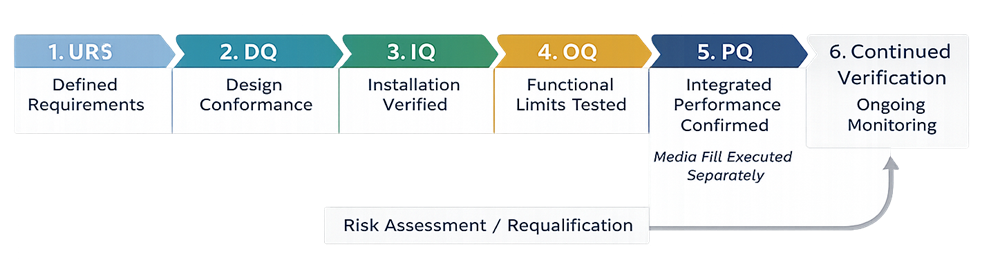
1. User Requirements Specification
Qualification begins with clearly defined user requirements. The URS must establish:
• Intended product types and container formats
• Target fill volumes and accuracy limits
• Maximum and minimum operating speeds
• Barrier integration requirements
• Data integrity and electronic record expectations
• Environmental classification at exposure points
Requirements must be measurable and testable. Ambiguous statements such as “high accuracy” or “robust performance” are not acceptable.
2. Design Qualification
Design Qualification verifies that the proposed filling line design meets the defined requirements and contamination control strategy. DQ review should include:
• Mechanical layout assessment
• Material compatibility
• Needle alignment and insertion design
• Stopper delivery mechanism design
• Reject logic architecture
• Control system structure
• Airflow interaction assessment
Critical exposure zones must be evaluated during DQ to confirm that mechanical framing, drive components, and access points do not interfere with ISO 5 protection.
3. Installation Qualification
Installation Qualification verifies that the system is installed according to approved design documentation and manufacturer specifications. IQ activities typically include:
• Equipment identification and configuration verification
• Utility connection verification
• Calibration status confirmation
• Control panel and sensor installation checks
• Software version documentation
• Documentation review
Installation must confirm that product-contact components, filters, manifolds, and single-use assemblies are configured according to approved specifications.
4. Operational Qualification
Operational Qualification confirms that the filling line operates within defined functional limits. OQ typically evaluates:
• Fill volume accuracy across speed ranges
• Needle positioning and travel limits
• Indexing synchronization
• Stopper insertion force consistency
• Crimp force verification
• Reject system performance
• Alarm and interlock functionality
• Control system response to simulated faults
Testing must represent worst-case operational parameters, including maximum speed and minimum dwell conditions. Environmental monitoring and airflow visualization may be repeated during OQ if mechanical adjustments affect exposure conditions.
Fill line qualification does not progress through phases by repetition of the same testing. The scope deepens and shifts from design confirmation to functional verification and finally to integrated performance demonstration. Each qualification phase addresses different risk dimensions of the filling line.
The table below illustrates how qualification scope evolves across lifecycle stages. It highlights which system elements are emphasized during Design Qualification, Installation Qualification, Operational Qualification, and Performance Qualification. This structure ensures traceability and prevents both over-testing and critical gaps.
| System Element | DQ – Design Conformance | IQ – Installation Verified | OQ – Functional Limits Tested | PQ – Integrated Performance Confirmed |
|---|---|---|---|---|
| Mechanical Architecture | Layout review, material compatibility, alignment concept | Installation verification, component identification | Speed range testing, indexing synchronization, mechanical limits | Stability during routine production batches |
| Filling Accuracy | Metering technology selection justification | Sensor and calibration verification | Fill volume accuracy across operating range | Batch-to-batch consistency under production conditions |
| Sterile Product Path | Drainability and dead leg assessment | Configuration verification, filter installation | Pressure stability and integrity test verification | Consistent performance during extended operation |
| Stoppering System | Insertion force design review | Mechanical setup verification | Insertion force testing, alignment confirmation | Consistent stopper seating across batches |
| Capping / Sealing | Crimp concept and force specification | Installation and adjustment verification | Crimp force testing and defect detection | Closure consistency under routine conditions |
| Reject Logic | Detection concept review | Sensor installation verification | Reject timing and synchronization testing | Reliable removal of nonconforming units |
| Control System | Architecture and interlock logic review | Software version and configuration verification | Alarm challenge tests, interlock verification | Stable operation without unintended stops |
| Environmental Integration | Exposure zone assessment | Installation within ISO 5 envelope | Functional verification under airflow conditions | Sustained environmental compliance during operation |
This matrix clarifies that DQ confirms design intent, IQ confirms installation integrity, OQ challenges functional boundaries, and PQ confirms integrated system performance. It reinforces that qualification is cumulative and risk-based rather than repetitive.
5. Performance Qualification
Performance Qualification demonstrates that the filling line performs consistently under routine production conditions.
PQ includes:
• Consecutive batch performance verification
• Process parameter stability
• Consistent reject performance
• Operator interaction verification
• Integration with barrier system under production configuration
Where aseptic processing is involved, media fill studies form part of PQ and represent the microbiological validation of the integrated system.
6. Media Fill Integration
Media fill studies are not a substitute for mechanical qualification. They confirm microbiological performance of the fully qualified and integrated aseptic process. The detailed design, execution, and acceptance criteria for media fills are addressed separately under Media Fill and Aseptic Process Simulation.
7. Control System Validation
Where electronic records, recipes, or audit trails are used, computerized system validation must be integrated into the lifecycle. This includes:
• Software configuration verification
• Access control testing
• Alarm handling validation
• Audit trail verification
• Data retention confirmation
Control system reliability directly affects sterility assurance because interlocks and sequencing logic prevent uncontrolled exposure events.
8. Requalification and Ongoing Verification
Requalification may be required following:
• Mechanical modification
• Control system updates
• Format change affecting alignment
• Speed increases
• Repeated deviation trends
Ongoing verification includes:
• Periodic review of fill accuracy data
• Environmental monitoring trend analysis
• Reject rate evaluation
• Maintenance impact assessment
Lifecycle management ensures that the validated state is maintained over time rather than assumed. Requalification should not be automatic, nor should it be discretionary. It must be driven by documented risk assessment evaluating potential impact on sterility assurance, mechanical performance, or validated operating limits. The table below provides a structured decision framework linking typical change categories to required qualification response. The objective is proportional response based on impact severity rather than procedural habit.
| Change / Event Category | Potential Impact Area | Risk Level (Example) | Required Action | Qualification Scope |
|---|---|---|---|---|
| Mechanical component replacement (non-critical zone) | Equipment reliability | Low | Documented assessment only | No requalification required |
| Replacement of filling needle | Critical exposure zone, fill accuracy | Medium | Targeted testing | OQ – Needle alignment and fill verification |
| Stopper bowl modification | Stopper orientation and seating | Medium | Targeted verification | OQ – Insertion force and seating consistency |
| Control system software update (non-sequencing logic) | Alarm reporting | Low to Medium | Verification testing | OQ – Alarm challenge testing |
| Control system update affecting sequencing or interlocks | Exposure control, reject logic | High | Partial requalification | OQ + PQ integration testing |
| Speed increase beyond validated range | Fill accuracy, indexing stability | High | Partial requalification | OQ – Speed limits + PQ confirmation |
| Format change affecting container size | Needle alignment, stopper force | Medium to High | Targeted OQ, possibly PQ | Alignment, fill accuracy, stopper verification |
| Barrier modification affecting airflow | First air protection | High | Full impact assessment | Environmental requalification + PQ |
| Repeated deviation trends | Process stability | Variable | Risk assessment required | Scope based on root cause |
| Major mechanical redesign | Multiple sterility risk zones | High | Full requalification | IQ + OQ + PQ as applicable |
Decision Logic Principles
- Low-risk changes that do not affect sterile exposure or validated parameters require documentation but not requalification.
- Medium-risk changes affecting mechanical precision or control functionality require targeted OQ verification.
- High-risk changes affecting critical exposure zones, interlocks, airflow interaction, or validated operating limits require partial or full requalification, potentially including PQ confirmation.
This structured approach ensures lifecycle control remains risk-based, defensible, and proportionate.
9. Risk-Based Qualification Strategy
The depth of testing should correspond to sterility risk and mechanical complexity. High-risk areas such as the filling zone, stopper insertion, and reject synchronization require focused verification.
Qualification documentation must demonstrate traceability from requirements through test execution and final approval.
Fill line qualification lifecycle therefore establishes documented evidence that the aseptic filling system performs reliably within defined mechanical and environmental limits. Without structured lifecycle control, sterility assurance cannot be substantiated.