
Washer Types and Design
Parts washers are widely used in pharmaceutical manufacturing, laboratories, and sterile processing environments to clean reusable components such as glassware, stainless steel parts, utensils, and equipment accessories. These systems automate the washing, rinsing, and drying of components under controlled and repeatable conditions. Proper washer design ensures that cleaning solutions and rinse water reach all surfaces of the loaded components and that residues are effectively removed prior to reuse.
Parts washers provide controlled mechanical action, chemical exposure, temperature control, and water distribution. Together these elements support effective removal of product residues, detergents, and particulate contamination from reusable equipment components.
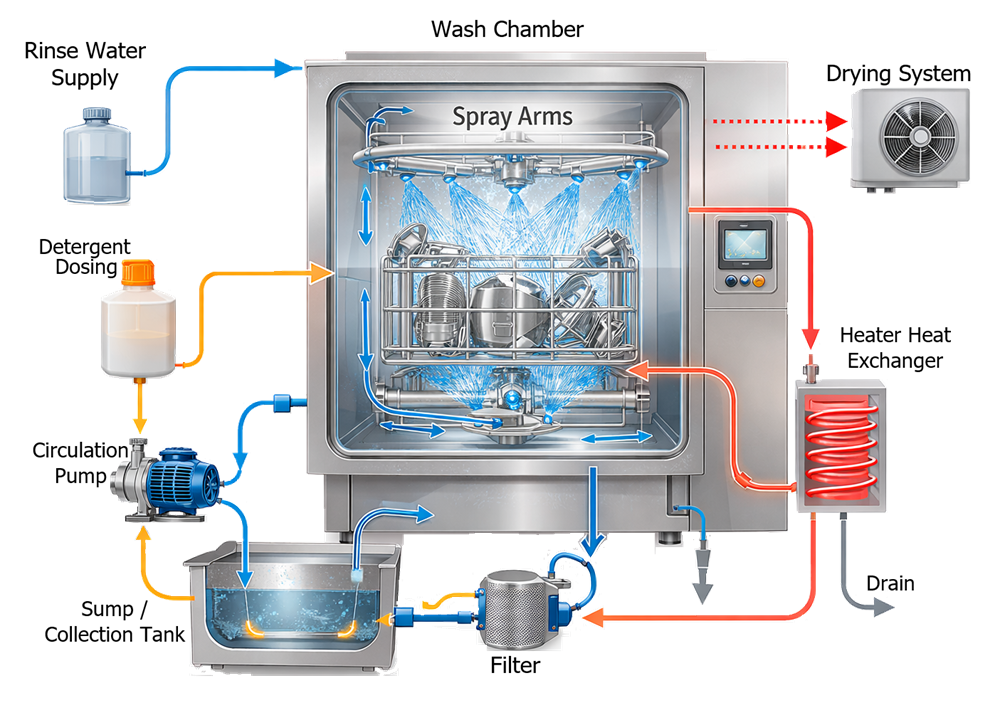
Parts washers operate as integrated systems that combine spray distribution, water circulation, detergent dosing, heating, and drying within a controlled washing chamber. Cleaning solution is recirculated through pumps and spray arms while detergents are injected at controlled concentrations and rinse water is introduced during later cycle stages. The diagram below illustrates the major functional components of a typical pharmaceutical parts washer and the primary circulation path of wash and rinse fluids during operation.
1. Major Types of Parts Washers
Several washer configurations are commonly used in pharmaceutical and laboratory environments. Selection depends on the types of items being cleaned, required throughput, and facility layout.
1.1 Cabinet Washers
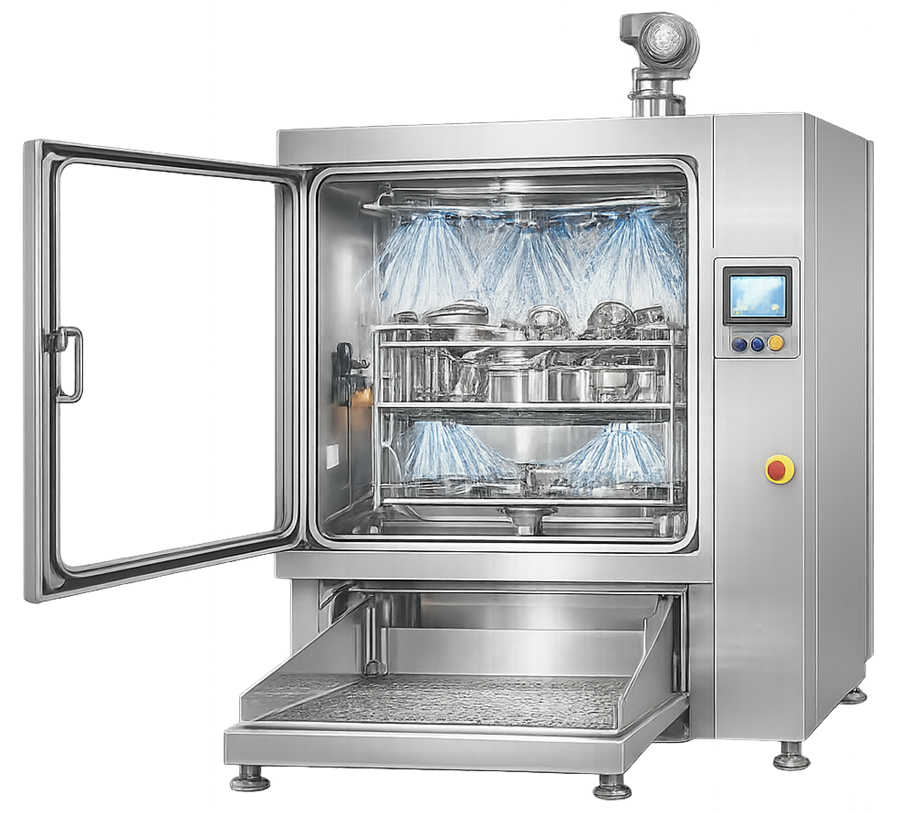
Cabinet washers are enclosed chamber systems designed to clean trays, small equipment parts, tools, and utensils. Components are loaded into racks or baskets within the washing chamber. High-pressure spray arms distribute cleaning solution and rinse water throughout the chamber.
Typical features include:
- rotating spray arms located at the top, bottom, or sides of the chamber
- programmable wash cycles
- detergent injection systems
- high-temperature rinse capability
- forced air or heated drying systems
Cabinet washers are commonly used for cleaning stainless steel parts, change parts from manufacturing equipment, and reusable utensils. The photograph below shows a typical pharmaceutical cabinet washer used for automated cleaning of reusable manufacturing components.
1.2 Glassware Washers
Glassware washers are designed specifically for cleaning laboratory vessels such as flasks, bottles, graduated cylinders, and other laboratory containers that require cleaning of both external and internal surfaces. Unlike general parts washers, these systems are engineered to ensure that cleaning solution is delivered directly into the interior of glassware.
The defining feature of laboratory glassware washers is the use of injection rack systems. These racks contain multiple vertical stainless steel spindles or injection tubes. Glassware is placed upside down on these tubes so that wash water, detergent solution, and rinse water are injected directly into the vessel interior. This design ensures effective removal of residues from internal surfaces that would otherwise be difficult to reach using external spray alone.
Typical design features include:
- injection racks with vertical cleaning spindles
- direct internal washing of flasks, bottles, and laboratory vessels
- programmable washing and rinsing cycles
- purified or deionized water final rinse
- controlled drying cycles
Glassware washers therefore differ significantly from standard cabinet parts washers. Conventional parts washers typically rely on spray arms that distribute cleaning solution throughout the chamber while components are placed in baskets or trays. In those systems:
- parts are placed loosely in baskets or racks
- cleaning relies primarily on external spray coverage
- rotating spray arms provide mechanical washing action
- internal surfaces of vessels are not actively injected
Because laboratory glassware requires reliable internal cleaning, the injection rack design is essential. This configuration allows cleaning solution to reach the interior surfaces of vessels and ensures reproducible cleaning performance required in quality control and microbiology laboratories.
1.3 Tunnel Washers
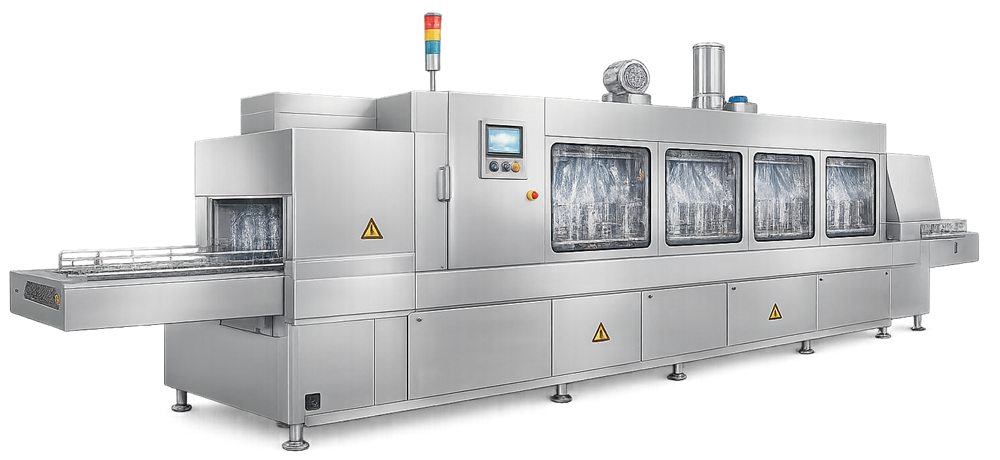
Tunnel washers are continuous conveyor systems used in high-throughput environments. Items enter the washer at one end and move through multiple washing and rinsing zones before exiting the system.
Typical tunnel washer stages include:
- pre-wash section
- detergent wash zone
- intermediate rinse zones
- final high-purity water rinse
- drying section
Tunnel washers are typically used in facilities where large volumes of equipment components must be cleaned. The photograph below shows a typical stainless steel tunnel washer used in pharmaceutical or sterile processing facilities.
1.4 Ultrasonic Washers
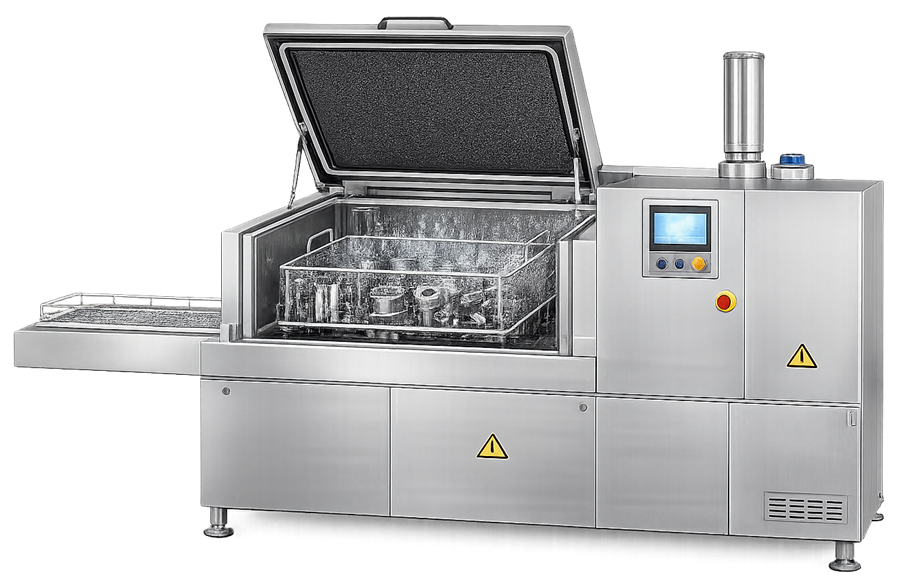
Ultrasonic washers use high-frequency sound waves in a liquid bath to generate microscopic cavitation bubbles. These bubbles collapse near component surfaces and help dislodge particles and residues from complex geometries.
Ultrasonic cleaning is commonly used for:
- precision components
- delicate laboratory tools
- parts with complex geometries
- components with narrow crevices
Ultrasonic cleaning is often used as a pre-cleaning step before automated washer cycles. The photograph below shows an ultrasonic cleaning unit commonly used for precision parts and laboratory instruments.
2. Fundamental Cleaning Mechanisms
EEffective cleaning in automated parts washers depends on the interaction of several key process parameters. These parameters determine how efficiently residues, particles, and cleaning agents are removed from equipment components and laboratory glassware during washer cycles.
Cleaning performance is influenced by a combination of mechanical, chemical, thermal, and operational factors. These elements must operate together within appropriate ranges to achieve reliable and reproducible cleaning results. In washer systems, these factors are controlled through programmed wash cycles and verified during equipment qualification and cleaning validation activities.
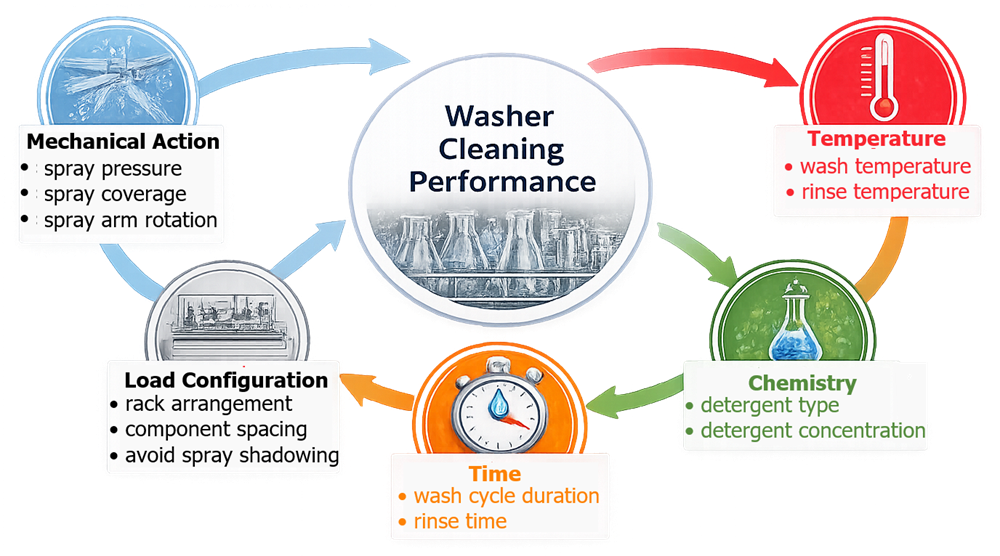
The diagram below summarizes the primary factors that influence washer cleaning effectiveness. These parameters correspond to the classic cleaning model often referred to as the Sinner Circle, which describes the interaction between mechanical action, chemistry, temperature, and time. For automated washers, load configuration is also a critical practical factor that directly affects spray coverage and cleaning performance. Key factors influencing washer performance include:
2.1 Mechanical Action
Mechanical cleaning energy is generated by pressurized wash water delivered through rotating spray arms or injection nozzles. This mechanical action helps dislodge residues from component surfaces. Important mechanical parameters include:
- spray pressure
- spray coverage
- spray arm rotation
2.2 Chemistry
Detergents and cleaning agents enhance the removal of residues by dissolving or dispersing contaminants. The effectiveness of chemical cleaning depends on both the detergent formulation and the concentration used during the wash cycle. Key chemical parameters include:
- detergent type
- detergent concentration
2.3 Temperature
Elevated temperatures improve the effectiveness of detergents and increase the solubility of many residues. Washer systems therefore control wash and rinse temperatures as part of the cleaning cycle. Temperature-related parameters include:
- wash temperature
- rinse temperature
2.4 Time
Sufficient exposure time is required for mechanical action and detergent chemistry to remove residues effectively. Washer cycles therefore include defined wash and rinse durations. Time-related parameters include:
- wash cycle duration
- rinse time
2.5 Load Configuration
The arrangement of components inside the washer chamber significantly influences cleaning effectiveness. Improper loading may block spray patterns and create areas where cleaning solution cannot reach the surfaces being cleaned. Important loading considerations include:
- rack arrangement
- component spacing
- avoidance of spray shadowing
Proper control of these parameters ensures that washer systems consistently deliver effective cleaning performance during routine operation. These factors are evaluated and verified during washer qualification and cleaning performance verification studies.
3. Spray System Design
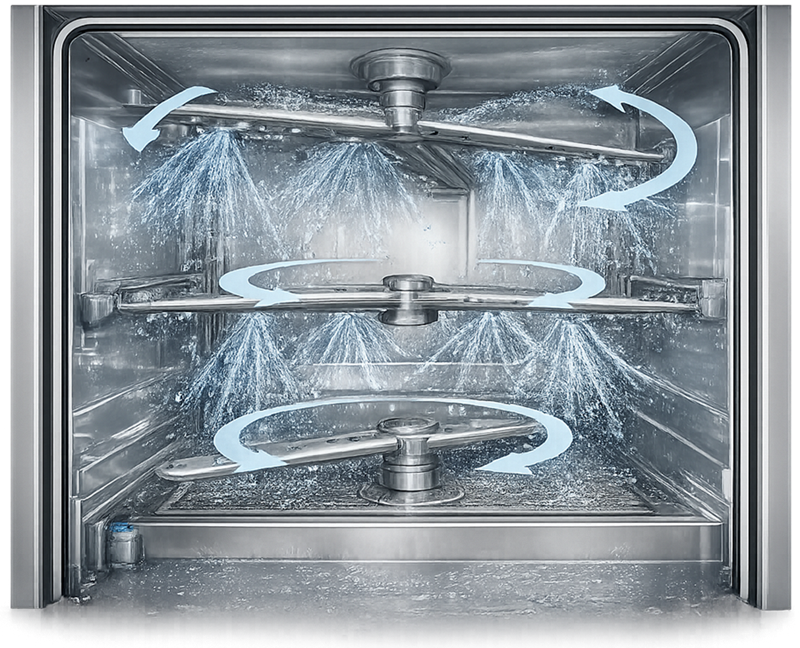
Most pharmaceutical parts washers rely on spray distribution systems to deliver cleaning solutions to the loaded components. Spray arms rotate during the cycle and distribute wash solution across the chamber.
Important spray system characteristics include:
- spray arm configuration and placement
- nozzle orientation and spray pattern
- rotation speed of spray arms
- pump capacity and flow rate
Proper spray system design ensures that wash water reaches all exposed surfaces of the components being cleaned. The diagram below illustrates how rotating spray arms distribute wash water across racks and baskets within the washing chamber.
4. Rack and Load Configuration
The arrangement of components within washer racks strongly influences cleaning effectiveness. Improper loading patterns may block spray paths or create shadowed regions where cleaning solution cannot reach. The diagram below compares correct loading configurations with improper loading patterns that create spray shadowing.
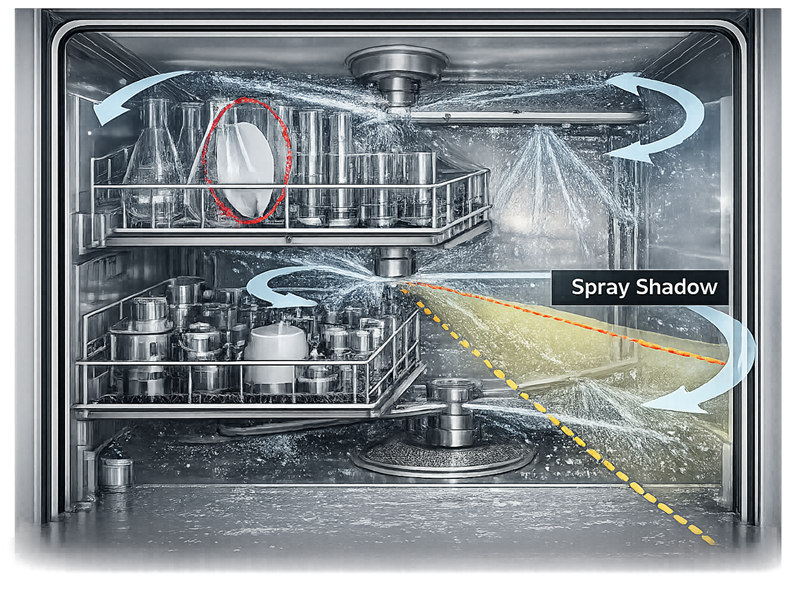
Rack systems are therefore designed to:
- maintain separation between components
- allow free circulation of wash solution
- support injection cleaning for vessels
- prevent movement of parts during washing
Facilities typically define validated loading patterns to ensure consistent cleaning performance.
5. Water Distribution and Circulation
Washer systems rely on recirculated wash water that is pumped through spray arms during the cleaning cycle. The circulation system typically includes several core components. These include:
- high-capacity circulation pumps
- spray distribution piping
- filtration systems to remove particulates
- collection sump for recirculated solution
Flow rate and pressure influence the mechanical cleaning energy delivered by the spray system.
6. Detergent Injection Systems
Detergents are commonly used during washer cycles to improve removal of residues. Washer systems therefore include controlled dosing systems that introduce cleaning agents at specific stages of the cycle. Typical features include:
- metered detergent pumps
- programmable injection timing
- concentration control through dosing volume
Correct detergent concentration is important to achieve effective cleaning without leaving detergent residues.
7. Heating and Temperature Control
Many cleaning processes rely on elevated temperatures to improve residue removal and increase detergent effectiveness. Washer systems may include electric heaters or steam heat exchangers to control wash water temperature. Temperature control systems allow:
- defined wash temperature setpoints
- high-temperature rinsing
- controlled drying cycles
Temperature is commonly monitored during qualification activities.
8. Drying Systems
After completion of washing and rinsing cycles, many washers include drying systems that remove residual moisture from cleaned components. Drying may be achieved through:
- heated air circulation
- high-efficiency filtered air
- vacuum-assisted drying
Proper drying prevents microbial growth and allows cleaned components to be returned to service more rapidly.
9. Design Considerations for Validation
From a validation perspective, washer design must support consistent and reproducible cleaning performance. Certain design elements are particularly important when evaluating washer suitability for pharmaceutical use. Important considerations include:
- accessibility of spray distribution to all load surfaces
- ability to define consistent loading configurations
- control and monitoring of cleaning cycle parameters
- reliable operation of pumps, spray arms, and dosing systems
- capability to record cycle parameters through the control system
These design characteristics allow washer performance to be evaluated during qualification and later verified during routine operation.