
Validation Vital Role
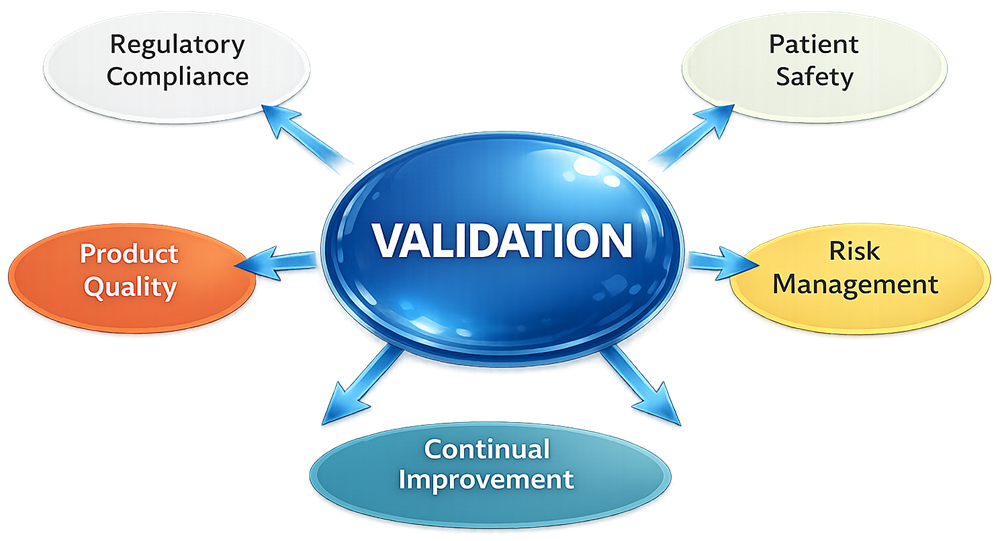
Validation is fundamental to the pharmaceutical and medical device industries because it provides documented evidence that products and processes are safe, effective, reliable, and consistently controlled. At its core, validation demonstrates ongoing adherence to predefined specifications and applicable regulatory requirements. It is not an academic exercise; it is a practical control mechanism that underpins compliance, quality, and patient protection.
Regulatory Compliance
Pharmaceutical and medical device operations are subject to stringent regulatory oversight to protect public health. Authorities such as the Food and Drug Administration require manufacturers to prove that their processes operate in a controlled and reproducible manner. Validation provides this proof. Without validated processes, claims of compliance lack credibility and are unlikely to withstand inspection.
Patient Safety
Patient safety is the primary non-negotiable objective. Validation ensures that drugs, medical devices, and supporting systems are designed and operated to minimize risk. By validating equipment, utilities, computerized systems, and manufacturing processes, organizations can identify hazards early, prevent operational errors, and reduce the probability of failures that could directly impact patients.
Product Quality
Consistent product quality does not occur by chance. Validation confirms that critical processes reliably deliver products that meet defined quality attributes, specifications, and performance requirements. Through validation, process variability is understood and controlled, defects are reduced, and products perform as intended throughout their lifecycle.
Risk Management
Validation is a practical extension of risk management. It supports the identification, assessment, and mitigation of risks associated with development, manufacturing, and distribution. Structured activities such as risk assessments, protocols, and documented acceptance criteria ensure that risks to quality, safety, efficacy, and compliance are addressed proactively rather than reactively.
Continual Improvement
Validation is not a one-time event. It supports continual improvement by establishing a baseline of process knowledge and performance. Periodic review, requalification, and change management allow organizations to improve efficiency, introduce new technologies, and modify existing processes while maintaining control and compliance.
Summary
Validation remains indispensable in the pharmaceutical and medical device industries. It enables regulatory compliance, protects patients, ensures consistent product quality, enforces process control, manages risk, and supports disciplined improvement. Organizations that treat validation as a core business discipline, rather than a regulatory burden, are consistently better prepared for inspections and long-term operational stability.