
Environmental Monitoring Program Execution
PurPurpose and Scope
This article describes how environmental monitoring programs are constructed and executed during routine GMP operations to verify that qualified environmental performance is maintained.
The scope includes derivation of monitoring elements, execution of viable and non-viable monitoring, definition of sampling locations and frequencies, operational conditions, governance, and response expectations. Environmental performance qualification and establishment of acceptance criteria are assumed as prerequisites.
How Environmental Monitoring Program Elements Are Derived
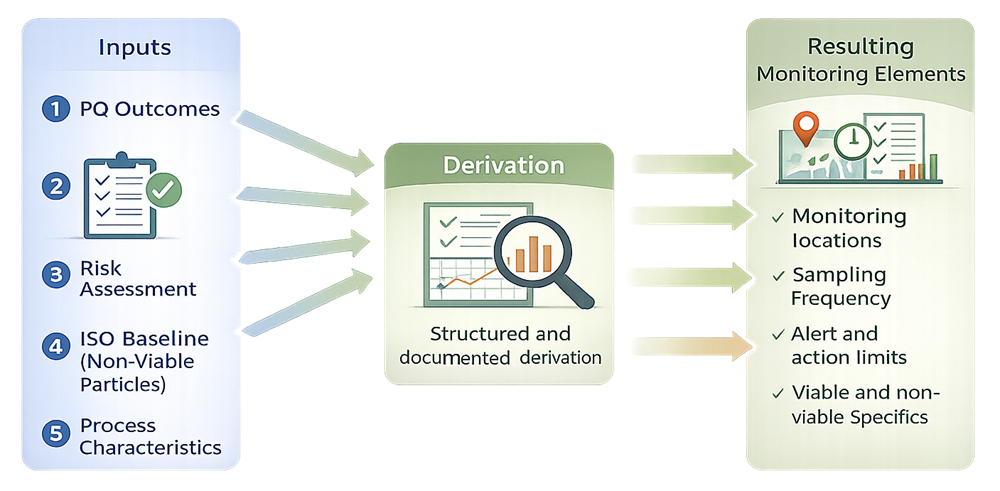
Environmental monitoring programs are constructed using a structured, risk-based approach. Program elements are derived from:
- Environmental performance qualification results
- Cleanroom classification requirements
- Process and product risk
- Facility layout, airflow behavior, and operational practices
- Historical monitoring performance
The purpose of program execution is to confirm that established environmental performance is maintained during routine operation.
Definition of Monitoring Types
Environmental monitoring programs typically include both non-viable and viable components, each serving a distinct purpose.
- Non-viable monitoring verifies continued control of airborne particulate levels relative to established cleanroom classification and acceptance criteria.
- Viable monitoring provides early detection of microbiological contamination risk associated with personnel, operations, and surfaces.
Both components are executed concurrently and evaluated together.
Non-Viable Environmental Monitoring Execution
Non-viable monitoring execution is derived from cleanroom classification requirements and qualification outcomes. Key execution elements include:
- Particle size ranges and acceptance criteria established during qualification
- Monitoring locations selected to represent classified areas and operational risk
- Sampling volumes and durations consistent with classification requirements
- Monitoring performed under defined operational states, typically in-operation
Non-viable monitoring locations are not selected to “map the room” but to verify that qualified particulate control is maintained at representative and sensitive locations.
Viable Environmental Monitoring Execution
Viable monitoring execution is derived from microbiological risk rather than classification standards. Program elements are defined based on:
- Room function and degree of product or material exposure
- Proximity to critical activities and open operations
- Personnel interaction and intervention frequency
- Surfaces most likely to accumulate contamination
Viable monitoring execution typically includes:
- Active air sampling at defined locations
- Surface sampling of work surfaces, equipment, and adjacent areas
- Personnel monitoring where gowning and aseptic practices are critical
Sampling methods, media, and incubation conditions are standardized to ensure repeatability and meaningful trending.
Selection of Sampling Locations
Sampling locations are not chosen uniformly or mathematically. They are selected to represent risk and exposure, informed by qualification observations and operational use. Locations typically include:
- Points of product exposure or critical operations
- Areas influenced by personnel movement or interventions
- Locations identified during qualification as sensitive or variable
- Representative background locations for context
Once established, sampling locations remain stable to support trending. Changes to locations are controlled through documented change management.
Determination of Sampling Frequency
Sampling frequency reflects a balance between risk, stability, and operational practicality. Frequencies are influenced by:
- Room classification and functional use
- Historical performance and variability
- Frequency of operations and interventions
- Impact of deviations or excursions
Higher-risk areas are monitored more frequently, while consistently stable environments may justify reduced frequency. Frequency adjustments are data-driven and documented.
Operational States and Sampling Conditions
Environmental monitoring results are valid only when sampling conditions are clearly defined and controlled. Programs specify:
- Whether sampling is performed at-rest or in-operation
- Activities occurring during sampling
- Personnel presence and equipment operation
Sampling is executed to represent routine and expected operating conditions, not idealized or artificial scenarios.
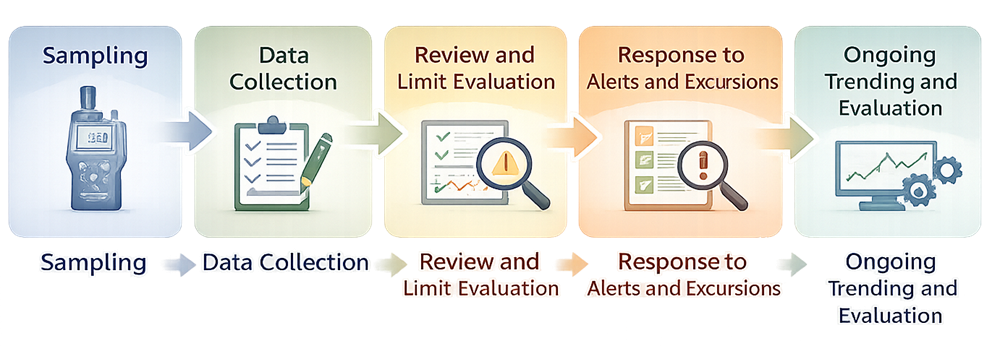
Data Collection and Initial Review
Environmental monitoring execution includes defined practices for data collection and initial assessment. This includes:
- Verification of correct sampling execution
- Documentation of sampling conditions
- Timely comparison to acceptance criteria and limits
Initial review focuses on identifying alerts, excursions, and anomalies requiring further evaluation.
Establishment of Alert and Action Limits
Alert and action limits used in environmental monitoring programs are established based on demonstrated environmental performance, risk, and regulatory expectations, and are finalized prior to routine program execution. Limits are derived using a structured approach that considers:
- Environmental performance qualification results and observed baseline behavior
- Cleanroom classification requirements for non-viable particulates
- Program-defined viable acceptance criteria informed by risk and historical data
- Expected operational variability under routine conditions
Alert Limits
Alert limits are established to identify early indications of potential drift from normal environmental performance. Alert limits are typically set:
- Within the established performance envelope demonstrated during qualification
- At levels that allow detection of emerging trends before loss of control occurs
- To trigger increased review, assessment, or heightened monitoring without immediate escalation
Exceedance of an alert limit does not, by itself, indicate noncompliance but signals the need for evaluation and continued observation.
Action Limits
Action limits represent conditions requiring formal investigation and documented response. Action limits are typically established:
- At or near the upper boundary of acceptable environmental performance
- At levels where the potential impact to product quality or compliance must be assessed
- To trigger predefined response actions, including investigation, impact assessment, and corrective measures
Exceedance of an action limit indicates a potential loss of environmental control and requires timely and documented follow-up.
Application During Program Execution
During routine execution of the environmental monitoring program:
- Results are evaluated against established alert and action limits at the time of review
- Alert-level results prompt focused assessment and enhanced trending
- Action-level results initiate formal response in accordance with approved procedures
Alert and action limits are applied consistently across comparable areas and sampling locations and are periodically reviewed to confirm continued suitability as operations, facility use, and historical performance evolve.
Response to Deviations and Excursions
Execution of the monitoring program includes defined responses to results exceeding alert or action limits. Responses may include:
- Assessment of sampling conditions and execution
- Review of recent operations and interventions
- Additional monitoring or increased frequency
- Initiation of investigations and corrective actions
The depth of response is proportional to risk and recurrence.
Program Governance and Ownership
Environmental monitoring execution requires defined ownership and oversight. This includes:
- Qualified personnel performing sampling
- Independent review of results by quality personnel
- Clear escalation and decision-making authority
Environmental monitoring is an active quality control function and requires consistent management attention.
Interface with Trending and Lifecycle Oversight
Data generated through routine monitoring execution feeds directly into trending and performance evaluation. Consistent execution is essential to ensure that trends reflect true environmental behavior, not variability in sampling technique or conditions. Monitoring execution, trending, and performance review together support:
- Continued verification of environmental control
- Identification of emerging risks
- Decisions related to requalification and change management
Maintaining Program Effectiveness
Environmental monitoring programs are periodically reviewed to confirm continued suitability. Reviews consider:
- Monitoring performance and trends
- Investigation outcomes
- Changes in facility use, equipment, or processes
Adjustments to the program are controlled, justified, and supported by data.