
Validation Requirements for Biopharmaceutical Production
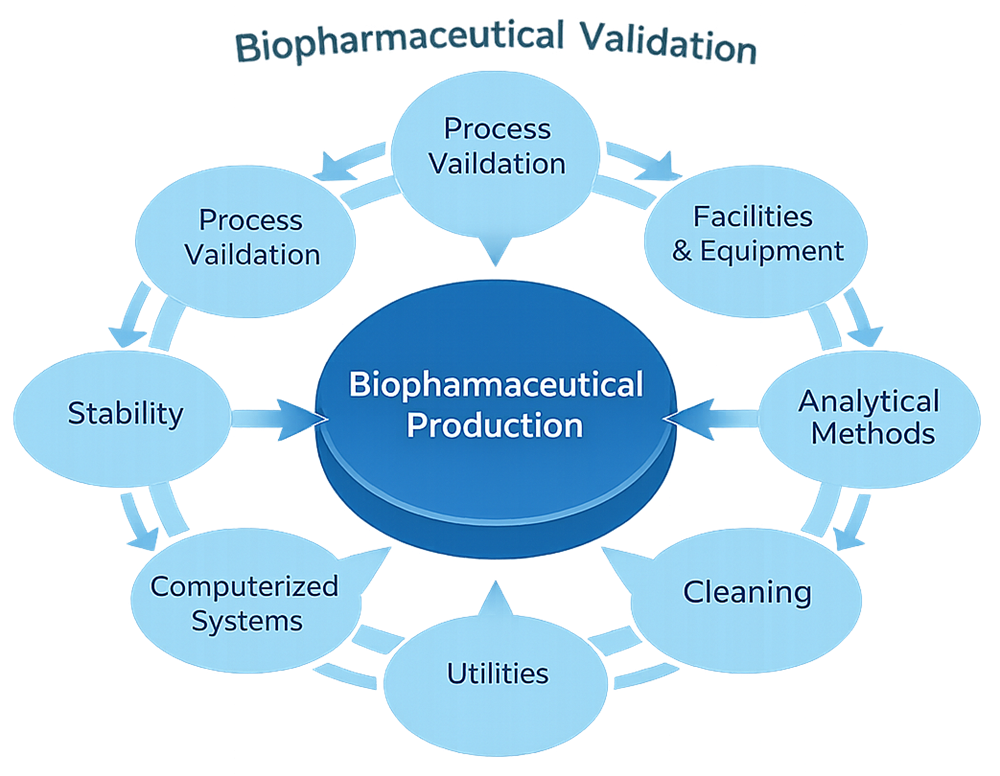
Regulatory validation requirements are central to maintaining control over biopharmaceutical manufacturing, where product quality cannot be assured by end testing alone. Biologics are inherently variable and sensitive to process conditions. As a result, regulators expect manufacturers to demonstrate, with documented evidence, that critical processes and systems consistently deliver products meeting requirements for safety, purity, potency, and efficacy.
In biopharmaceutical production, validation is not a paperwork exercise. It is the formal mechanism by which a firm proves it understands and controls the process that makes the product.
Regulatory Authority and Applicable Regulations
In the United States, biopharmaceutical products are regulated under the Federal Food, Drug, and Cosmetic Act (FD&C Act) and, where applicable, the Public Health Service Act (PHS Act). FDA’s authority over the manufacture, testing, and distribution of biologics is implemented through multiple sections of Title 21 of the Code of Federal Regulations, including 21 CFR Parts 210 and 211, as well as Parts 600 and 610, which establish requirements specific to biological products.
Collectively, these regulations require manufacturers to establish and maintain validated processes, qualified facilities and equipment, and reliable analytical methods to ensure that biopharmaceutical products are safe, pure, potent, and effective throughout their lifecycle.
Key Validation Requirements
Process Validation
Process validation establishes documented evidence that the manufacturing process consistently produces a biopharmaceutical product meeting predefined quality attributes and specifications. For biologics, the emphasis is typically placed on:
- Control of critical process parameters
- Demonstration of consistency across lots
- Ongoing monitoring to confirm the process remains in a controlled state
Because biologics are highly process-dependent, regulators expect robust lifecycle control, not one-time qualification.
Facility and Equipment Validation
Facilities, utilities, and equipment must be qualified to demonstrate they are suitable for their intended use and capable of operating within defined limits. Biopharmaceutical operations typically require stronger emphasis on:
- Cleanroom and environmental controls
- Utility systems such as purified water, clean steam, gases, HVAC
- Sterile boundary controls and contamination prevention
- Equipment cleaning, sanitization, and hold-time controls
The underlying expectation is consistent: facilities and equipment must not introduce contamination or uncontrolled variability.
Analytical Method Validation
Validated analytical methods are required to ensure that testing used for release, stability, in-process control, and characterization generates reliable and meaningful results. For biologics, method suitability often includes:
- Sensitivity to detect variability in complex molecules
- Control of assay performance over time
- Demonstrated accuracy, precision, and specificity for intended use
Weak analytical methods create the illusion of control while hiding real variation. Regulators treat that as a serious risk.
Cleaning Validation
Cleaning validation is essential to prevent carryover, cross-contamination, and microbial contamination. For biopharmaceutical production, cleaning programs must account for:
- Protein residues and product-related impurities
- Bioburden and endotoxin risks
- Worst-case selection and validated sampling methods
- Established acceptance criteria tied to product and patient risk
This area is frequently inspected because contamination failures in biologics are high consequence events.
Stability Testing
Stability programs confirm that product quality is maintained throughout its shelf life under defined storage and transport conditions. For biologics, stability expectations often include:
- Condition monitoring for temperature-sensitive materials
- Stability indicating methods that detect degradation
- Justified shelf life and storage conditions
- Ongoing stability commitments
Stability is where regulatory theory meets real-world distribution. Firms that treat it casually get burned later.
Applicable Regulatory Framework
Biopharmaceutical manufacturing may fall under multiple sections of 21 CFR, depending on product type, facility scope, and operations. Commonly relevant parts include:
- 21 CFR Part 600 and Part 610
These address biologics standards, general provisions, and testing expectations for biological products. - 21 CFR Part 211
While written for drug cGMP, it remains highly relevant because many provisions are applied in biologics manufacturing in practice, particularly around systems, documentation, controls, and laboratory operations. - Other applicable requirements
Depending on the operation, additional regulations may apply. Manufacturers must determine applicability based on product classification and regulatory pathway.
Bottom Line
Biopharmaceutical validation is fundamentally about demonstrating and maintaining process control. Regulators expect manufacturers to prove that product quality is built into the process through qualified facilities, validated methods, controlled cleaning, and an effective stability program. Firms that manage validation conservatively and systematically are best positioned for inspection readiness and sustained compliance.