
Biosafety Cabinets vs Laminar Flow Hoods
1. Purpose and Scope
This article examines the engineering and functional differences between biosafety cabinets and laminar flow hoods as primary ISO 5 work zone controls. Although both systems deliver HEPA-filtered air intended to protect sterile manipulations, they operate on fundamentally different airflow and containment principles and are not interchangeable.
The discussion focuses on airflow architecture, protection mechanisms, and the exposure considerations that drive equipment selection. It explains how vertical and horizontal laminar flow configurations differ in airflow geometry and how those differences affect staging and operator technique. It also clarifies the functional distinctions between Class II Type A2 and Type B2 biosafety cabinets, particularly in relation to exhaust management and facility integration. Workflow implications within each system are addressed to demonstrate how airflow design translates into practical operating constraints.
Certification, qualification, and lifecycle control requirements are addressed separately. The objective here is to provide a technically grounded framework for understanding design intent and selecting the appropriate engineering control based on material hazard profile, process characteristics, and facility infrastructure.
2. Protection Mechanism, Airflow Architecture, and Risk Logic: LFH vs BSC
Selection between a laminar flow hood and a biosafety cabinet must be understood through three linked elements: airflow design, protection mechanism, and exposure risk. These systems are built on fundamentally different engineering principles.
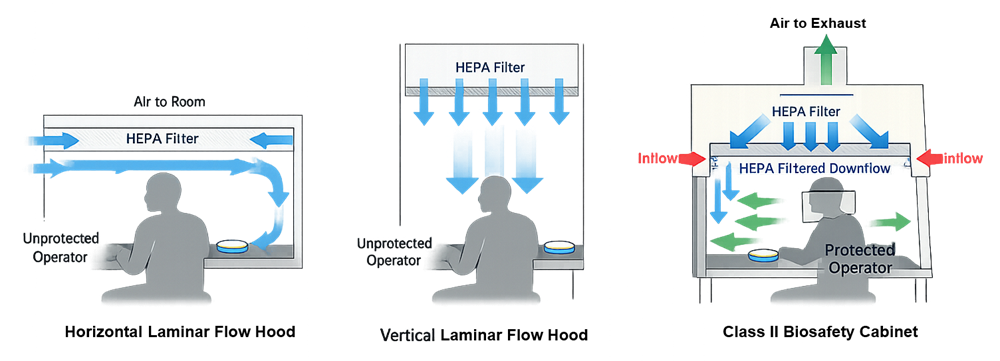
The fundamental difference between laminar flow hoods and biosafety cabinets is illustrated by their airflow architecture.”
2.1 Laminar Flow Hood – Clean Air Displacement Without Containment
A laminar flow hood operates as a single-pass clean air displacement system intended to establish a localized ISO 5 environment over the work surface.
Room air is drawn through a prefilter, passed through a HEPA filter, and delivered as a uniform, unidirectional airflow across the critical work zone. In horizontal units, air moves from the rear filter toward the operator. In vertical units, air moves downward from the top filter toward the work surface. After sweeping the work area, the air exits directly into the surrounding room.
Product protection is achieved by continuously bathing critical sites in first air from the HEPA filter. The outward displacement of clean air pushes ambient room contamination away from the work zone. However, this outward sweep is the only protective mechanism. There is:
• No controlled inflow barrier at the opening
• No defined capture velocity at the front edge
• No engineered exhaust pathway
• No internal pressure separation
Any aerosol, vapor, or particulate generated during manipulation follows the airflow path outward. The operator and surrounding room are exposed to whatever the process produces.
Control variables are limited to blower performance, HEPA integrity, and airflow velocity uniformity. The system does not rely on inflow balance or containment thresholds. Once airflow uniformity is disrupted by room drafts, personnel motion, or poor staging, there is no secondary containment feature to compensate. A laminar flow hood is therefore appropriate only when:
• The material presents no inhalation or dermal hazard
• Aerosol generation is negligible under routine and upset conditions
• Only product protection is required
It is a clean air supply device. It is not a containment device.
2.2 Biosafety Cabinet – Balanced Airflow Containment System
A Class II biosafety cabinet operates as a dynamically balanced airflow system designed to provide product protection, personnel protection, and environmental protection simultaneously.
Room air is drawn inward through the front opening at a specified inflow velocity. This creates a directional air curtain across the sash opening, establishing a defined capture zone that limits escape of process-generated aerosols. Within the cabinet:
• HEPA-filtered vertical downflow supplies first air over the work surface
• Contaminated air is captured through engineered front and rear grilles
• Exhaust air is HEPA filtered before recirculation or discharge
Protection mechanisms are interdependent:
• Inflow protects the operator
• Downflow protects the product
• HEPA-filtered exhaust protects the environment
Airflow balance is critical. If inflow drops below specification, containment fails. If inflow increases excessively, turbulence destabilizes internal downflow. If downflow is obstructed or return grilles are blocked, both product protection and containment degrade simultaneously.
Unlike the laminar flow hood, the biosafety cabinet relies on controlled pressure relationships and airflow interdependence. Performance depends on blower calibration, filter loading, exhaust static pressure, sash position, and room cross-drafts. The cabinet is therefore an engineered containment system that also provides ISO 5 product protection.
2.3 Risk-Based Selection Logic
The distinction between LFH and BSC is ultimately a risk determination. A laminar flow hood becomes technically inappropriate when credible exposure hazards exist. Hazard assessment must consider:
• Toxicity or pharmacologic potency of materials
• Potential for aerosolization during normal operations
• Aerosol generation during upset or low-frequency events
• Volume and frequency of manipulation
• Consequences of inhalation, dermal exposure, or surface contamination
• Environmental contamination implications
Even infrequent aerosol events such as syringe disconnection, vial pressure equalization, or powder handling can produce respirable particles. In a displacement-only system, those particles exit directly into the operator’s breathing zone. If exposure consequences extend beyond product contamination, product protection alone is insufficient. Containment becomes a design requirement.
A biosafety cabinet introduces defined inflow capture and controlled exhaust filtration, reducing the probability of aerosol escape. It does not eliminate hazard, but it provides engineered mitigation rather than relying solely on procedural discipline.
Selection must follow a documented hazard and exposure assessment. If operator or environmental risk is credible under routine or worst-case conditions, use of a laminar flow hood cannot be justified solely because it produces ISO 5 air at the work surface.
3. Vertical vs Horizontal Laminar Flow Hoods
3.1 Horizontal Flow Hoods
In a horizontal laminar flow hood, HEPA-filtered air is discharged from the rear filter and moves in a straight line toward the operator. Critical sites placed closest to the filter receive direct first air, and contamination from the room is displaced outward as the air exits the front opening.
This configuration works well for small, low-profile manipulations where airflow from the rear to the front can remain unobstructed. The airflow pattern is simple and predictable as long as large objects do not interrupt the path.
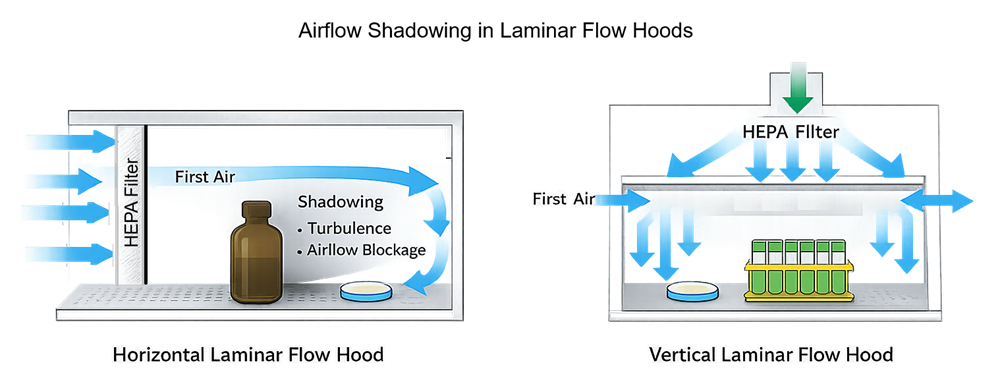
Its limitation is structural: the clean air stream moves directly toward the operator. Any aerosol generated during manipulation follows that same path into the breathing zone and the room. In addition, items positioned upstream can create downstream shadowing, depriving critical sites of first air.
Effective workflow requires staging sterile components near the rear filter, keeping hands and packaging downstream, minimizing vertical stacking, and preserving a clear path between the HEPA source and the critical site.
3.2 Vertical Flow Hoods
In a vertical laminar flow hood, HEPA-filtered air is delivered downward from a top-mounted filter across the work surface. First air is supplied from above, allowing taller objects to be accommodated more easily than in horizontal flow configurations.
Because the airflow originates over the entire work plane, complex or variable setups can be arranged without a single rear-to-front shadow path. However, the downward airflow column is sensitive to disruption. Arm movement, leaning into the hood, or blocking return grilles can create turbulence and compromise first air at critical sites.
Workflow control focuses on keeping critical manipulations directly under unobstructed downflow, avoiding blockage of front or rear returns, minimizing stacking of materials, and maintaining deliberate, controlled movements.
Vertical hoods provide flexibility for larger or more varied configurations, but airflow stability depends heavily on disciplined staging and operator positioning.
As illustrated below, object placement relative to HEPA discharge directly influences first air integrity.
4. Class II Biosafety Cabinets: Functional Considerations
Class II biosafety cabinets provide ISO 5 product protection and personnel protection through coordinated inflow, downflow, and HEPA-filtered exhaust. The functional difference between Type A2 and Type B2 lies primarily in exhaust management and facility integration. Cabinet type must be selected based on material hazard profile and facility HVAC capability. Containment performance is directly linked to both cabinet design and building exhaust integration.
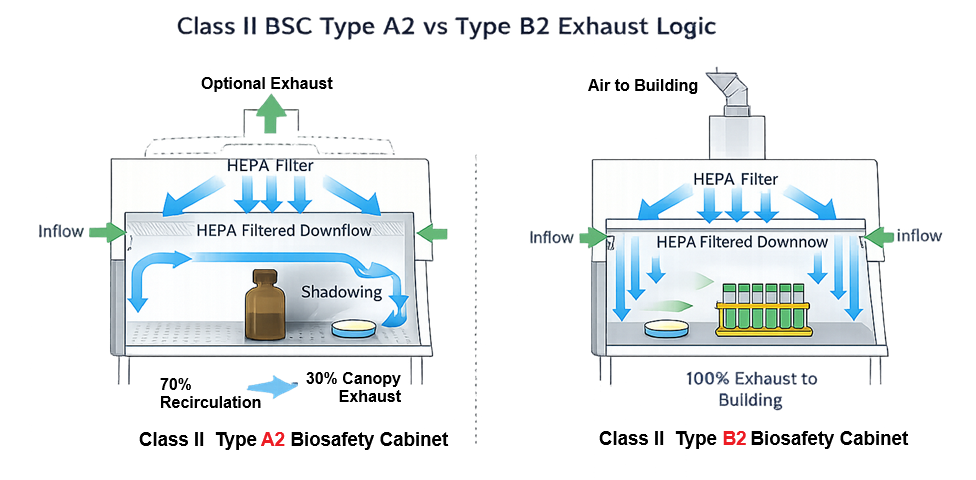
Type A2 and Type B2 cabinets differ primarily in exhaust management and facility integration.
4.1 Type A2
A Type A2 cabinet supplies HEPA-filtered vertical downflow over the work surface and draws room air inward through the front opening to protect the operator. A substantial portion of the air is recirculated within the cabinet after HEPA filtration, while the remainder is exhausted through a HEPA filter.
Exhaust may be discharged back into the room or connected to building exhaust via a canopy connection. Because the cabinet does not rely entirely on a hard-ducted exhaust system, it is less dependent on building HVAC stability than a B2 unit.
Type A2 cabinets are appropriate for sterile manipulations involving aerosols or hazardous particulates where personnel protection is required, but where significant volatile toxic chemicals are not present. HEPA filtration addresses particulate hazards; volatile compounds are not the primary design target.
4.2 Type B2
A Type B2 cabinet operates as a total exhaust system. All air entering the cabinet is exhausted through HEPA filtration to the building exhaust. No internal recirculation occurs within the work chamber.
This configuration is used when volatile toxic chemicals or higher containment requirements make recirculation unacceptable. Because the cabinet depends entirely on building exhaust performance, stable duct pressure, monitoring, and alarm integration are critical to maintaining containment.
Type B2 cabinets require coordinated facility design and cannot function safely without properly engineered exhaust support.
5. Workflow Control Inside ISO 5 Work Zones
Airflow design alone does not ensure aseptic control. The operator’s technique, staging decisions, and movement patterns determine whether first air actually reaches critical sites. Workflow inside laminar flow hoods and biosafety cabinets must therefore be deliberately structured around airflow behavior rather than convenience.
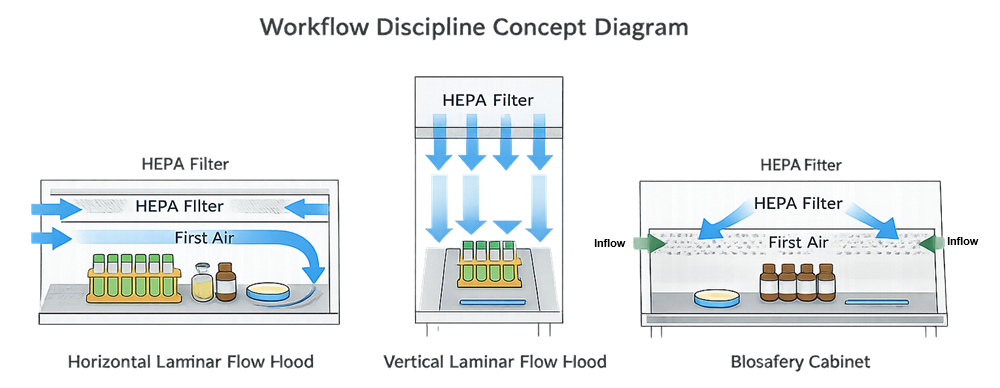
Proper staging preserves first air and prevents airflow disruption.
5.1 General Aseptic Workflow Principles
Regardless of equipment type, the objective is to maintain uninterrupted first air to all critical sites. This requires positioning sterile components so that HEPA-filtered air reaches them before contacting less clean surfaces or hands. Movements must be controlled and deliberate to avoid turbulence. Work should remain within the stable airflow region defined during qualification, not at edges where room air intrusion is more likely. Process flow should move from cleaner to less clean activities to reduce the risk of cross-contamination.
5.2 Workflow in Horizontal Laminar Flow Hoods
In horizontal flow units, airflow moves from the rear HEPA filter toward the operator. Critical sites must therefore be positioned closest to the filter face so that they receive first air directly. Hands, packaging materials, and waste containers should remain downstream to avoid contaminating the airflow before it reaches sterile components.
Operators should avoid working at the extreme front edge of the hood, where airflow stability is weakest and room disturbances can intrude. Large objects placed between the HEPA filter and the critical site must be avoided, as they create shadowing and turbulence that compromise first air protection.
5.3 Workflow in Vertical Laminar Flow Hoods
In vertical flow units, HEPA-filtered air descends from above. Critical manipulations should be positioned directly under unobstructed downflow. Supplies and tools should be arranged laterally rather than stacked vertically to prevent blockage of the airflow column.
Front and rear return grilles must remain clear at all times. Blocking these grilles alters velocity distribution and can create recirculation zones. Operators should avoid leaning into the hood or making rapid arm movements that disrupt the downward airflow pattern.
5.4 Workflow in Biosafety Cabinets
In a biosafety cabinet, both product protection and containment depend on preserving airflow balance. Work must be performed well inside the sash opening to maintain the inflow air curtain. Front and rear grilles must never be obstructed, as this affects both containment and internal airflow stability.
Arm movements through the sash opening should be slow and controlled to prevent disruption of the air barrier. Heat sources and open flames should be avoided because they distort airflow and compromise both product protection and containment.
Proper workflow within a biosafety cabinet requires continuous awareness that inflow, downflow, and exhaust function together. Disruption in one area affects the entire protection system.
6. Summary
Laminar flow hoods and Class II biosafety cabinets both generate ISO 5 unidirectional airflow at the point of use, but they serve different protection objectives. A laminar flow hood is a clean air displacement device intended solely for product protection. It does not provide engineered containment for personnel or the surrounding environment.
A Class II biosafety cabinet integrates controlled inflow, vertical downflow, and HEPA-filtered exhaust to provide both product protection and containment. Its performance depends on maintaining airflow balance, correct sash position, and stable exhaust conditions.
Horizontal and vertical laminar flow configurations impose different staging and workflow constraints. Airflow direction determines how critical sites are positioned and how operator movement must be controlled to preserve first air.
Selection must be driven by documented hazard and exposure assessment. Where operator or environmental risk exists, containment becomes a design requirement. ISO 5 classification alone does not define suitability; protection mechanism and risk profile do.