
Cold Rooms and Walk-In Freezers
1. Overview of Cold Rooms and Walk-In Freezers
Cold rooms and walk-in freezers are large temperature-controlled storage environments used in pharmaceutical manufacturing, laboratories, and distribution facilities. Unlike laboratory refrigerators and freezers, which store materials in relatively small chambers, cold rooms provide controlled storage conditions for large volumes of materials such as raw materials, intermediates, finished drug products, and stability samples.
Typical operating ranges include refrigerated cold rooms maintained between 2–8 °C and walk-in freezers operating between −15 and −25 °C. These systems are designed to maintain stable temperature conditions across larger storage areas where personnel may enter the chamber to access stored materials. Because cold rooms represent room-scale environments rather than compact appliances, temperature control, airflow distribution, and heat infiltration dynamics differ significantly from those observed in smaller refrigeration units.
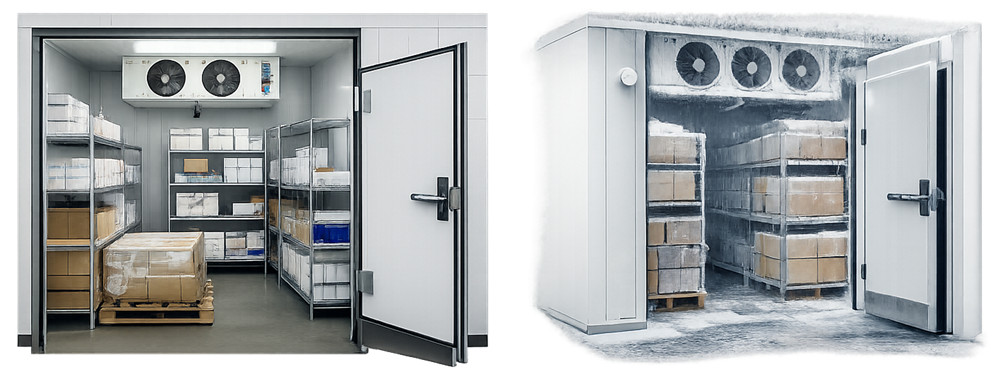
The images below show typical pharmaceutical cold room and walk-in freezer installations used for controlled storage of materials in regulated environments.
2. Structural Design and Refrigeration Systems
2.1 Insulated Panel Construction
Cold rooms and walk-in freezers are typically constructed using modular insulated panels that form a thermally controlled enclosure. Panels commonly consist of rigid polyurethane or polyisocyanurate insulation sandwiched between metal surfaces such as stainless steel or coated steel. High insulation performance is necessary to reduce heat transfer between the controlled interior environment and the surrounding facility. Door seals, panel joints, and penetrations for piping or sensors must also be properly sealed to prevent thermal leakage.
Walk-in freezers often include heated door frames or anti-condensation heaters to prevent ice formation around door openings.
2.2 Refrigeration Equipment
Cooling for cold rooms and walk-in freezers is typically provided by external refrigeration systems connected to evaporator units installed inside the chamber. Key system components typically include:
- compressor units located outside the cold room
- evaporator coils with circulation fans inside the chamber
- condensers used to reject heat to the surrounding environment
- expansion valves that regulate refrigerant flow
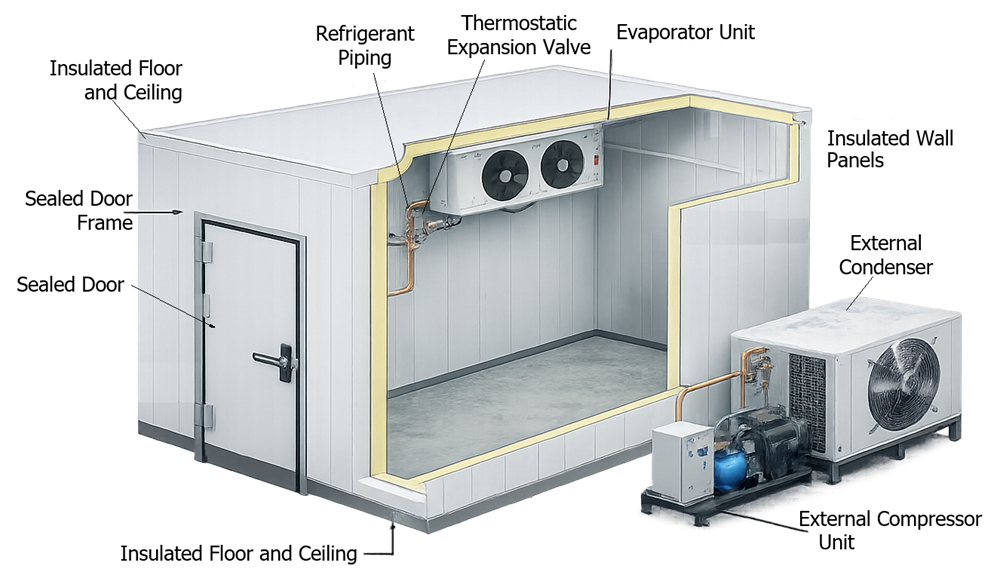
These systems operate using the same vapor-compression refrigeration principles used in smaller refrigerators and freezers but are designed to handle larger thermal loads and greater air volumes. The diagram below illustrates the main structural elements and refrigeration components typically used in cold room and walk-in freezer systems.
3. Airflow Distribution in Large Refrigerated Spaces
Maintaining temperature uniformity inside a cold room requires careful control of airflow distribution. Evaporator units typically include multiple fans that circulate cooled air throughout the storage space. Airflow patterns in cold rooms are influenced by:
- evaporator fan capacity and placement
- shelving systems and pallet racks
- product loading density
- door openings and personnel movement
In large storage environments, airflow paths may extend across several meters. If airflow becomes obstructed by stored materials or pallet racks, localized warm or cold zones may develop. The diagram below shows a typical airflow circulation pattern inside a cold room and how cooling air is distributed throughout the storage space.
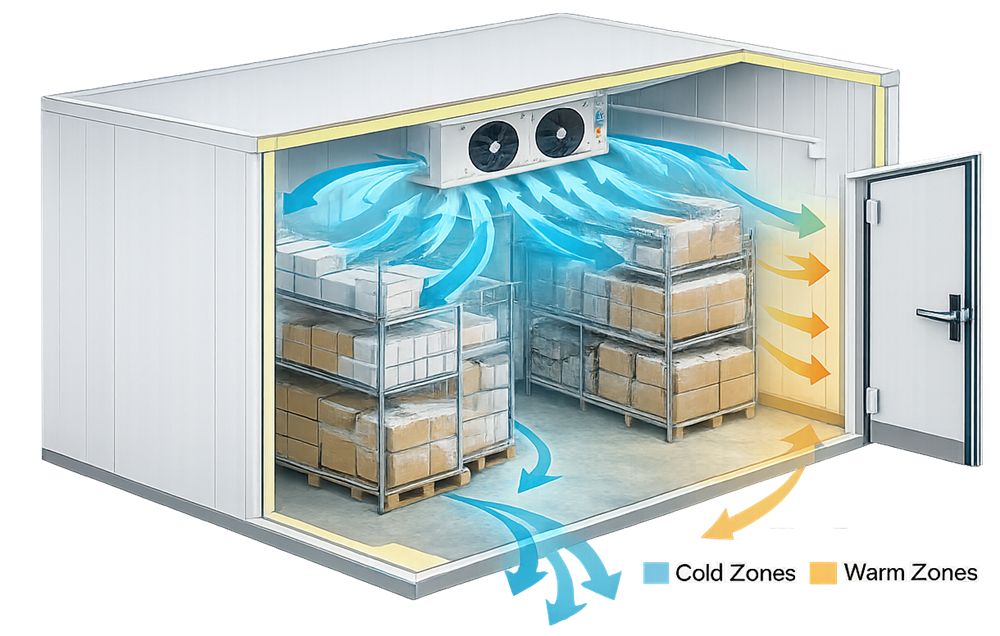
Unlike small refrigerators, temperature stratification in cold rooms can occur both vertically and horizontally across the room. Areas near the evaporator outlet may be colder, while areas near doors or distant corners of the room may experience slightly warmer temperatures.
4. Impact of Door Openings and Personnel Access
Cold rooms are routinely accessed by personnel for storage and retrieval of materials. Door openings therefore represent a major source of heat infiltration into the controlled environment. When the door is opened, warmer ambient air enters the chamber through the upper portion of the doorway while colder dense air from inside the room tends to spill outward near the floor. This bidirectional air exchange results in mixing between the incoming warm air and the cooled internal air, producing a temporary increase in chamber temperature.
The magnitude of this temperature disturbance depends on several factors:
- duration of door opening
- ambient room temperature
- size of the doorway
- frequency of access
- thermal mass of stored materials
Rooms containing large quantities of stored product often experience slower temperature changes because the stored materials act as thermal mass that dampens rapid temperature fluctuations.
In walk-in freezers, door openings may also introduce moisture from the surrounding environment. When this moisture enters the low-temperature chamber, it can condense and freeze on evaporator coils, door frames, or interior structures, potentially affecting airflow and cooling efficiency over time.
To reduce temperature disturbances, facilities often implement operational controls such as minimizing door opening duration, organizing storage layouts to allow rapid material access, and in some cases installing strip curtains or air curtains to reduce warm air infiltration during door access.
5. Temperature Distribution and Storage Configuration
Temperature distribution inside a cold room is strongly influenced by storage configuration and product loading patterns. Unlike small refrigeration equipment where airflow paths are relatively short and predictable, cold rooms rely on circulation fans and unobstructed air pathways to distribute cooled air throughout a much larger volume. Storage racks, palletized materials, and large containers can significantly affect airflow movement and create localized temperature gradients.
Evaporator units typically discharge cooled air across the storage area. If this airflow path becomes obstructed by stored materials, circulation efficiency can be reduced and certain zones may experience reduced cooling. As a result, temperature conditions within the room may vary between areas directly exposed to circulating air and locations where airflow is restricted.
To maintain consistent temperature conditions, storage configurations are usually designed to preserve unobstructed airflow paths throughout the room. Facilities commonly establish loading restrictions or storage guidelines to prevent conditions that may interfere with air circulation. Typical storage restrictions may include:
- maintaining minimum clearance between stored materials and evaporator outlets
- avoiding storage directly in front of evaporator discharge airflow
- maintaining clearance between pallet racks and walls to allow air circulation
- limiting pallet stacking height near airflow outlets
- maintaining open aisles to allow airflow movement through the storage space
- avoiding dense packing of large containers that restrict internal airflow
- maintaining clearance below ceiling-mounted evaporator units
- preventing storage directly against temperature sensors or monitoring probes
These practices help ensure that cooled air can circulate throughout the storage space and reduce the risk of localized warm or cold areas.
Because cold rooms often contain large quantities of stored materials, the thermal mass of the stored product can help dampen short-term temperature fluctuations. However, thermal mass does not compensate for restricted airflow. Uneven loading patterns or obstructed airflow pathways may still create zones where temperature recovery is slower or where cooling efficiency is reduced.
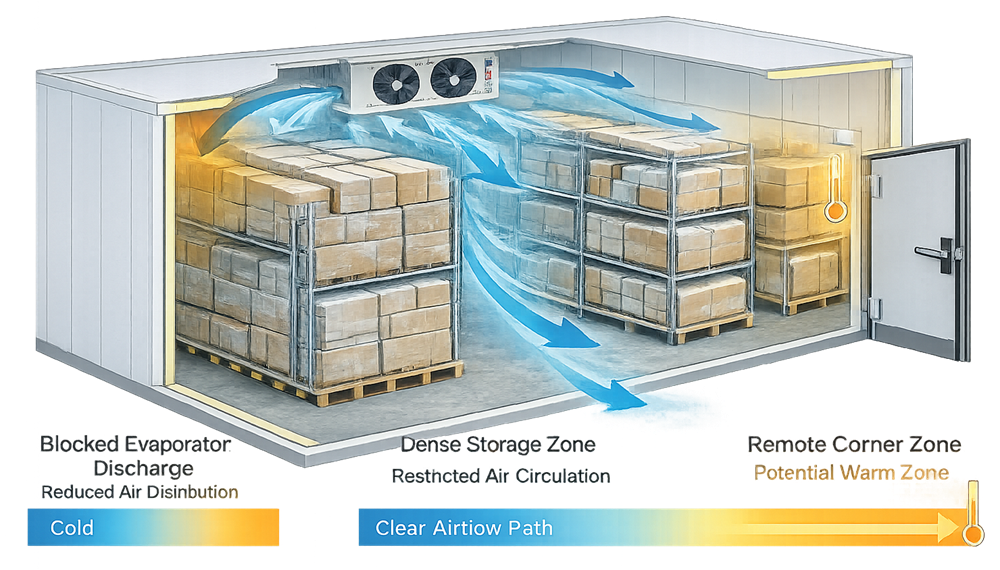
The illustration below demonstrates how storage layout can influence airflow circulation within a cold room. The diagram highlights typical conditions such as blocked evaporator discharge, dense storage zones with restricted airflow, and remote areas of the room where air circulation may be reduced.
6. Monitoring and Sensor Considerations
Cold rooms typically incorporate temperature monitoring systems to continuously verify that storage conditions remain within defined limits across the controlled environment. Because cold rooms represent relatively large storage volumes, temperature conditions may vary between different areas of the room. Continuous monitoring therefore provides assurance that stored materials remain within acceptable temperature ranges during routine operation.
Temperature monitoring probes are commonly installed at fixed locations inside the room where they can represent typical storage conditions. In practice, monitoring locations are selected to provide coverage of areas where temperature variation is most likely to occur. These locations may include positions near doors, corners of the room, areas distant from evaporator airflow outlets, or locations that have historically demonstrated temperature variability during qualification studies.
The final placement of monitoring sensors is typically established during temperature distribution studies performed as part of equipment qualification. These studies evaluate temperature conditions throughout the room using multiple measurement locations and help identify representative monitoring points for routine operation.
Monitoring probes are often installed in protective housings or probe holders to ensure stable positioning and to prevent accidental displacement during routine storage activities. Care is usually taken to avoid placing sensors directly in evaporator discharge airflow or in locations where stored materials may obstruct accurate temperature measurement.
In many installations, monitoring sensors are buffered using thermal media such as glycol solutions, glass beads, or other inert materials. Buffering reduces the influence of short-term air temperature fluctuations caused by compressor cycling, door openings, or temporary airflow disturbances. As a result, buffered probes provide temperature readings that more closely represent the thermal conditions experienced by stored products rather than instantaneous air temperature changes.
7. Qualification Considerations for Cold Rooms
Qualification activities for cold rooms and walk-in freezers focus on verifying that the system can maintain acceptable temperature conditions throughout the storage space. Testing typically evaluates:
- temperature uniformity throughout the room
- recovery performance following door openings
- influence of product loading patterns
- airflow distribution within the storage area
- stability of refrigeration system operation
Because cold rooms represent large environments, temperature distribution studies usually require multiple sensors distributed throughout the space to evaluate temperature conditions across different zones of the room.
These studies help identify potential warm or cold areas and confirm that the storage environment remains within the required temperature limits during normal operation.