
Endotoxin Analytical System Qualification
Endotoxin analytical system qualification establishes documented evidence that instruments and associated software used for bacterial endotoxin testing are fit for their intended use in a GMP laboratory. In quantitative methods such as kinetic chromogenic assays, reported endotoxin values are directly dependent on optical measurement accuracy, incubation control, timing precision, and validated calculation algorithms. The analytical platform therefore constitutes a regulated system.
Qualification must address hardware performance, software functionality, data integrity, and lifecycle control.
1. Scope of the Analytical System
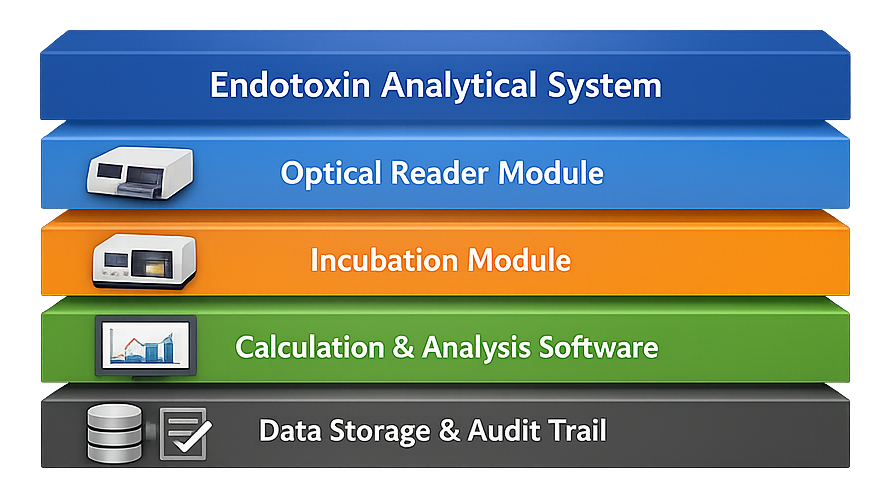
An endotoxin analytical system typically includes:
• Microplate or tube reader
• Incubation module with controlled temperature
• Optical detection components
• Control and data acquisition software
• Standard curve calculation algorithms
• Electronic record storage and audit trail functionality
Where kinetic methods are used, the system must reliably measure absorbance at defined wavelengths over time and accurately determine reaction onset or time to threshold.
The diagram below illustrates the structural components of a typical endotoxin analytical system. Optical detection, incubation control, computational algorithms, and electronic data management function as an integrated platform. Qualification must therefore address each module individually and the system as a whole.
2. Regulatory Framework
Qualification and control of endotoxin analytical systems are supported by:
• 21 CFR 211 – laboratory equipment suitability and control
• 21 CFR Part 11 – electronic data requirements
• USP <85> Bacterial Endotoxins Test – method requirements and suitability
For multinational operations, expectations may also align with EU GMP Annex 11.
The system must be controlled, secure, and capable of generating accurate and traceable analytical results.
3. Qualification Lifecycle
Endotoxin analytical systems follow a structured lifecycle approach.
Installation Qualification (IQ)
• Verification of equipment installation
• Confirmation of utilities and environmental conditions
• Software installation and version documentation
• Verification of instrument configuration
• Documentation of manufacturer specifications
IQ confirms that the system is installed correctly and configured as intended.
Operational Qualification (OQ)
OQ verifies that the system operates within defined technical specifications. Typical tests include:
• Wavelength accuracy verification
• Photometric accuracy and linearity
• Temperature accuracy and uniformity
• Timer and reaction time accuracy
• Alarm and error handling verification
• User access level testing
For kinetic assays, reaction timing precision and optical stability are critical performance elements.
Temperature Control Qualification
Many endotoxin analytical systems, including kinetic chromogenic platforms such as KQCL, incorporate an integrated incubation module. Because reaction kinetics are temperature-dependent, the incubator must be qualified as a critical system component. Temperature Control Qualification should include:
• Temperature setpoint verification
• Temperature accuracy against calibrated reference
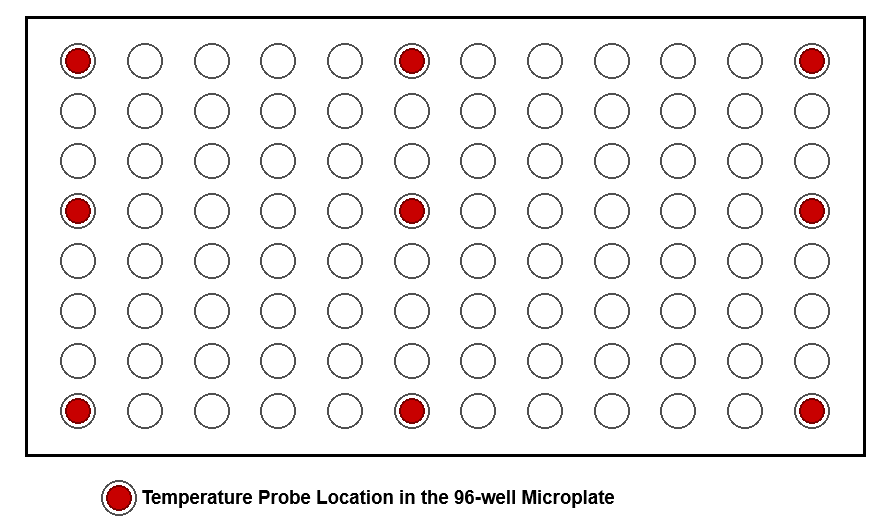
• Uniformity mapping across the microplate surface
• Stability over defined incubation period
• Recovery time after plate insertion
Temperature tolerance limits must be defined and justified. Ongoing control should include:
• Periodic temperature verification
• Alarm functionality testing
• Trending of incubation stability
For kinetic assays, temperature control is not a secondary feature. It is a determinant of analytical accuracy and must be treated as a qualified parameter within the system lifecycle.
The schematic below illustrates temperature uniformity mapping across a 96-well microplate surface during Operational Qualification. Calibrated temperature probes are positioned at representative locations across the incubation platform to verify setpoint accuracy, spatial uniformity, and stability over the defined assay period.
Performance Qualification (PQ)
PQ demonstrates that the system performs reliably under routine laboratory conditions. Typical elements include:
• Replicate standard curve generation
• Verification of correlation coefficient and slope consistency
• Endotoxin recovery testing
• Repeatability and precision assessment
• Verification of method suitability performance
PQ confirms that the instrument produces reproducible and accurate endotoxin measurements when used with validated methods.
4. Critical Technical Parameters
Several parameters directly influence endotoxin quantification:
• Wavelength accuracy
• Photometric linearity
• Temperature control stability
• Reaction time measurement precision
• Software calculation accuracy
In kinetic chromogenic assays, even small deviations in temperature or timing can significantly affect calculated endotoxin concentration. Qualification must demonstrate control within defined tolerances.
5. Software Validation and Data Integrity
Endotoxin analytical systems commonly generate and store electronic records. Software validation must address:
• User access control and role management
• Audit trail functionality
• Electronic signature configuration
• Data backup and recovery
• Protection against unauthorized modification
Audit trails should capture:
• Standard curve creation
• Sample identification
• Result calculation
• Result modification or invalidation
Compliance with 21 CFR Part 11 requires that electronic data be attributable, legible, contemporaneous, original, and accurate.
6. Calibration and Ongoing Control
After qualification, the system must remain in a state of control. Routine activities may include:
• Scheduled photometric verification
• Temperature checks
• Control standard testing
• Trending of standard curve slope and correlation coefficient
• Preventive maintenance
Adverse trends may indicate optical drift, temperature instability, or software performance issues.
7. Change Management and Requalification
Changes that may require assessment or requalification include:
• Software upgrades or configuration changes
• Firmware updates
• Replacement of optical components
• Incubator repair
• Equipment relocation
A documented impact assessment should determine whether partial testing or full requalification is required.
Core Qualification Principle
Endotoxin analytical systems directly determine reported endotoxin values. Because quantitative results depend on optical measurement, timing, and validated computational algorithms, the system must be qualified and maintained under GMP controls.
Reliable endotoxin testing requires not only a validated method but also a qualified analytical platform operating within defined and documented performance limits.