
Environmental Control and Monitoring Overview
Purpose and Scope
Environmental control and monitoring are fundamental elements of GMP facility design and operation. This article provides a high-level overview of how controlled environments are established, maintained, and evaluated to support product quality and regulatory compliance.
The focus is conceptual and strategic, not procedural. Detailed monitoring methods, qualification activities, and data analysis are addressed in subsequent articles.
Role of Environmental Control in GMP Operations
Environmental control is a preventive control, not a detection mechanism. Its primary objective is to establish conditions that minimize contamination risk before product exposure occurs.
Key principles include:
- Control of airborne particulates and microorganisms
- Directional airflow and pressure relationships
- Stable temperature and humidity to support processes and materials
- Integration with facility layout, zoning, and personnel flow
Environmental control is inseparable from HVAC system design and facility architecture.
Controlled vs Monitored Environments
Not all spaces require the same level of control or monitoring.
- Controlled environments
Areas where conditions are actively maintained within defined limits because they directly or indirectly affect product quality. - Monitored environments
Areas where data is collected to confirm expected conditions, detect drift, or support trending, without requiring continuous control.
The distinction is risk-based and must be justified during design and qualification.
Relationship Between HVAC Systems and Environmental Monitoring
HVAC systems provide the means of control, while environmental monitoring provides the evidence of performance. Environmental monitoring:
- Confirms that HVAC design intent is achieved in operation
- Detects adverse trends or loss of control
- Supports qualification, requalification, and ongoing assurance
Monitoring does not replace good design. Poorly designed systems cannot be monitored into compliance.
Environmental Classification and Operational States
Environmental expectations are defined by:
- Room classification or functional designation
- Operational state, such as at rest or in operation
- Product and process risk
Monitoring and evaluation must always be interpreted in the context of the applicable operational state.
Lifecycle Perspective
Environmental control and monitoring extend across the facility lifecycle:
- Design and layout decisions
- Initial qualification and performance confirmation
- Routine operation and monitoring
- Periodic review, requalification, and change management
This lifecycle view ensures that environmental control remains effective as processes, equipment, and usage evolve.
Regulatory Expectations
Regulatory agencies expect firms to demonstrate:
- A rational environmental control strategy
- Monitoring programs aligned with risk and use
- Data-driven confirmation of continued control
- Timely response to adverse trends or excursions
Documentation and decision-making must show intent, understanding, and ownership—not just data collection.
Link to Subsequent Articles
This overview establishes the framework for:
- Environmental Monitoring Program Execution, which addresses how viable and non-viable monitoring is designed and performed
- Environmental Performance, Limits, and Trending, which addresses qualification, alert and action limits, and ongoing data evaluation
Environmental Control as an Ongoing Process
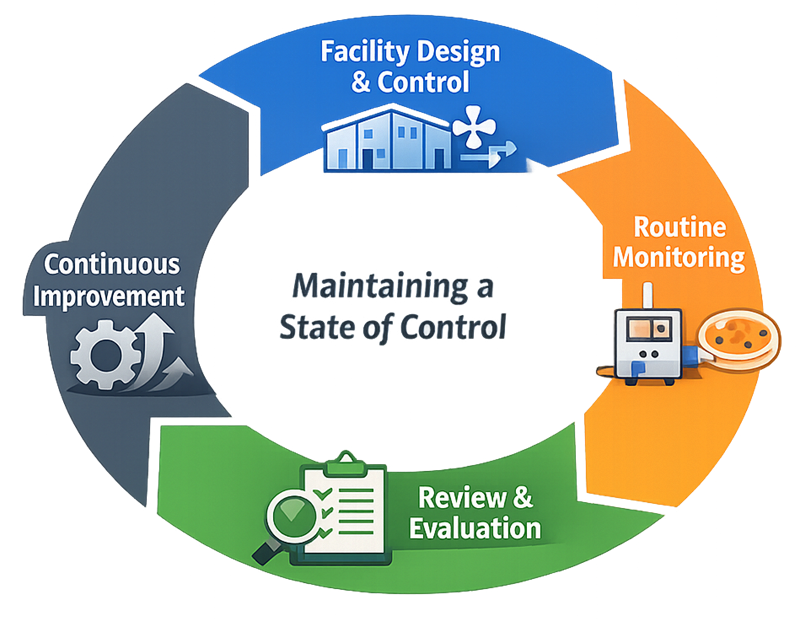
Effective environmental control is achieved through design, discipline, and review. Monitoring is not an end in itself but a tool used to demonstrate and sustain a state of control over time.
As facilities, processes, and operating patterns evolve, environmental control strategies must be periodically evaluated to confirm they remain appropriate and effective. Ongoing review of monitoring data, coupled with change management and risk assessment, ensures that controlled environments continue to support product quality and regulatory compliance throughout the facility lifecycle.