
Environmental Performance Qualification, Limits, and Trending
Purpose and Scope
This article defines how environmental performance is established, evaluated, and maintained in GMP-controlled environments. It explains the basis for environmental performance qualification, the derivation of alert and action limits, and the role of trending in demonstrating ongoing control.
Environmental monitoring programs, including sampling locations and frequencies, are derived from demonstrated environmental performance. Monitoring is not designed in isolation; it is built on qualification outcomes, risk assessment, and regulatory expectations.
Environmental Performance as the Foundation
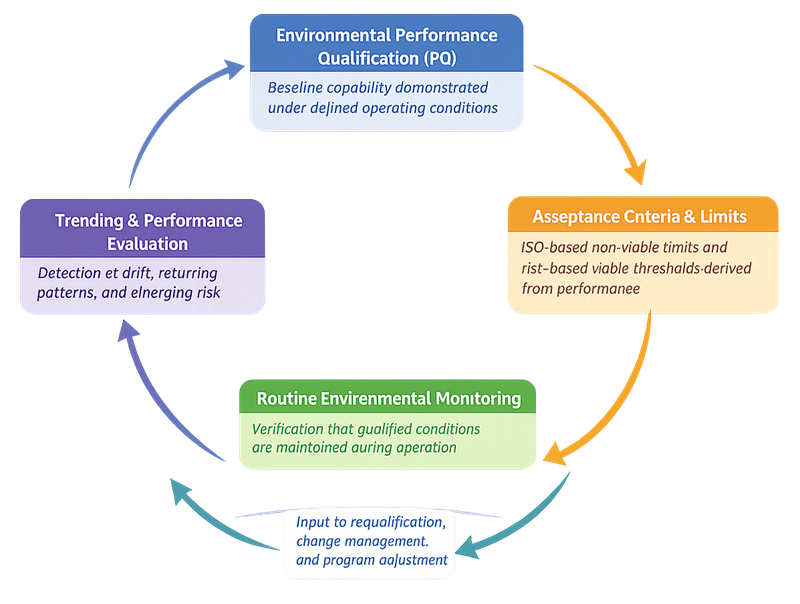
Environmental performance answers a fundamental question: Can the facility and HVAC systems consistently maintain environmental conditions in accordance with design specifications, applicable regulatory requirements, and recognized industry standards under defined operating conditions?
Only after this capability is demonstrated through qualification can monitoring expectations, including sampling locations, frequencies, and acceptance criteria, be meaningfully established.
Environmental Performance Qualification
Environmental performance qualification provides documented evidence that facility and HVAC systems are capable of maintaining environmental conditions within approved design specifications, regulatory requirements, and applicable industry standards during both static and dynamic operating conditions. It is a structured evaluation of environmental control capability under defined, reproducible conditions that reflect actual facility use.
Scope of Performance Qualification
Environmental performance qualification typically evaluates, as applicable, environmental conditions under both static at-rest conditions and dynamic in-operation conditions, including the presence of personnel, equipment, and routine operational activities representative of actual facility use.
- Airborne particulate concentrations relative to the required environmental classification, confirmed under defined static and dynamic operating conditions
- Microbiological conditions during representative operational activities, including:
- Airborne viable monitoring
- Surface viable monitoring of work surfaces, equipment, and adjacent areas
- Stability and consistency of key environmental parameters over defined time periods, including:
- Temperature
- Relative humidity
- Differential pressure relationships
Preconditions for Environmental Performance Qualification
Environmental performance qualification is conducted only after the following prerequisites are met and documented:
- HVAC systems are installed, commissioned, and have successfully completed Installation and Operational Qualification
- Airflow patterns, airflow directionality, air change rates, and pressure differentials have been verified and approved during Operational Qualification
- Airflow balancing and room pressure relationships are established and controlled (Airflow balancing report is available for review)
- HEPA filtration integrity testing is completed and documented, where applicable.
- Environmental monitoring instruments and methods are qualified
- Room classification requirements and defined operational states such as at-rest and in-operation are formally established and documented prior to performance qualification.
Environmental performance qualification assumes that these controls are in place and functioning. PQ does not re-establish or challenge airflow design; it evaluates whether the environment remains in control while those verified controls are subjected to routine and worst-case operational conditions.
Sampling Plans for Environmental Performance Qualification
Environmental performance qualification relies on predefined, documented sampling plans designed to challenge and characterize the capability of the environment to maintain control under representative and worst-case operating conditions.
Sampling plans are developed using a structured, risk-based approach and are informed by cleanroom classification requirements, qualification observations, and operational risk.
Role of ISO Classification
For non-viable airborne particulates, cleanroom classification standards establish the minimum acceptance criteria and minimum number of sampling locations required to demonstrate compliance with the applicable environmental classification.
These standards define:
- Particle size ranges to be evaluated
- Maximum allowable particle concentrations
- Minimum sampling locations based on room area
ISO classification requirements establish the baseline framework for non-viable particulate assessment during qualification. They do not, by themselves, define a complete environmental monitoring strategy.
Development of Qualification Sampling Plans
Beyond ISO minimums, qualification sampling plans are expanded and refined based on facility- and process-specific considerations, including:
- Room function and process risk, including the nature of activities performed and degree of product exposure
- Airflow patterns and identified critical zones, as established during design and Operational Qualification
- Locations of open product handling, critical operations, or interventions
- Personnel movement and routine operational behaviors
- Expected worst-case operating conditions, including maximum occupancy and equipment operation
For viable monitoring, including airborne and surface sampling, acceptance criteria and sampling density are not defined by ISO classification standards. These elements are established using a risk-based approach informed by regulatory guidance, industry practice, historical performance, and qualification data.
Qualification Versus Routine Monitoring
During environmental performance qualification, sampling plans are typically more intensive than those used for routine monitoring. The objective is to establish baseline performance, characterize normal variability, and identify areas of sensitivity or increased risk. Data generated during qualification is then used to:
- Confirm environmental classification compliance
- Define appropriate routine monitoring locations and frequencies
- Support establishment of alert and action limits
- Provide a defensible basis for ongoing trending and review
Environmental monitoring programs are therefore derived from qualification outcomes, with ISO classification serving as the minimum technical foundation for non-viable particulate assessment.
Outcome of Performance Qualification
Data generated during environmental performance qualification establishes the baseline performance envelope for the space. This baseline defines what acceptable, stable environmental control looks like under defined operating conditions. The results of performance qualification directly inform:
- Acceptance criteria and limits
- Routine monitoring locations and frequencies
- Trending expectations
- Requalification and change management decisions
Environmental monitoring programs are derived from this demonstrated performance and exist to confirm that the qualified state is maintained during routine operations.
Relationship Between Qualification and Monitoring
Environmental monitoring programs are derived from qualification outcomes. Specifically:
- Sampling locations are selected based on airflow behavior, risk points, and qualification observations
- Monitoring frequencies are informed by demonstrated stability and variability
- Alert and action limits are established based on acceptable performance, not arbitrary targets
Environmental monitoring is implemented to confirm that environmental conditions demonstrated during qualification continue to be maintained during routine operations in accordance with approved specifications, applicable regulatory requirements, and recognized industry standards. Environmental monitoring does not establish performance criteria; it provides ongoing verification that the qualified state is sustained.
Acceptance Criteria for Non-Viable Airborne Particulates
Acceptance criteria for non-viable airborne particulates are derived from recognized cleanroom classification standards, specifically ISO 14644-1, which defines allowable particle concentrations by size for classified environments. These criteria:
- Define maximum allowable airborne particulate concentrations at specified particle sizes
- Are directly linked to room classification and applicable operational states such as at-rest and in-operation
- Represent internationally recognized benchmarks for assessing airborne particulate control
During environmental performance qualification, non-viable particulate monitoring data is used to demonstrate compliance with the required ISO classification. During routine operation, the same ISO-based criteria provide an objective reference for confirming that the qualified environmental state is being maintained.
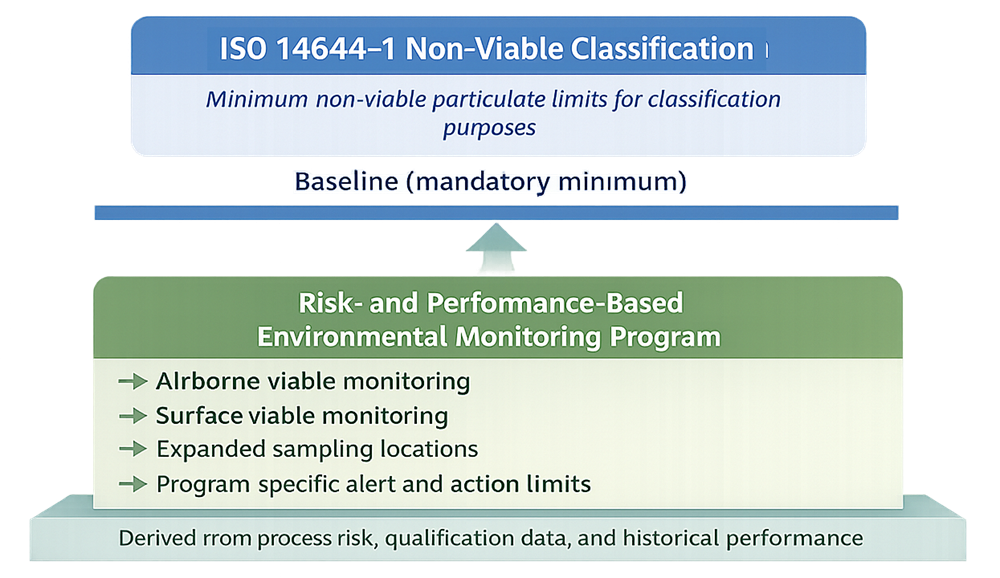
Acceptance limits for common classifications, including ISO 5, ISO 7, ISO 8, and ISO 9, are typically summarized in tabular form to support qualification and ongoing monitoring activities.
ISO Cleanroom Classification – Non-Viable Airborne Particulate Limits (Reference: ISO 14644-1)
| ISO Class | Maximum Particles ≥ 0.5 µm (particles/m³) | Maximum Particles ≥ 5.0 µm (particles/m³) |
|---|---|---|
| ISO 5 | 3,520 | 29 |
| ISO 7 | 352,000 | 2,930 |
| ISO 8 | 3,520,000 | 29,300 |
| ISO 9 | 35,200,000 | 293,000 |
- These limits represent baseline acceptance criteria for non-viable particulate control. More stringent internal limits or expanded monitoring may be applied based on risk, process requirements, or historical performance.
- Limits are defined for cleanroom classification purposes and apply to the specified operational state used during qualification or monitoring.
- ISO 14644-1 establishes particle size ranges, concentration limits, and minimum sampling locations required to demonstrate classification compliance.
- ISO 9 environments are typically unclassified or background areas but may still be included in qualification and monitoring programs where justified by process flow, zoning, or contamination risk.
Acceptance Criteria for Viable Monitoring
Unlike non-viable airborne particulates, there are no universally mandated numerical limits for viable contamination established by regulation or international cleanroom classification standards. Viable acceptance criteria are therefore established using a risk-based, program-specific approach, informed by:
- Room classification and functional use
- Process and product risk, including exposure duration and criticality
- Historical environmental monitoring performance
- Applicable industry guidance and regulatory expectations
In industry practice, typical baseline acceptance ranges are often applied as starting points and refined based on facility-specific performance and risk. For airborne viable monitoring, commonly observed industry practice includes:
- ISO 5 areas: target values approaching zero, with any recovery investigated
- ISO 7 areas: low single-digit CFU per cubic meter under in-operation conditions
- ISO 8 areas: higher allowable CFU levels, reflecting background or support space use
For surface viable monitoring, industry practice commonly differentiates between:
- Critical work surfaces and equipment in proximity to exposed product
- Non-critical surfaces and adjacent areas
Acceptance levels are typically set lower for surfaces directly associated with critical operations and higher for peripheral or background surfaces.
These values are not regulatory limits but program-defined thresholds selected to be achievable, sensitive to loss of control, and appropriate for the intended use of the space. Acceptance criteria are periodically reviewed and adjusted based on trending, investigations, and demonstrated environmental performance.nal or punitive.
Alert and Action Limits
Alert and action limits establish predefined thresholds used to evaluate environmental monitoring results and to distinguish normal variability from potential loss of control.
- Alert limits are set to provide early indication of adverse trends or emerging shifts in environmental performance. Exceedance of an alert limit does not necessarily indicate noncompliance but signals the need for heightened review, assessment of contributing factors, and increased attention to trending.
- Action limits represent conditions that require formal investigation and documented response. Exceedance of an action limit indicates a potential loss of environmental control and typically triggers defined actions, which may include impact assessment, corrective and preventive actions, and evaluation of the need for requalification or changes to the monitoring program.
Alert and action limits shall be:
- Appropriate for the room classification, functional use, and process risk
- Justified using environmental performance qualification data, historical monitoring results, and applicable industry guidance
- Applied consistently across comparable areas and monitoring locations
Limits are not static. Periodic review is required to confirm that alert and action thresholds remain suitable as processes, equipment, facility use, and historical performance evolve. Adjustments to limits must be data-driven, documented, and supported by demonstrated environmental performance.
TrendTrending and Ongoing Performance Evaluation
Trending is the primary mechanism for evaluating environmental performance over time and for distinguishing normal process variability from meaningful changes in environmental control. Effective trending focuses on:
- Patterns, shifts, and recurring behaviors, rather than isolated results
- Recurrent alert or action limit exceedances, even when individual results remain within acceptance criteria
- Long-term stability and consistency of both viable and non-viable monitoring data
- Correlation of environmental data with operational changes, including personnel activity, process changes, equipment operation, maintenance activities, or facility modifications
Trending enables proactive identification of emerging risks before loss of control occurs. It provides objective, data-driven input into deviation investigations, corrective and preventive actions, requalification decisions, and change management activities.
When applied consistently, trending demonstrates not only compliance, but ongoing understanding and control of the environmental monitoring program.
Maintaining a State of Control
Environmental performance is not demonstrated once and assumed forever. It must be continually confirmed through disciplined monitoring, evaluation, and response.
Environmental monitoring programs operate as a feedback mechanism, confirming that qualified performance is sustained and identifying when reassessment is required. Together, qualification, limits, and trending provide a defensible framework for maintaining a state of environmental control throughout the facility lifecycle.