
Facility Automation and Monitoring Architecture and Concepts
Facility automation and monitoring architecture defines how control, monitoring, alarming, and data handling functions are structured and interact within a GMP-regulated facility. The architecture establishes clear system boundaries, data flow paths, and responsibilities across engineering, operations, and quality functions. A well-defined architecture is essential to ensure that monitoring data is reliable, alarms are actionable, and control strategies remain sustainable over the facility lifecycle.
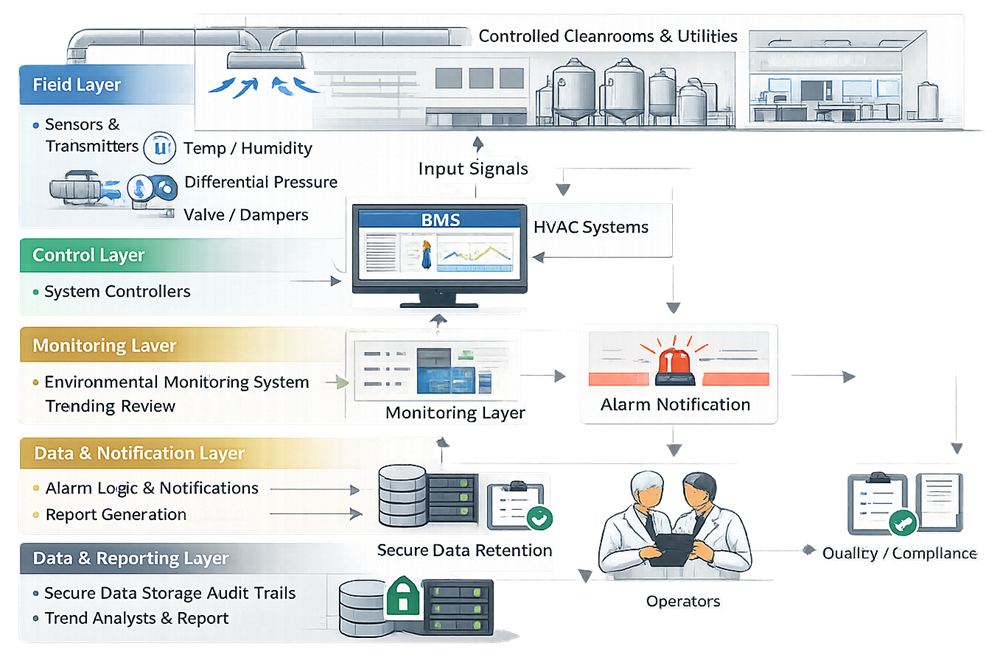
Architectural Layers
Facility automation and monitoring systems are typically organized into logical layers. Each layer has a defined role and should not be overloaded with responsibilities outside its intended function.
- Field Layer
Sensors, transmitters, and actuators measuring environmental and utility parameters such as temperature, humidity, pressure, airflow, and utility conditions. - Control Layer
Controllers and control logic responsible for maintaining operating conditions within defined ranges. This layer is commonly implemented through the Building Management System. - Monitoring Layer
Systems responsible for collecting, trending, and evaluating environmental and utility data, including the Environmental Monitoring System where applicable. - Alarm and Notification Layer
Logic and infrastructure used to evaluate conditions against alert and alarm thresholds and notify responsible personnel. - Data and Reporting Layer
Secure storage, audit trails, trend analysis, and reporting functions supporting review, investigation, and periodic assessment.
Clear separation between layers improves system reliability and simplifies qualification, troubleshooting, and change management.
BMS and EMS Conceptual Roles
Although often integrated, BMS and EMS serve distinct purposes.
The Building Management System is primarily responsible for control. It maintains environmental conditions through automated responses based on sensor inputs and predefined logic.
The Environmental Monitoring System is primarily responsible for monitoring and documentation. It provides independent data collection, trending, and reporting to demonstrate continued control and support quality oversight.
Blurring these roles can complicate validation and weaken data integrity expectations. Mature architectures define responsibilities clearly, even when platforms are technically integrated.
Data Flow Concepts
Monitoring data flows in a defined and traceable manner:
- Sensors generate raw signals
- Signals are processed and evaluated by control or monitoring systems
- Results are logged as time-stamped records
- Alarm conditions trigger notifications when thresholds are exceeded
- Data is retained for review, trending, and investigation
Data flow should be predictable, documented, and testable during qualification. Hidden logic paths or undocumented data transformations introduce compliance risk.
Alarm Concepts
Alarm logic is based on comparison of measured values against predefined thresholds. These thresholds are established based on qualification results, operating ranges, and risk assessment.
Architecturally, alarm evaluation should occur at a controlled and auditable point in the system. Alarm generation, notification, and acknowledgment should be traceable and time-stamped, supporting investigation and response documentation.
Alarm handling is not a user-interface feature. It is a core system behavior that must remain consistent regardless of display or reporting tools.
Integration With Quality Oversight
Facility automation and monitoring architecture must support quality review without requiring operational intervention. Quality users should be able to access monitoring data, alarm history, and trends independently of system control functions.
This separation reinforces data integrity and supports unbiased assessment of facility performance.
Lifecycle Considerations
Architectural decisions made early in facility design have long-term consequences. Systems that are tightly coupled, poorly documented, or vendor-dependent are difficult to qualify, maintain, and modify.
A robust architecture supports:
- Efficient qualification and requalification
- Predictable change control impact assessment
- Meaningful periodic review
- Scalable expansion without redesign
From a compliance perspective, simplicity and clarity outperform complexity every time.