
Facility Zoning and Segregation Concepts
Purpose and Context
Facility zoning and segregation establish the physical framework that supports contamination control in GMP manufacturing. While cleanroom classification, airflow, and flow design define environmental capability and movement logic, zoning determines where controls apply and how they are protected.
Several zoning principles have already been introduced in earlier articles, including Cleanroom Design Principles and Material, Personnel, and Waste Flow Design. This article builds on those foundations by addressing zoning as a deliberate design strategy, not a collection of room labels.
What Zoning Really Means in GMP Facilities
Zoning is the intentional division of a facility into areas with different levels of control, based on risk, process requirements, and regulatory expectations. Effective zoning limits the spread of contamination, reduces operational complexity, and supports predictable behavior during routine and worst-case operations.
Zoning is not defined by walls alone. It is expressed through:
- Physical separation
- Controlled transitions
- Access restrictions
- Integrated flow paths
Inspectors evaluate zoning by asking whether the facility enforces correct behavior by design, rather than relying on procedures or training to compensate for weak layout decisions.
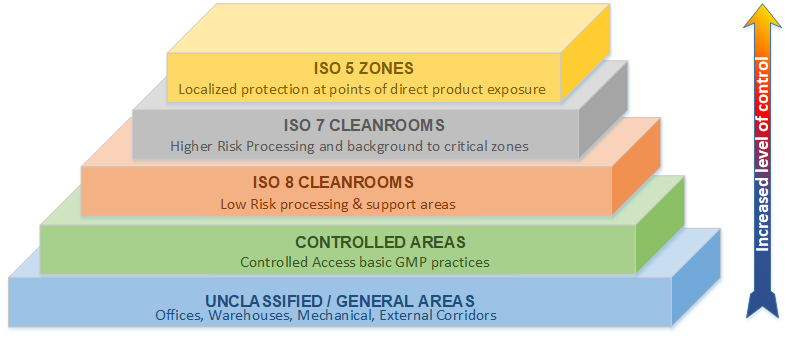
The conceptual diagram below illustrates the hierarchical zoning structure commonly used in GMP facilities, with increasing levels of control from general areas to critical processing zones.
Segregation as a Design Control
Segregation is the practical outcome of zoning. It ensures that incompatible activities, materials, or conditions do not interact unintentionally.
Common segregation objectives include separation of:
- Classified and unclassified areas
- Clean and less-clean operations
- Incoming materials and waste
- Personnel entry and exit paths
- Different product types or risk profiles
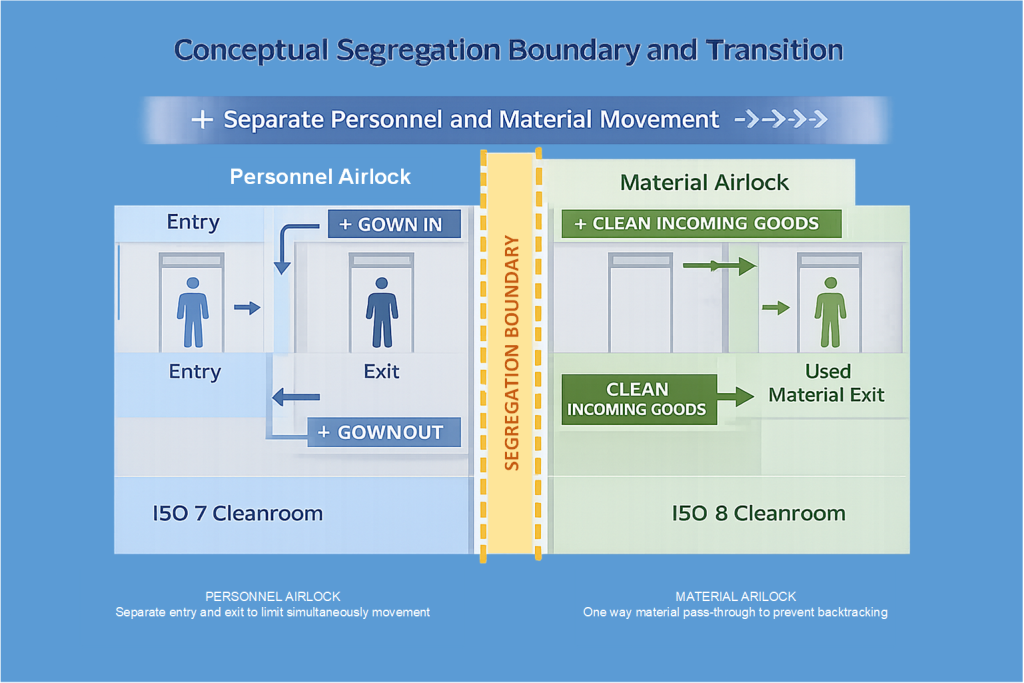
When segregation relies primarily on scheduling or administrative controls, regulators typically view this as a design limitation, not an acceptable mitigation. The conceptual diagram below illustrates a segregation boundary with dedicated personnel and material transition points between cleanroom zones of differing classification.
Zoning Aligned with Cleanroom Classification
Cleanroom classification provides environmental definition, but zoning determines how those environments are protected.
Effective zoning ensures that:
- Higher-grade areas are surrounded by appropriate background zones
- Direct transitions from unclassified to critical areas are avoided
- Controlled corridors, airlocks, or transition spaces are used where classifications change
Zoning that contradicts classification logic, such as placing critical areas adjacent to uncontrolled spaces, is difficult to defend during inspection regardless of monitoring results.
Functional Zoning Beyond Cleanrooms
Zoning applies beyond classified rooms. Facilities must also consider segregation of:
- Manufacturing versus support functions
- Production versus maintenance activities
- Clean utilities versus plant utilities
- Product contact versus non-product contact spaces
Failure to address functional zoning often leads to recurring deviations during maintenance, cleaning, or high-activity periods.
The table below contrasts contamination control zoning with functional use designation to highlight how each serves a different but complementary role in GMP facility design.
Zoning Versus Functional Use — Conceptual Comparison
| Aspect | Zoning (Control-Based) | Functional Use (Activity-Based) |
|---|---|---|
| Primary Purpose | Establish contamination control hierarchy | Support operational and process activities |
| Basis for Definition | Risk level, cleanliness requirements, regulatory expectations | Type of activity performed, equipment use, workflow needs |
| Typical Boundaries | Physical barriers, access controls, airlocks, classification changes | Operational areas, rooms, suites, or activity groupings |
| Relationship to Cleanroom Classification | Directly aligned with ISO classification and control levels | May span multiple classifications or zones |
| Regulatory Focus | High — inspectors expect zoning to be deliberate and defensible | Secondary — acceptable if aligned with zoning controls |
| Change Impact | Changes often trigger qualification or requalification | Changes may be operational but still require zoning impact assessment |
| Common Failure Mode | Zoning defined on paper but not enforced by design | Functional convenience overriding zoning intent |
| Inspection Risk | High if zoning logic is inconsistent or bypassed | High if functional use contradicts zoning boundaries |
Zoning Under Normal and Worst-Case Conditions
Zoning effectiveness must be evaluated under real operating conditions, not idealized scenarios.
Inspectors assess whether zoning remains effective during:
- Peak staffing
- Simultaneous operations
- Material surges
- Cleaning and maintenance activities
A zoning concept that only works when activity is low is not considered robust.
Common Zoning and Segregation Failures
Regulators frequently observe:
- Overlapping zones with unclear boundaries
- Excessive reliance on SOPs to manage poor layout
- Temporary barriers used as permanent solutions
- Zoning diagrams that do not reflect actual operations
These issues often indicate that zoning was treated as a documentation exercise rather than as a core design decision.
Relationship to Qualification and Lifecycle Management
Zoning decisions directly affect:
- Qualification scope and sampling strategies
- Environmental monitoring program design
- Change control impact assessments
- Requalification frequency and effort
Clear, well-defined zones simplify validation activities and reduce long-term compliance burden.
Bottom Line
Facility zoning and segregation are foundational contamination control tools. When zoning is intentional, aligned with process risk, and reinforced by physical design, compliance becomes sustainable. When zoning is vague or procedural, deviations become routine.
Inspectors quickly distinguish between facilities where zoning was designed with intent and those where it evolved reactively. The difference is evident in both layout and operation.