
Qualification, Monitoring, and Requalification of Gas Utilities
1. Purpose and Scope
This article defines a structured approach for the qualification, ongoing monitoring, and requalification of gas utilities used in GMP manufacturing, including compressed air systems, process gas systems, and on-site nitrogen generation.
Gas utilities are considered GMP-relevant utilities when their failure, contamination, or loss of control could reasonably affect product quality, equipment function, or controlled environments. The depth of qualification and monitoring applied to these systems must be proportionate to their intended use and associated risk.
This article focuses on how control is established and maintained over time, rather than on system design, which is addressed separately.
2. Regulatory and Standards Context
Regulatory expectations for gas utilities are derived from general facility and equipment requirements rather than utility-specific prescriptions.
Relevant regulatory references include:
- 21 CFR 211.42 – Design and construction features
- 21 CFR 211.63 – Equipment design and suitability
- 21 CFR 211.65 – Equipment construction and maintenance
- 21 CFR 211.68 – Automated systems where applicable
International standards such as ISO 8573 and ISO 7396-1 are commonly used as technical reference frameworks for air and gas quality classification and distribution practices. These standards are applied as engineering benchmarks, not as GMP requirements, and must be interpreted in the context of intended use and risk.
3. Risk-Based Qualification Strategy
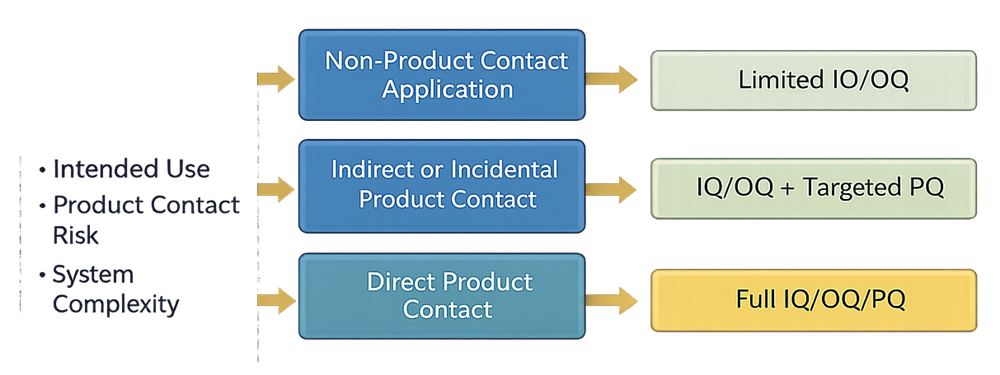
Gas utility qualification is not uniform across all systems. Qualification scope and depth must be determined based on:
- Intended use
- Proximity to product or product-contact surfaces
- Impact of failure on product quality
- System complexity and failure modes
- Historical performance and reliability
Utilities supporting non-product-contact applications may require limited qualification, while systems with direct or indirect product contact require more comprehensive verification.
Risk assessment should be documented and used to justify qualification decisions. The scope and depth of gas utility qualification are determined by intended use, system complexity, and risk to product quality rather than by utility type alone.
4. Qualification Scope and Typical Activities
Installation Qualification (IQ)
IQ activities confirm that the gas utility system is installed as designed and is suitable for its intended use.
Typical IQ elements include:
- Verification of system configuration and components
- Materials of construction and compatibility
- Utility connections and capacity
- Instrument installation and identification
- Documentation review and drawing verification
The depth of IQ should reflect system complexity and criticality.
Operational Qualification (OQ)
OQ activities verify that the system operates within defined and acceptable ranges under expected operating conditions.
Typical OQ elements include:
- Pressure control and regulation
- Alarm and interlock functionality where implemented
- System response to normal operating conditions
- Verification of control functions
OQ focuses on functional performance, not routine monitoring.
Performance Qualification (PQ)
PQ demonstrates that the gas utility consistently delivers gas of appropriate quality under actual operating conditions.
Typical PQ elements may include:
- Verification of gas quality attributes at points of use
- Stability of performance over time
- Confirmation of controls supporting higher-risk applications
Where continuous monitoring is implemented and justified, PQ activities may be limited in scope.
5. System-Specific Qualification Considerations
Compressed Air Systems
Compressed air systems typically require the most comprehensive qualification due to:
- On-site generation
- Multiple conditioning stages
- Diverse failure modes
Qualification depth increases with product contact risk and reliance on air quality.
Process Gas Systems
Cylinder-based and bulk process gas systems generally require more limited qualification, focused on:
- Distribution integrity
- Pressure control
- Correct gas identification and segregation
- Point-of-use protection
Supplier certification plays a significant role, but does not eliminate the need for facility-level verification.
Nitrogen Generation Systems
On-site nitrogen generation systems represent a hybrid case.
Qualification must consider:
- Dependence on compressed air quality
- Generator performance and stability
- Buffer storage and distribution controls
These systems typically require more qualification than cylinder-based gas supply, but less than full compressed air systems.
6. Ongoing Monitoring and Performance Review
Qualification alone does not ensure continued control.
Gas utilities must be subject to ongoing monitoring appropriate to their risk, which may include:
- Pressure monitoring
- Dew point monitoring for compressed air
- Purity monitoring where applicable
- Alarm review and response
Performance data should be periodically reviewed to identify trends, deviations, or early indicators of loss of control.
Periodic performance review is an active control mechanism, not a retrospective exercise.
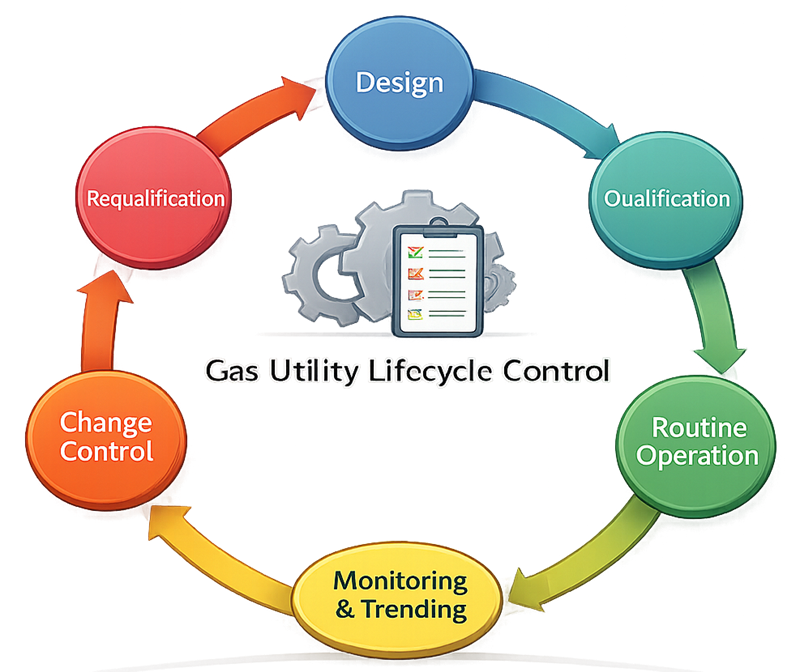
Gas utility control is maintained through a lifecycle approach that integrates qualification, monitoring, change control, and requalification.
7. Requalification Triggers and Scope Determination
Requalification is not performed on a fixed schedule by default.
Requalification may be triggered by:
- System modifications or component replacement
- Changes in intended use
- Performance drift or repeated deviations
- Extended outages or abnormal events
- Findings from periodic performance review
Requalification scope may range from:
- Documented review only
- Targeted testing
- Partial requalification
- Full system requalification
The selected scope must be justified based on risk and available evidence.
8. Documentation and Lifecycle Control
All qualification, monitoring, and requalification activities must be appropriately documented.
Documentation should:
- Clearly define scope and rationale
- Reference applicable standards and procedures
- Capture results and conclusions
- Support continued fitness for intended use
Gas utility lifecycle control must integrate with change control, deviation management, and periodic review processes.
9. Lifecycle Boundary and Integration
This article defines how control of gas utilities is established and maintained throughout their operational life. Design considerations are addressed separately, while monitoring and requalification activities are integrated into routine GMP quality systems.
Together, these elements ensure that gas utilities remain suitable for their intended use throughout their lifecycle.