
HEPA Filtration and Air Distribution
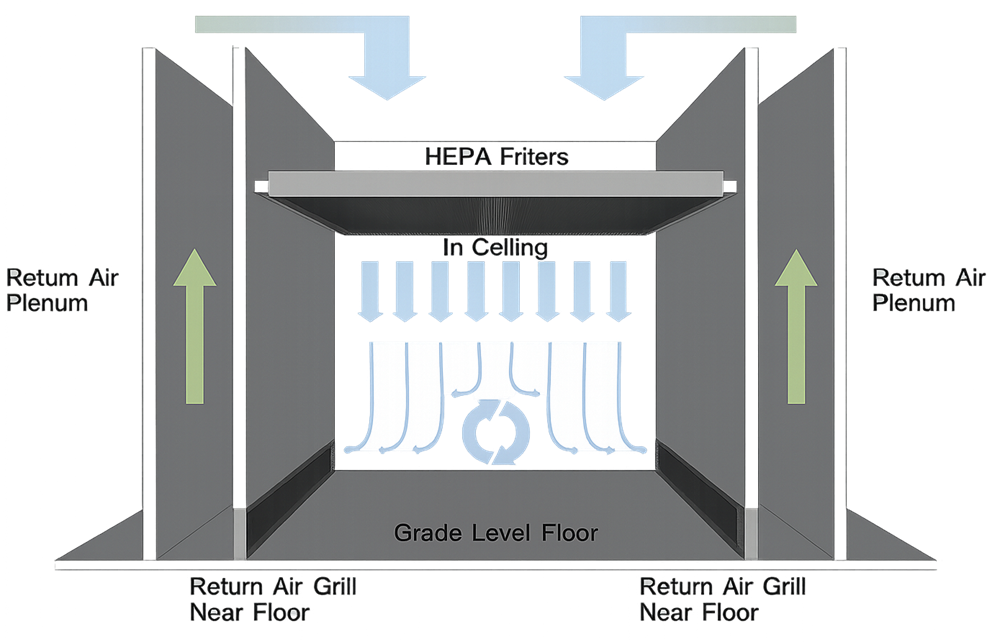
HEPA filtration and air distribution are the primary mechanisms by which HVAC systems achieve and maintain cleanroom classification. While temperature, humidity, and air change rates establish environmental conditions, HEPA filtration and air distribution determine cleanliness.
Filtration without proper air distribution does not provide control. Air distribution without verified filtration provides false confidence. Both must function together to maintain a state of control. The following diagram illustrates how HEPA filtration and air distribution work together to maintain cleanroom control.
Regulatory and GMP Context
GMP regulations require air supplied to classified and controlled areas to be appropriately filtered and delivered in a manner that minimizes contamination risk. Regulatory focus is not limited to the presence of HEPA filters. Inspectors evaluate how air is supplied, how it moves through the space, and how contaminants are removed. Expect scrutiny of:
- HEPA filter specification and integrity
- Airflow direction and uniformity
- Relationship between air distribution and room classification
- Ongoing verification and monitoring
Clean air must be delivered where it is needed and removed in a controlled manner.
HEPA Filtration Fundamentals
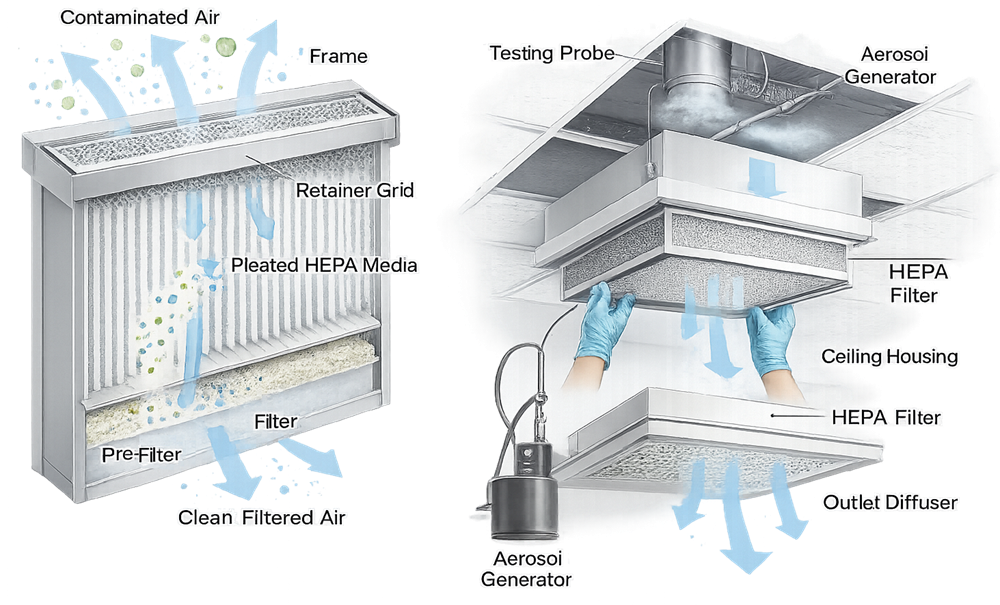
High-Efficiency Particulate Air filters are designed to remove airborne particles down to 0.3 microns with high efficiency. In GMP environments, HEPA filters serve as the final barrier between the HVAC system and the controlled space. Key principles:
- HEPA filters are terminal devices or part of terminal air supply assemblies
- Filter efficiency must be verified through integrity testing
- Installation quality directly impacts performance
- Filters do not compensate for poor airflow design
A HEPA filter that passes integrity testing but is poorly installed or improperly supplied with air does not ensure environmental control.
Air Distribution Concepts
Air distribution defines how filtered air enters, moves through, and exits a controlled space. Effective air distribution must:
- Deliver clean air to critical zones
- Sweep contaminants away from product and operations
- Avoid stagnation, turbulence, and short-circuiting
- Support pressure cascades and airflow direction
Air distribution is a design function first and a balancing exercise second.
Unidirectional and Non-Unidirectional Airflow
Depending on room classification and process risk, air distribution may be unidirectional or non-unidirectional. Unidirectional airflow:
- Used in higher-risk areas and critical zones
- Provides predictable contaminant removal paths
- Requires tight control of air velocity and diffuser layout
Non-unidirectional airflow:
- Used in lower-risk classified and controlled areas
- Relies on dilution rather than sweep
- Requires adequate air change rates and return placement
The airflow pattern must be appropriate for the operation, not the other way around.
Supply and Return Placement
The location of supply diffusers and return grilles has a direct impact on contamination control. Poor placement can result in:
- Short-circuiting of clean air
- Dead zones with inadequate air movement
- Unintended turbulence over critical operations
Returns must support contaminant removal, not simply relieve air volume.
HEPA Filters Are Not Standalone Controls
A common misconception is that HEPA filters alone define cleanroom performance. In reality:
- Filters provide clean air
- Air distribution determines where that air goes
- Room configuration and operations determine contamination risk
Cleanliness classification is achieved through the combined performance of filtration, airflow, pressure control, and operational discipline.
Qualification and Verification Expectations
HEPA filtration and air distribution are verified through a combination of tests, including:
- HEPA filter integrity testing
- Airflow visualization or smoke studies
- Air velocity and volume measurements
- Room recovery and performance testing
Qualification confirms that air is filtered, delivered, and removed as intended. Ongoing monitoring confirms that performance is sustained.
Operational Reality
From an inspection standpoint:
- Failed HEPA integrity tests raise immediate concern
- Poor airflow visualization results undermine confidence
- Inconsistent airflow patterns trigger broader HVAC review
HEPA filtration and air distribution are not optional enhancements. They are foundational controls that directly support product protection.