
Liquid Nitrogen Cryogenic Storage
1. Overview of Liquid Nitrogen Cryogenic Storage
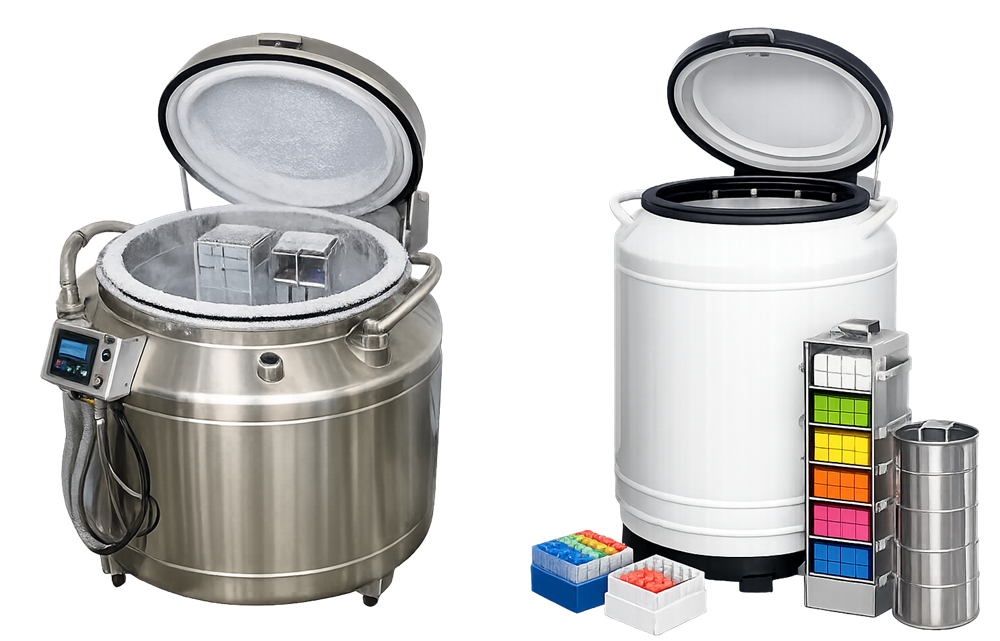
Liquid nitrogen cryogenic storage systems are widely used in pharmaceutical, biotechnology, and research environments for preservation of biological materials that require extremely low temperatures. These systems are commonly used for long-term storage of cell banks, microbial cultures, biological samples, tissues, and reference materials. The images below show typical liquid nitrogen cryogenic storage vessels used for preservation of biological samples in pharmaceutical and research laboratories.
Liquid nitrogen maintains a temperature of approximately −196 °C, allowing biological materials to remain in a stable, suspended state for extended periods of time. At these temperatures biochemical activity is effectively halted, preserving the viability and integrity of stored materials.
Cryogenic storage systems typically consist of vacuum-insulated vessels designed to minimize heat transfer from the surrounding environment. Samples are stored in racks, canisters, or boxes that allow organized storage and retrieval while maintaining cryogenic conditions.
2. Cryogenic Storage System Design
2.1 Cryogenic Storage Vessels
Liquid nitrogen storage vessels, commonly referred to as cryogenic dewars or cryogenic storage tanks, are specifically engineered to maintain extremely low temperatures while minimizing heat transfer from the surrounding environment. These vessels are designed to store liquid nitrogen at approximately −196 °C, allowing long-term preservation of biological materials.
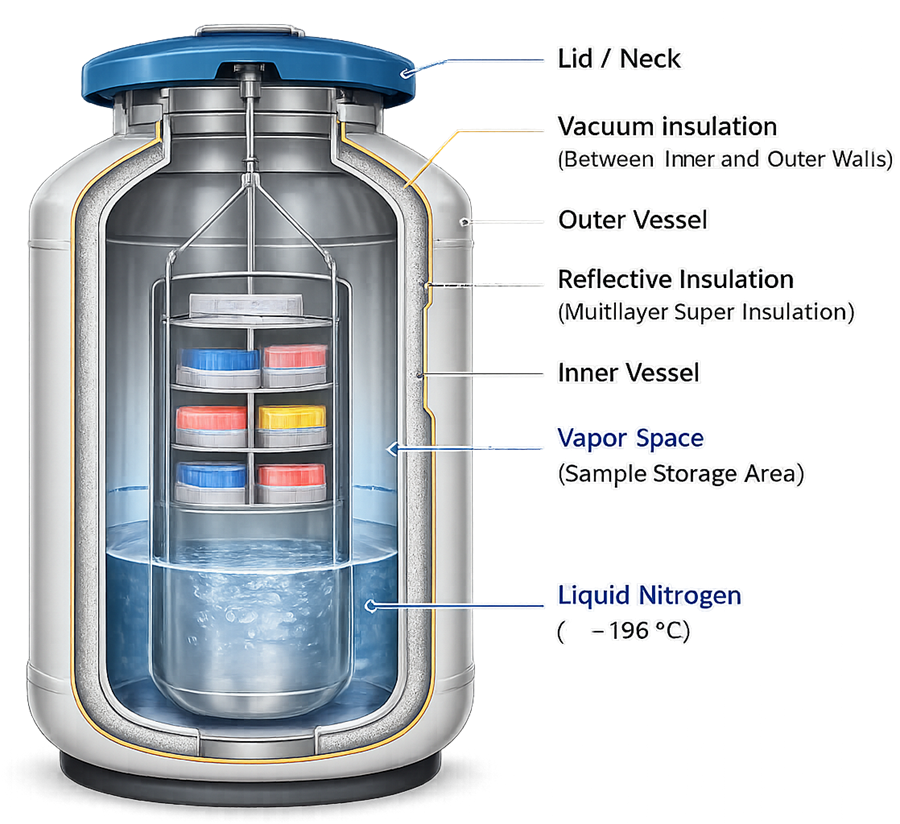
Cryogenic storage vessels typically use a double-wall construction consisting of an inner storage vessel and an outer protective shell. The space between these two walls is evacuated to create a high-vacuum insulation layer. This vacuum significantly reduces conductive and convective heat transfer from the surrounding environment into the cryogenic storage chamber. In addition to vacuum insulation, many cryogenic vessels incorporate multilayer reflective insulation within the vacuum space. These reflective layers reduce radiative heat transfer by reflecting thermal radiation away from the inner vessel. The combination of vacuum insulation and reflective insulation allows the vessel to maintain cryogenic temperatures with relatively low nitrogen evaporation rates.
The inner vessel contains the liquid nitrogen and the storage racks that hold biological samples. These racks typically support canisters or boxes containing cryogenic vials, straws, or other sample containers. The vessel opening at the top, often referred to as the neck, is designed to minimize heat entry while allowing access to storage racks.
In vapor-phase systems, samples are stored within the cold nitrogen vapor above the liquid nitrogen level. Temperatures within this vapor space remain extremely low because the evaporating nitrogen gas continuously absorbs heat from the surrounding environment. Additional design features commonly found in cryogenic storage vessels include:
- suspension systems for storage racks or canisters
- insulated lids designed to minimize heat ingress during storage
- structural supports that minimize thermal conduction between vessel walls
- ports for temperature sensors or liquid nitrogen level monitoring systems
These design features allow cryogenic storage vessels to maintain stable ultra-low temperatures for extended periods while minimizing nitrogen consumption. The diagram below illustrates the construction of a typical cryogenic storage vessel and highlights the major structural components and insulation systems used to maintain cryogenic conditions.
2.2 Storage Configurations
Cryogenic storage systems typically operate in one of two configurations:
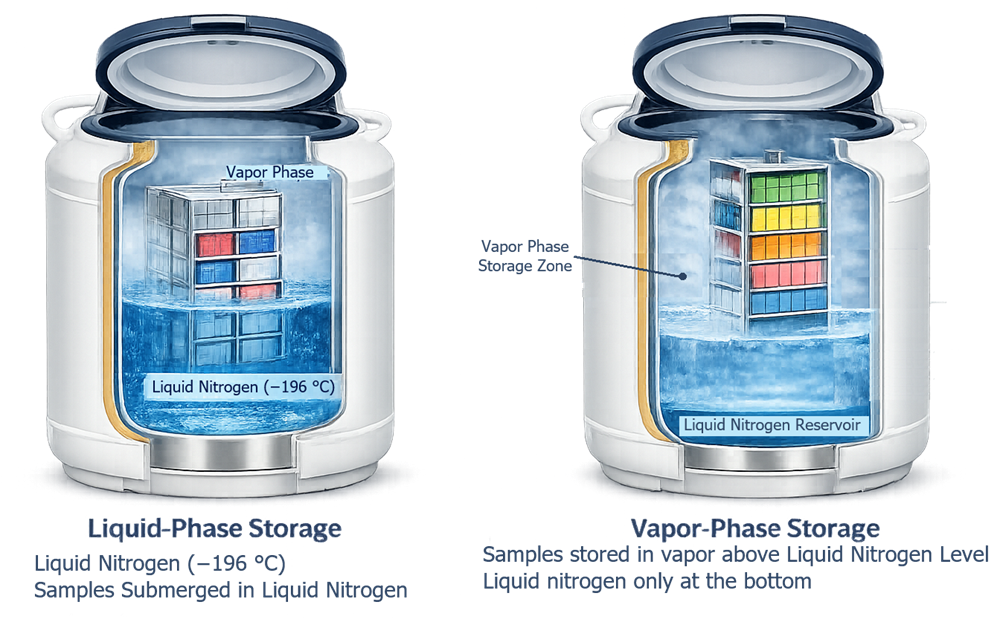
- Liquid-phase storage: Samples are stored directly in liquid nitrogen. This configuration provides extremely stable temperatures but may introduce a risk of cross-contamination if the liquid nitrogen becomes contaminated.
- Vapor-phase storage: Samples are stored above the liquid nitrogen surface within the cold nitrogen vapor space. Vapor-phase storage reduces cross-contamination risk and is widely used for cell banks and biological sample repositories.
In vapor-phase systems the temperature within the storage zone remains extremely low but may vary slightly depending on the distance from the liquid nitrogen surface and the liquid nitrogen level.
Diagram comparing liquid-phase storage where samples are submerged in liquid nitrogen and vapor-phase storage where samples are suspended above the liquid nitrogen surface in the cold vapor zone.
3. Temperature Characteristics of Cryogenic Storage
Cryogenic storage systems do not regulate temperature through mechanical refrigeration. Instead, extremely low temperatures are maintained through the Cryogenic storage systems maintain extremely low temperatures through the thermodynamic properties of liquid nitrogen, rather than through mechanical refrigeration. Liquid nitrogen boils at approximately −196 °C, and as it absorbs heat from the surrounding environment it continuously evaporates. This evaporation process removes heat from the vessel and maintains cryogenic conditions inside the storage chamber.
Because cooling is driven by the phase change of liquid nitrogen, temperature conditions inside the vessel are closely related to the liquid nitrogen level and the vertical position of stored materials. The region closest to the liquid nitrogen surface typically experiences the lowest and most stable temperatures. In contrast, the temperature within the upper vapor region may vary slightly as nitrogen gas warms while rising toward the vessel opening. Several factors can influence temperature behavior within the vapor storage region:
- liquid nitrogen level within the vessel
- vertical position of storage racks relative to the liquid surface
- storage rack and canister configuration
- frequency and duration of lid openings
- heat infiltration from the surrounding environment
For vapor-phase cryogenic storage systems, maintaining an adequate liquid nitrogen level is particularly important. If the nitrogen level drops too low, the temperature within the vapor storage zone may gradually increase, potentially exposing stored materials to conditions outside the intended cryogenic range.
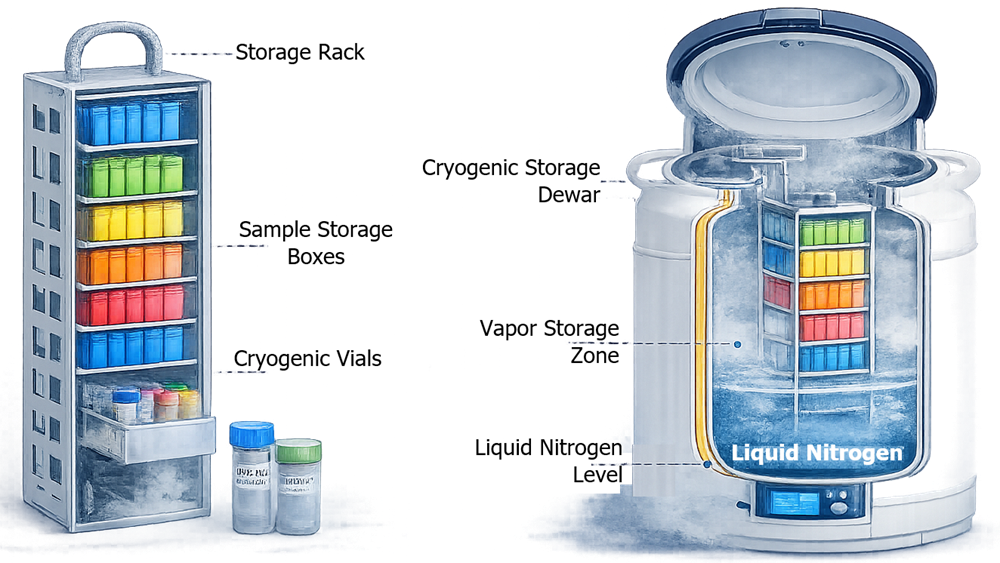
Cryogenic storage vessels therefore use structured rack and canister systems to organize samples at defined positions within the storage space. These racks suspend sample boxes or canisters vertically within the vessel, allowing samples to remain within the cold nitrogen vapor region while maintaining consistent spacing and organized retrieval.
The illustration below shows a typical cryogenic storage rack and sample organization system. Storage racks hold multiple stacked sample boxes that contain cryogenic vials, and the entire rack assembly is lowered into the cryogenic vessel so that samples remain within the controlled vapor storage zone above the liquid nitrogen surface.
4. Liquid Nitrogen Supply and Level Control
Cryogenic storage vessels rely on liquid nitrogen as the cooling medium, and the nitrogen inventory inside the vessel gradually decreases due to continuous evaporation. Even well-insulated dewars experience a steady boil-off rate as heat enters the vessel from the surrounding environment. Maintaining an adequate liquid nitrogen level is therefore essential to ensure that the storage region remains within the required cryogenic temperature range.
As liquid nitrogen evaporates, the remaining liquid level slowly decreases. If the level falls too low, the temperature within the storage region—particularly in vapor-phase systems—may begin to rise. For this reason, cryogenic storage installations are designed to provide reliable nitrogen replenishment and continuous monitoring of liquid level. Liquid nitrogen may be supplied to storage vessels using several different approaches depending on facility size and operational requirements:
- manual filling from portable dewars, typically used in small laboratories or low-volume storage applications
- transfer from centralized liquid nitrogen supply systems, where bulk tanks distribute nitrogen through insulated transfer lines
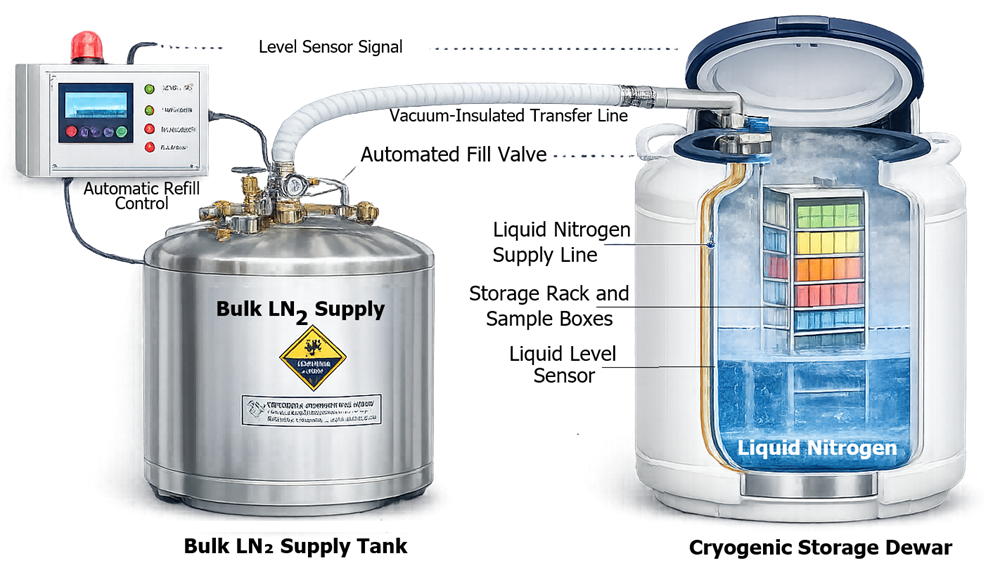
- automated refill systems, which maintain nitrogen levels using level sensors and controlled refill valves
In many modern installations, automated refill systems are used to maintain stable nitrogen levels with minimal operator intervention. These systems typically incorporate liquid nitrogen level sensors installed within the cryogenic vessel. The sensor continuously measures the nitrogen level and transmits this information to a control module or monitoring system. When the liquid nitrogen level falls below a predefined threshold, the control system activates an automated fill valve that allows liquid nitrogen to flow from the supply source into the storage vessel. Once the level rises to the upper setpoint, the valve closes and the refill cycle stops. This controlled refill process helps maintain stable cryogenic conditions while preventing overfilling.
Reliable level monitoring is critical because a sustained loss of liquid nitrogen can eventually result in gradual warming of the storage environment and potential loss of stored biological materials. For this reason, cryogenic storage systems typically incorporate additional safeguards such as:
- low nitrogen level alarms
- remote monitoring systems
- redundant level sensors in critical installations
- alarm notification to facility monitoring systems
The diagram below illustrates a typical configuration used in cryogenic storage installations, showing a liquid nitrogen supply source connected to a storage vessel equipped with level monitoring and an automatic refill control system.
5. Safety Systems and Oxygen Monitoring
Cryogenic storage systems present several safety considerations that must be addressed during installation and operation.
Liquid nitrogen expands rapidly when it evaporates, producing large volumes of nitrogen gas. In enclosed areas this gas can displace oxygen and create an oxygen-deficient atmosphere. For this reason, rooms containing cryogenic storage vessels typically include oxygen monitoring systems that continuously measure ambient oxygen concentration. These systems generally include:
- fixed oxygen sensors installed in the storage area
- audible and visual alarm indicators
- alarm thresholds commonly set near 19.5% oxygen concentration
- integration with facility monitoring systems where required
Proper ventilation is also typically provided in cryogenic storage areas to prevent accumulation of nitrogen gas. Personnel handling cryogenic systems must also protect against cold exposure hazards. Direct contact with liquid nitrogen or cryogenic surfaces can cause severe frostbite. Appropriate protective equipment such as insulated gloves and face protection is commonly required.
6. Monitoring and Alarm Systems
Cryogenic storage systems incorporate monitoring systems to ensure safe operation and protection of stored materials. Typical monitoring parameters include:
- liquid nitrogen level monitoring
- temperature monitoring within vapor storage regions
- alarm systems for low nitrogen levels
- alarm systems for abnormal temperature conditions
Monitoring systems provide early warning of conditions that could compromise stored materials or indicate failure of nitrogen supply systems.
7. Installation Qualification
Installation Qualification verifies that the cryogenic storage system and associated safety systems are installed correctly according to manufacturer specifications and facility requirements. Typical IQ activities include verification of:
- storage vessel identification and specifications
- vessel installation and physical integrity
- vacuum-insulated vessel construction
- connection to liquid nitrogen supply systems
- transfer line installation and insulation
- installation of level sensors and monitoring systems
- installation of oxygen monitoring systems
- alarm panel wiring and connections
- adequate room ventilation
Documentation such as equipment manuals, engineering drawings, and calibration certificates for monitoring sensors are also typically reviewed during installation qualification.
8. Operational Qualification
Operational Qualification confirms that the cryogenic storage system and monitoring components operate correctly under controlled conditions. Typical OQ testing may include:
- verification of liquid nitrogen level sensor operation
- testing of automatic refill systems
- verification of low-level alarm activation
- oxygen monitor alarm testing
- verification of monitoring system communication and alarm notification
- verification of temperature conditions within vapor storage zones
Operational testing ensures that monitoring systems and alarms function as intended and that nitrogen supply systems maintain stable cryogenic conditions.
9. Performance Qualification
Performance Qualification demonstrates that the cryogenic storage system consistently maintains appropriate storage conditions during routine operation. Typical PQ activities may include:
- verification of stable liquid nitrogen levels over extended operation
- evaluation of nitrogen consumption rates
- confirmation that vapor-phase storage temperatures remain within acceptable limits
- verification of system recovery after sample access
- evaluation of alarm response during simulated low nitrogen level conditions
These activities confirm that the cryogenic storage system reliably maintains conditions necessary for long-term preservation of stored biological materials.