
Periodic Equipment Assessment
Periodic Equipment Assessment is a structured, documented review performed to confirm that GMP-relevant equipment, systems, and utilities remain fit for their intended use and continue to operate in a state of control following initial qualification. Unlike initial validation, which establishes fitness for use, periodic assessment evaluates ongoing performance, emerging risks, and the continued adequacy of controls over time.
Periodic assessment is a key element of lifecycle validation and supports risk-based decisions related to maintenance, change management, and requalification.
Purpose of Periodic Equipment Assessment
The primary purpose of periodic equipment assessment is to provide objective evidence of continued control. It ensures that previously qualified equipment continues to meet GMP expectations and that changes in performance, usage, or operating conditions are identified and addressed proactively.
Periodic assessment supports:
- Verification of continued equipment performance
- Identification of adverse trends or recurring issues
- Confirmation that existing controls remain effective
- Input to risk-based requalification decisions
Periodic assessment does not replace validation or qualification activities. Instead, it complements them by providing lifecycle oversight.
Scope and Applicability
Periodic Equipment Assessment applies to GMP-relevant equipment, systems, and utilities that have the potential to impact:
- Product quality
- Patient safety
- Data integrity
- Regulatory compliance
The depth and frequency of periodic assessment are determined based on:
- Equipment criticality
- Results of the initial risk assessment
- Complexity of the system
- Operational history and performance data
Not all equipment requires the same level of review. A risk-based approach is applied to ensure assessment effort is proportionate to impact.
Assessment Frequency
Periodic assessments are performed at defined intervals established by procedure, risk assessment, or Quality requirements. The assessment interval may be adjusted based on:
- Equipment performance trends
- Deviation and CAPA history
- Changes to operating conditions or usage
- Results of previous periodic assessments
Periodic assessment intervals are not fixed by default and should not be calendar-driven without justification.
Data Sources Reviewed
Periodic Equipment Assessment relies on the review of objective, documented evidence. Typical data sources include, but are not limited to:
- Preventive and corrective maintenance records
- Calibration results and history
- Deviation, nonconformance, and investigation records
- CAPA status and effectiveness
- Alarm history and system logs
- Environmental or process monitoring data, where applicable
- Change control history
- Prior validation and qualification documentation
The selection of data sources is based on equipment type, function, and risk profile.
Assessment Methodology
The periodic assessment is conducted using a structured, documented approach. The assessment evaluates whether equipment performance remains consistent with validated and qualified conditions and whether new or increased risks have emerged.
Key considerations include:
- Equipment reliability and availability
- Frequency and severity of deviations
- Effectiveness of maintenance and calibration programs
- Adequacy of procedural and technical controls
- Evidence of adverse trends or recurring issues
The assessment focuses on trend evaluation, not isolated events.
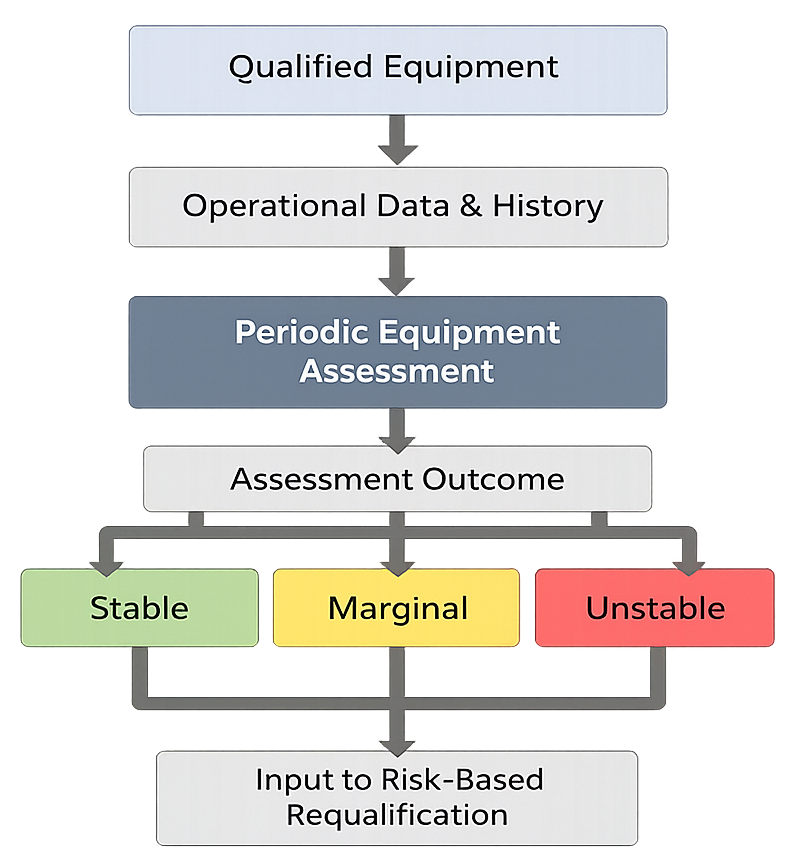
Assessment Outcomes
Based on the review of data and trends, equipment performance is typically categorized into one of the following conditions:
- Stable – Equipment performance is consistent and controlled, with no significant adverse trends
- Marginal – Isolated or emerging issues identified that require monitoring or minor corrective action
- Unstable – Recurrent issues or adverse trends indicating loss of control
These outcomes are documented and used to determine appropriate follow-up actions.
Actions Resulting from Periodic Assessment
Depending on the assessment outcome, actions may include:
- No action beyond continued monitoring
- Enhanced monitoring or increased assessment frequency
- Preventive maintenance or procedural updates
- Corrective actions or CAPA
- Input to requalification scope and interval decisions
Periodic assessment does not automatically trigger requalification. Instead, it provides documented input into risk-based decision-making.
Documentation and Review
Periodic Equipment Assessments shall be documented in a formal assessment record. The documentation includes:
- Scope of the assessment
- Data reviewed
- Summary of findings
- Assessment outcome
- Recommended actions
Periodic assessment records are reviewed and approved by appropriate roles, which may include the System Owner, Subject Matter Experts, and Quality Assurance, in accordance with established procedures.
Role of Periodic Assessment in Requalification
The Periodic Equipment Assessment does not, by itself, define requalification requirements. Instead, it provides objective, documented evidence regarding the ongoing performance and control of equipment, systems, and utilities.
The outcomes of the Periodic Equipment Assessment are evaluated together with:
- The initial risk assessment
- Equipment criticality
- Change history
- Deviation and CAPA history
- Historical performance and trend data
This combined information is used to support risk-based decisions related to requalification, including:
- The appropriate scope of requalification activities
- The required depth of testing or verification
- The appropriate requalification interval
The process for determining requalification requirements based on risk and performance history is addressed in the Risk-Based Requalification article.
Conclussion
Periodic Equipment Assessment provides evidence of continued control and performance. Requalification decisions are made separately based on risk, performance history, and Quality oversight.ment confirms continued control. Risk-Based Requalification determines when and how requalification is required.