
QSR vs ISO 13485 in Medical Device Manufacturing
The Quality System Regulation QSR, established and enforced by the U.S. Food and Drug Administration, defines the mandatory quality system requirements for medical device manufacturers marketing products in the United States. QSR is codified in 21 CFR Part 820 and is legally binding for any organization that designs, manufactures, packages, labels, or services medical devices intended for the US market.
ISO 13485, developed by the International Organization for Standardization, is an internationally recognized quality management system standard applicable to medical device manufacturers worldwide. While ISO 13485 is not a regulation, it is widely adopted and often required by customers, notified bodies, and foreign regulatory authorities.
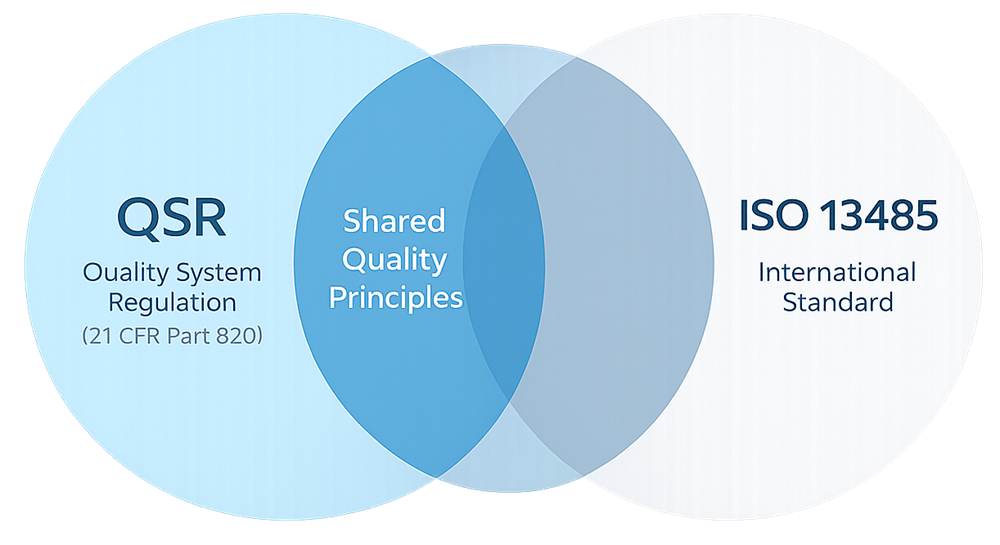
Both frameworks are built around the same fundamental objective: ensuring that medical devices are safe, effective, and consistently manufactured. However, they differ significantly in regulatory intent, structure, and enforcement.
Regulatory Scope and Compliance Expectations
QSR is a federal regulation with direct legal authority in the United States. Compliance is mandatory, and enforcement is carried out through FDA inspections and regulatory actions. Failure to comply may result in Form 483 observations, warning letters, product seizures, or restrictions on market access.
ISO 13485 is a voluntary standard, but in practice it is often contractually or commercially required. Compliance is assessed through third-party certification audits rather than government inspection. Loss of certification may impact market access and customer confidence but does not carry direct legal enforcement.
In practical terms, ISO 13485 supports global market participation, while QSR determines whether a medical device may be legally marketed in the United States.
Quality System Structure and Documentation
QSR specifies a set of required, device-centric records that form the backbone of FDA inspection activities. These include the Design History File, Device Master Record, and Device History Record. The regulation is prescriptive in defining what documentation must exist and how it supports traceability across the product lifecycle.
ISO 13485 requires the establishment of a formal quality management system, including a quality manual, documented procedures, and supporting records. While documentation is required, the standard allows greater flexibility in how records are structured and maintained, provided the system is effective and controlled.
As a result, QSR tends to drive documentation toward regulatory defensibility, while ISO 13485 emphasizes system consistency and manageability.
Design and Development Controls
QSR includes explicit design control requirements intended to ensure that medical devices meet user needs and intended use. These controls require documented design planning, defined design inputs and outputs, design reviews, verification, validation, and controlled design transfer into production. Design controls are among the most frequently scrutinized elements during FDA inspections.
ISO 13485 also addresses design and development activities, but places greater emphasis on integrating these activities into the overall quality management system. While the underlying concepts are aligned, QSR is more prescriptive in terminology and execution.
Organizations certified to ISO 13485 must still ensure that their design controls meet the specific expectations defined in QSR when operating in the US market.
Validation and Manufacturing Controls
Both QSR and ISO 13485 require validation of processes where outputs cannot be fully verified by subsequent inspection or testing. This includes manufacturing processes, sterilization, cleaning, and automated operations.
QSR places strong emphasis on documented evidence demonstrating that validated processes consistently produce conforming product. FDA inspectors routinely expect to see structured qualification and validation activities supported by clear acceptance criteria and traceable results.
ISO 13485 incorporates process validation into a broader, risk-based quality system framework. In practice, traditional validation methodologies such as IQ, OQ, and PQ are acceptable under both standards when applied with appropriate rigor.
Post-Market Controls and Oversight
ISO 13485 includes explicit requirements for post-market surveillance activities across global markets, including feedback mechanisms, trend analysis, and continuous improvement. These requirements are closely aligned with international regulatory expectations.
QSR addresses post-market activities through complaint handling, corrective and preventive action, and management review requirements. While effective when properly implemented, these requirements are less explicit than those defined in ISO 13485.
Many manufacturers use ISO 13485 frameworks to strengthen post-market controls beyond the minimum expectations of QSR.
Practical Interpretation
ISO 13485 certification demonstrates quality system maturity and supports global market access, but it does not replace compliance with the Quality System Regulation. For manufacturers selling medical devices in the United States, QSR compliance is mandatory and directly enforceable.
The most resilient quality systems are designed to satisfy ISO 13485 requirements while fully meeting QSR expectations through conservative validation practices, disciplined documentation, and effective change control. Organizations that rely solely on ISO certification without addressing QSR-specific requirements often encounter compliance gaps during FDA inspection.