
Quality System Regulation: Validation Requirements for Medical Devices
Quality System Regulation QSR — 21 CFR Part 820
21 CFR Part 820, commonly referred to as the Quality System Regulation QSR, establishes the regulatory baseline for the design, manufacture, packaging, labeling, storage, installation, and servicing of medical devices marketed in the United States. The regulation is issued and enforced by the U.S. Food and Drug Administration and is intentionally lifecycle-oriented, emphasizing prevention, control, and documented evidence over after-the-fact testing.
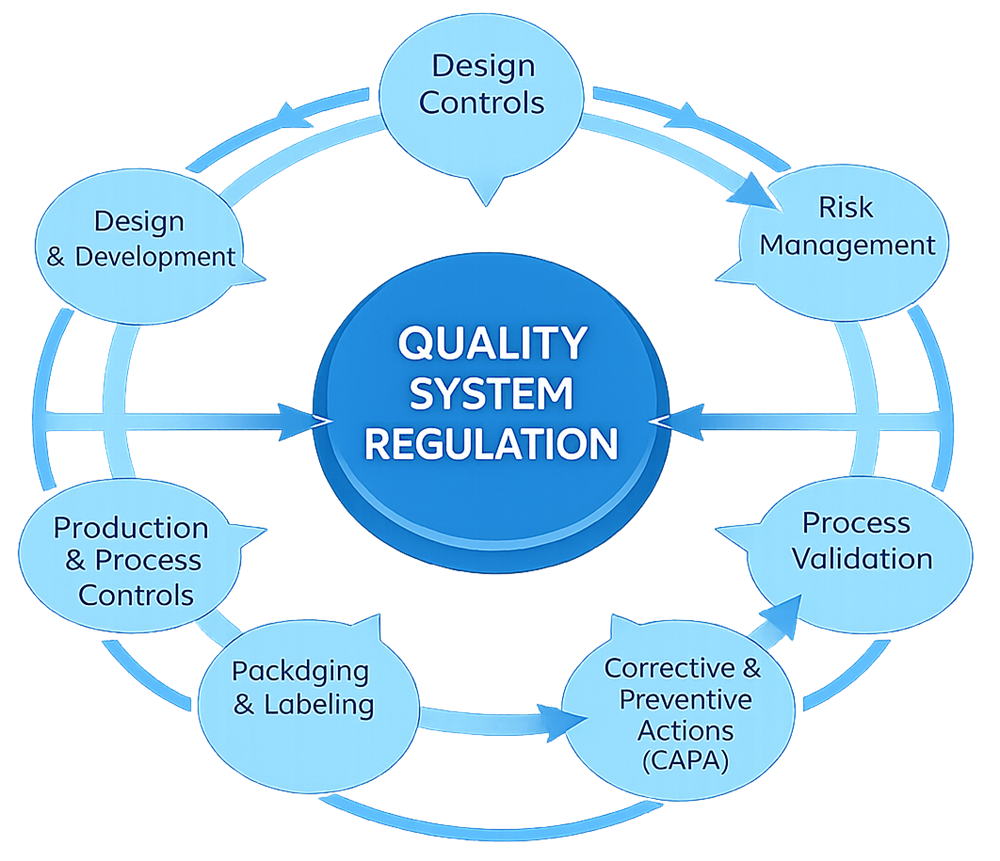
From a validation perspective, Part 820 is not optional guidance. It is a legally enforceable requirement and a frequent focal point during FDA inspections. Organizations that approach QSR validation casually tend to learn the hard way.
Purpose and Regulatory Intent
The purpose of the QSR is to ensure that medical devices are safe, effective, and consistently manufactured in accordance with their intended use. Validation under Part 820 serves three core objectives:
- Demonstrate that design outputs meet user needs and intended use
- Prove that manufacturing processes consistently produce conforming product
- Ensure that changes, deviations, and failures are systematically controlled
In practical terms, validation is the mechanism by which manufacturers translate quality-system theory into operational reality.
Key Validation Requirements Under 21 CFR Part 820
Design Controls — § 820.30
Design validation is foundational for medical devices and is frequently cited in FDA warning letters.
Manufacturers are required to establish and maintain procedures that ensure:
- Design inputs are clearly defined, complete, and unambiguous
- Design outputs are measurable and verifiable against inputs
- Design validation confirms that the device conforms to defined user needs and intended uses
- Validation activities are completed prior to commercial distribution
Design validation typically includes clinical evaluation, usability testing, simulated use testing, and where applicable, software validation. Informal design reviews do not meet regulatory expectations.
Process Validation — § 820.75
Any process where the output cannot be fully verified by subsequent inspection or testing must be validated.
This includes, at minimum:
- Manufacturing and assembly processes
- Sterilization and cleaning processes
- Environmental controls impacting product quality
- Automated or semi-automated operations
Process validation must demonstrate that the process operates within established parameters and consistently produces conforming product. The classic IQ OQ PQ model remains a defensible and regulator-friendly approach when executed with discipline.
Software Validation — § 820.30 g
Software validation is required for:
- Embedded device software
- Manufacturing and automation systems
- Quality system software used for data capture, analysis, or decision-making
Manufacturers must provide documented evidence that software:
- Meets defined functional and performance requirements
- Performs reliably under normal and worst-case conditions
- Maintains data integrity and traceability
From an inspection standpoint, undocumented software assumptions are indefensible. If software influences quality decisions, it must be validated.
Packaging Validation — § 820.130
Packaging validation ensures that medical devices are protected throughout their shelf life and distribution cycle.
Validation activities typically address:
- Package integrity and seal strength
- Protection against environmental and mechanical stress
- Compatibility with sterilization methods
- Shelf-life and aging studies where applicable
Packaging failures are viewed by regulators as direct patient-risk events, not cosmetic issues.
Labeling Validation — § 820.120
Labeling controls extend beyond proofreading.
Validation must confirm that labels:
- Are accurate, legible, and compliant with regulatory requirements
- Match the approved device configuration and intended use
- Are correctly applied and remain durable through distribution and storage
Mislabeling is one of the fastest ways to escalate a routine inspection into a compliance event.
Production and Process Controls — § 820.70
This section mandates the establishment of controlled manufacturing conditions, including:
- Documented production procedures
- Defined equipment settings and tolerances
- Environmental and contamination controls
- Change control and deviation management
From a validation standpoint, § 820.70 ties together equipment qualification, process validation, and ongoing process monitoring. Validation is not a one-time exercise but an operational state that must be maintained.
Compliance Reality Check
QSR validation is not about generating paperwork to satisfy auditors. It is about proving control. Organizations that succeed under Part 820 typically share three traits:
- Conservative interpretation of regulatory expectations
- Structured, traceable validation documentation
- Respect for proven validation practices rather than shortcuts
FDA inspectors recognize rigor immediately. They also recognize improvisation just as fast.