
Refrigerators and Freezers
1. Overview of Refrigerators and Freezers
Refrigerators and freezers are widely used in pharmaceutical, biotechnology, clinical laboratory, and compounding environments for the storage of temperature-sensitive materials. These units maintain controlled thermal conditions required to preserve the stability, potency, and integrity of drug products, biological materials, reagents, and reference standards. Common storage ranges include:
- 2–8 °C refrigerators used for vaccines, sterile drug products, reagents, and temperature-sensitive raw materials
- −20 °C freezers used for intermediate biological materials, reagents, and retained samples
- −70 to −80 °C ultra-low freezers used for long-term storage of biological samples, cell banks, and reference standards
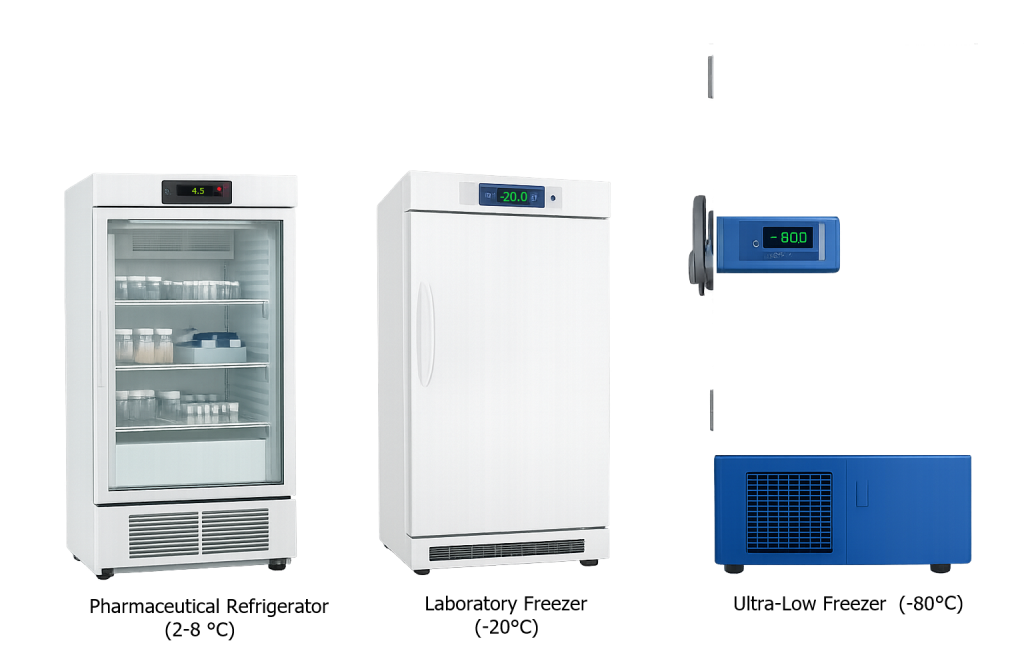
The illustration below presents typical examples of controlled laboratory and pharmaceutical storage units including a pharmaceutical refrigerator, a −20 °C laboratory freezer, and an ultra-low −80 °C freezer.
Because stored materials may degrade rapidly outside defined temperature limits, refrigerators and freezers used in regulated environments must demonstrate reliable temperature control, acceptable temperature uniformity, and effective alarm functionality. Qualification activities confirm that the equipment performs consistently under expected operating conditions.
2. Design Characteristics of Pharmaceutical Refrigerators and Freezers
2.1 Refrigeration System Architecture
Most laboratory and pharmaceutical refrigeration units operate using a vapor-compression refrigeration cycle consisting of:
- compressor
- condenser
- expansion device
- evaporator coil
The diagram below illustrates the main components of a typical refrigeration system and the heat transfer process that removes heat from the storage chamber.
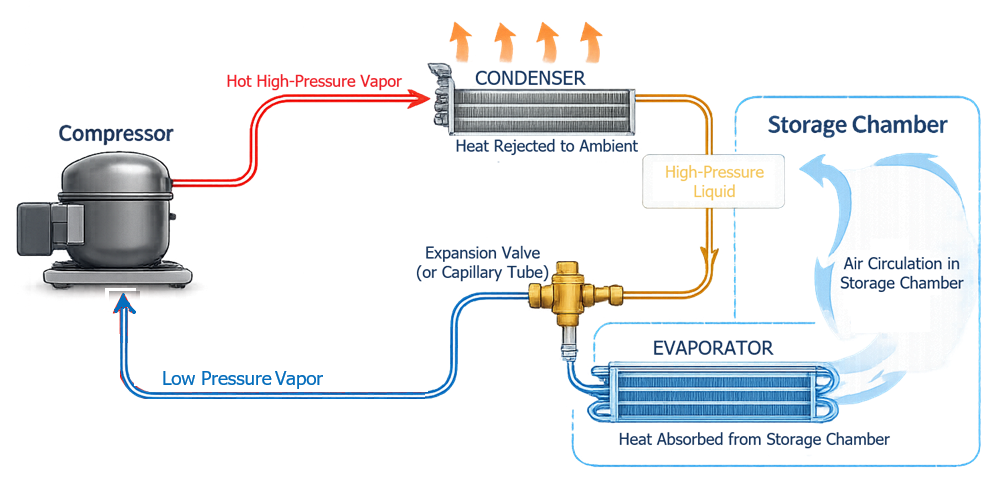
The compressor circulates refrigerant through the system. As refrigerant evaporates within the evaporator coil inside the storage chamber, heat is absorbed from the internal air. The condenser then removes this heat to the surrounding environment. Pharmaceutical-grade equipment typically includes enhanced airflow systems and digital temperature controllers to maintain tighter temperature stability than domestic appliances.
2.2 Air Circulation and Temperature Control
Temperature control inside pharmaceutical refrigerators and freezers is strongly influenced by internal airflow patterns. Most pharmaceutical-grade units incorporate internal circulation fans that distribute cooled air throughout the storage chamber. The evaporator and fan assembly typically supply cooled air into the chamber, which then circulates across shelves and stored materials before returning to the cooling unit.
Proper air circulation is essential for maintaining consistent temperature conditions across the storage space. Continuous airflow helps reduce vertical temperature stratification and improves temperature uniformity between upper and lower shelves as well as between the front and rear of the chamber.
However, airflow distribution inside the refrigerator is rarely perfectly uniform. Air circulation patterns can be significantly affected by several operational factors, including:
- shelving configuration
- storage containers and packaging geometry
- product loading density
- obstruction of airflow pathways
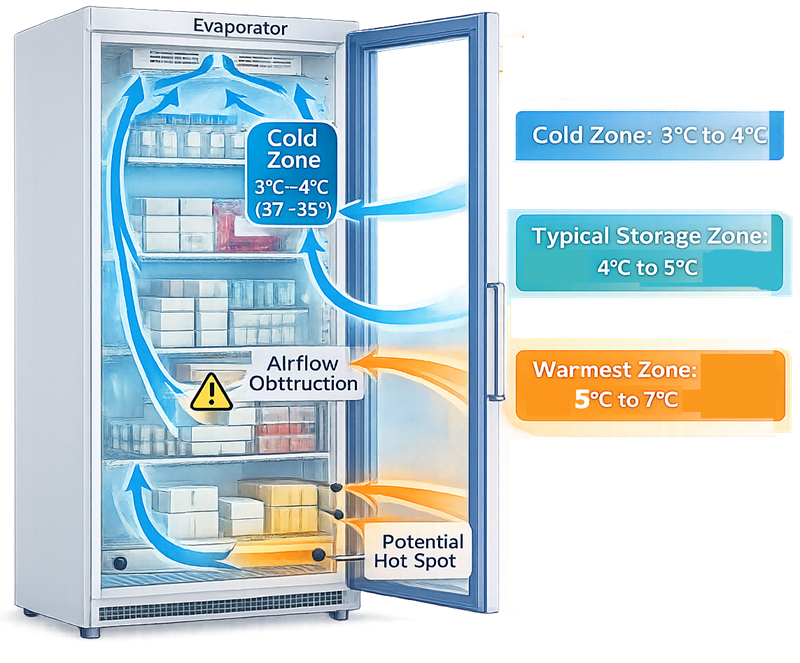
Dense storage arrangements or large containers may block airflow paths and create localized regions where cooling air circulation is reduced. These areas may develop warmer temperatures compared to surrounding regions of the chamber.
The illustration below demonstrates typical airflow circulation and temperature distribution inside a pharmaceutical refrigerator. Cooling air supplied by the evaporator fan circulates through the chamber, while product loading and airflow obstruction may influence temperature distribution across shelves and storage zones.
2.3 Single-Compressor vs Cascade Systems
Different refrigeration architectures are used depending on the temperature range. Refrigerators and −20 °C freezers typically use a single-compressor refrigeration system. Ultra-low freezers operating at −70 to −80 °C often use cascade refrigeration systems, where two compressors operate in series to achieve extremely low temperatures. Cascade systems improve thermal performance but introduce additional complexity in compressor control and heat rejection.
3. Temperature Control Behavior and Thermal Dynamics
3.1 Compressor Cycling
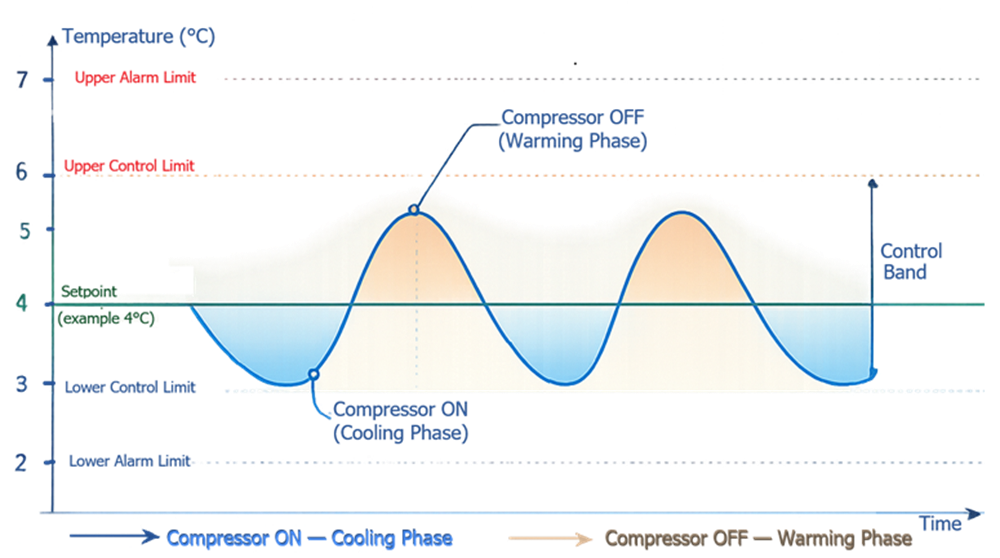
Refrigeration systems maintain temperature by cycling the compressor on and off around the configured setpoint. During compressor operation, heat is removed from the storage chamber and the internal air temperature gradually decreases. When the temperature reaches the controller’s lower control threshold, the compressor stops and the temperature slowly rises as heat enters the chamber from the surrounding environment. Once the upper control threshold is reached, the compressor starts again and the cooling cycle repeats.
This operating behavior produces a cyclic temperature pattern rather than a perfectly constant temperature. As a result, temperatures inside refrigerators and freezers naturally fluctuate within a defined control band around the setpoint during normal operation.
The illustration below demonstrates a typical temperature profile resulting from compressor cycling. The graph shows how temperature oscillates between upper and lower control limits as the compressor alternates between cooling and warming phases. During qualification and temperature mapping studies, these fluctuations are evaluated to verify that temperatures remain within acceptable operating limits.
3.2 Temperature Stratification
Even with forced airflow, refrigerators and freezers rarely maintain perfectly uniform temperatures throughout the chamber. Temperature differences may develop due to:
- vertical stratification between upper and lower shelves
- proximity to evaporator coils
- airflow obstruction caused by stored materials
- localized heat gain near doors
Stratification is particularly common in larger chambers and in units with high product loading.
3.3 Impact of Door Openings
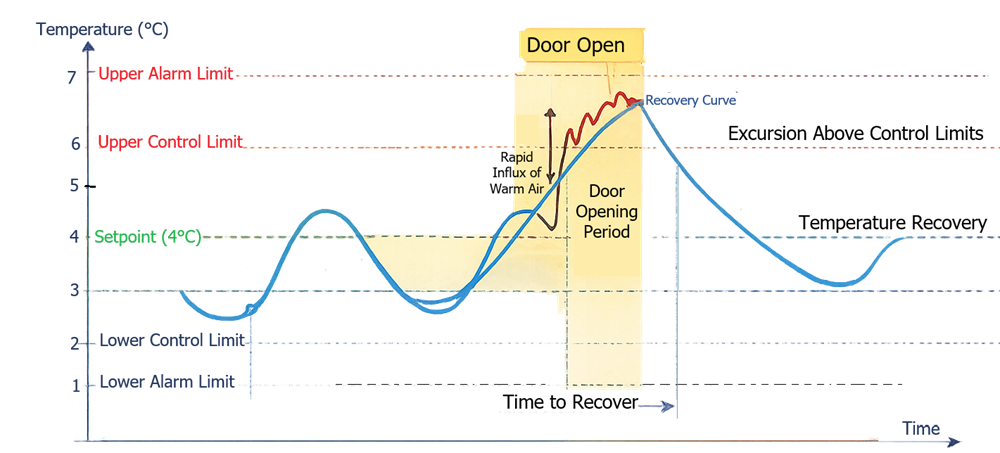
Door openings introduce warm ambient air into the storage chamber. The magnitude of the temperature excursion depends on several factors:
- duration of door opening
- ambient room temperature
- storage load mass
- internal air circulation efficiency
Following a door opening event, the refrigeration system must remove the introduced heat and restore the chamber to the target temperature. The chart below illustrates the effect of door opening on the internal temperature recovery profile in a refrigerated storage unit.
4. Defrost Cycles and Their Impact on Temperature Stability
Freezers and some refrigerator designs incorporate automatic defrost cycles to prevent the accumulation of ice on evaporator coils. Frost formation occurs as moisture from the chamber air condenses and freezes on the cold evaporator surfaces during normal cooling operation. If not periodically removed, this frost layer can reduce heat transfer efficiency and restrict airflow across the evaporator.
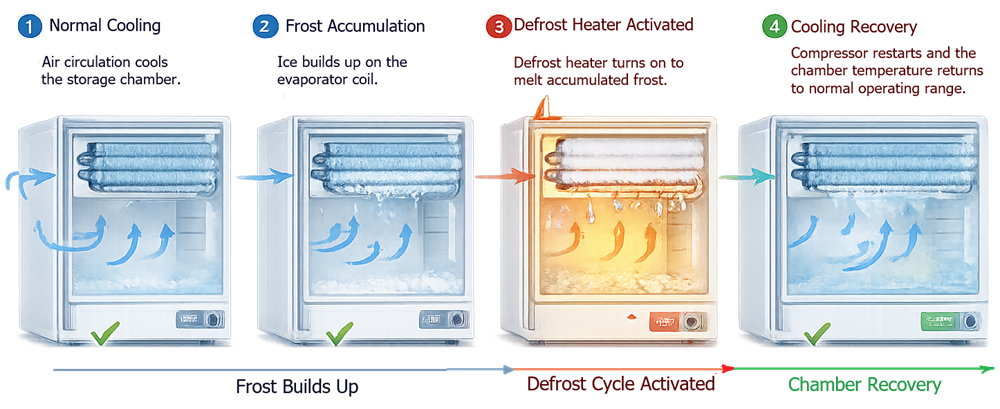
During a defrost event the normal cooling process is temporarily interrupted. Depending on the equipment design, electric heaters or controlled warming cycles are activated to melt accumulated frost on the evaporator coil. While this process restores cooling efficiency, it can also introduce additional heat into the refrigeration system.
As a result, defrost cycles may cause temporary increases in chamber temperature until the refrigeration system resumes normal cooling operation and the temperature returns to the setpoint range. The magnitude of these temperature fluctuations depends on several factors, including:
- defrost frequency
- defrost duration
- chamber load mass
- insulation efficiency
The illustration below demonstrates the typical sequence of events during a defrost cycle, including normal cooling operation, frost accumulation on the evaporator coil, activation of the defrost heater, and recovery of chamber temperature once cooling resumes.frost cycles to ensure stored materials remain within acceptable temperature limits.
5. Influence of Product Loading and Storage Configuration
5.1 Thermal Mass Effects
Stored materials act as thermal mass that influences temperature stability inside the chamber. Higher thermal mass generally stabilizes temperature fluctuations because stored materials absorb and release heat slowly. However, excessive loading can obstruct airflow and create localized temperature gradients.
5.2 Airflow Obstruction
Improper loading patterns may block airflow pathways generated by internal circulation fans. When airflow is restricted, certain areas of the chamber may experience:
- warmer zones due to insufficient cooling airflow
- colder zones near evaporator outlets
Storage practices should therefore maintain adequate spacing between stored materials to allow air circulation.
5.3 Shelf and Container Influence
Shelving materials, container geometry, and packaging density also influence temperature distribution. Solid shelves may reduce vertical airflow, while wire shelving generally improves circulation.
Large storage containers placed near airflow outlets can redirect cooling airflow and alter temperature distribution patterns.
6. Sensor Placement and Monitoring Considerations
6.1 Control Sensors
Refrigerators and freezers rely on internal temperature control sensors to regulate compressor operation and maintain the configured setpoint. These sensors provide feedback to the temperature controller, which cycles the compressor on and off within the defined control band. Control sensors are typically positioned by the manufacturer in locations that represent the average chamber temperature or the primary airflow path near the evaporator outlet. The placement is designed to allow stable temperature regulation while preventing excessive compressor cycling.
Because these sensors control the refrigeration system directly, their accuracy, calibration status, and proper functioning are critical for maintaining stable temperature conditions within the storage chamber.
6.2 Monitoring Sensor Placement
In regulated environments, refrigerators and freezers are commonly equipped with independent monitoring sensors used to verify actual storage conditions within the chamber. Sensor placement is often determined based on temperature distribution studies and commonly includes locations such as:
- representative product storage zones
- previously identified warmest locations
- areas susceptible to temperature variation
In many installations, monitoring probes are buffered using glycol, glass beads, or other thermal media. Sensor buffering reduces the influence of short-term air temperature fluctuations and produces readings that more closely reflect the temperature of stored materials rather than rapid changes in circulating air.
7. Qualification Considerations for Refrigerators and Freezers
Refrigerators and freezers used in regulated environments must demonstrate consistent temperature control, reliable alarm performance, and acceptable temperature distribution throughout the storage chamber. Qualification testing evaluates how the equipment performs under expected operating conditions and verifies that critical control and safety functions operate correctly. Typical qualification testing evaluates the following performance characteristics:
- stable compressor cycling around the configured temperature setpoint
- acceptable temperature uniformity within the storage chamber
- recovery performance following door opening events
- temperature behavior during automatic defrost cycles
- reliability of temperature display and control functions
- proper operation of local alarm functions
- response of monitoring system alarms where monitoring probes are installed
- temperature stability during simulated power interruption events
Temperature distribution studies are performed to identify the warmest and coldest locations within the storage chamber. These studies support verification of temperature uniformity and help determine appropriate locations for routine monitoring sensors.
Additional qualification testing may evaluate the influence of representative product loading conditions. Storage configurations and product mass can significantly affect airflow patterns and temperature distribution within the chamber.
Power interruption testing is often performed to evaluate how the unit responds to electrical power loss. This testing may confirm proper alarm activation, controller restart behavior, and the ability of the equipment to return to stable operating conditions once power is restored.
8. Local Alarm Functions
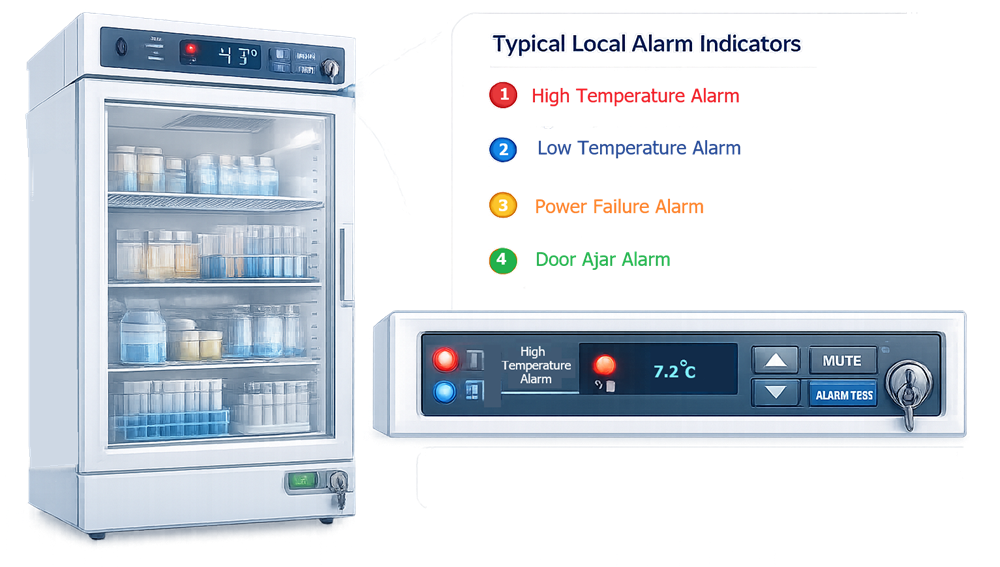
Most pharmaceutical refrigerators and freezers include built-in alarm functions designed to alert operators when abnormal conditions occur. These alarms provide immediate notification when storage temperatures deviate from acceptable limits or when equipment operation is interrupted. Common local alarms include:
- high temperature alarm
- low temperature alarm
- door open alarm
- power failure alarm
These alarms are typically indicated through audible signals and visual indicators located on the equipment control panel. Audible alarms alert nearby personnel, while visual indicators provide confirmation of the specific alarm condition. The illustration below shows a typical laboratory refrigerator control panel with common local alarm indicators used to alert operators to high temperature, low temperature, power failure, and door open conditions.
Local alarms provide immediate notification of abnormal conditions at the equipment level and allow operators to respond quickly to potential temperature excursions or equipment malfunctions.