
Risk-Based Requalification
Risk-Based Requalification is a structured, documented process used to determine when requalification is required, to what extent it should be performed, and at what interval, based on risk and objective performance evidence. Unlike calendar-driven requalification programs, a risk-based approach ensures that requalification activities are commensurate with equipment criticality, historical performance, and demonstrated state of control. Risk-based requalification decisions are made using inputs from the initial risk assessment, Periodic Equipment Assessment outcomes, change history, and Quality oversight.
Purpose of Risk-Based Requalification
The purpose of risk-based requalification is to ensure that GMP-relevant equipment, systems, and utilities continue to operate in a validated and qualified state throughout their lifecycle, while avoiding unnecessary or redundant requalification activities.
Risk-based requalification supports:
- Continued assurance of product quality and patient safety
- Efficient allocation of validation resources
- Timely identification of loss of control
- Defensible extension or modification of requalification intervals
Requalification is not performed as a routine administrative exercise. It is a Quality decision based on risk and evidence.
Principles of Risk-Based Requalification
Risk-based requalification is governed by the following principles:
- Requalification decisions are evidence-based, not calendar-driven
- Equipment criticality determines baseline requalification expectations
- Stable performance supports extended or reduced requalification scope
- Adverse trends or recurring issues increase requalification rigor
- Quality has final authority over requalification decisions
These principles ensure that requalification remains aligned with actual risk.
Inputs to Risk-Based Requalification Decisions
Risk-based requalification decisions are not based on a single activity or assessment. They are derived from a consolidated evaluation of post-mitigation risk and demonstrated equipment performance, supported by documented evidence across the equipment lifecycle.
Inputs to risk-based requalification decisions include:
- Post-remediation risk levels for individual equipment risk factors, as established through initial risk assessment activities
- Periodic Equipment Assessment results, including confirmation of continued control, performance trends, and identification of recurring or emerging issues
- Operational and Quality history, such as deviations, investigations, CAPAs, and maintenance effectiveness
- Change history, including changes to configuration, intended use, operating conditions, or control strategy
These inputs are reviewed collectively to determine the overall equipment risk classification, which serves as the basis for defining requalification scope, depth, and interval.
Composite Equipment Risk Determination
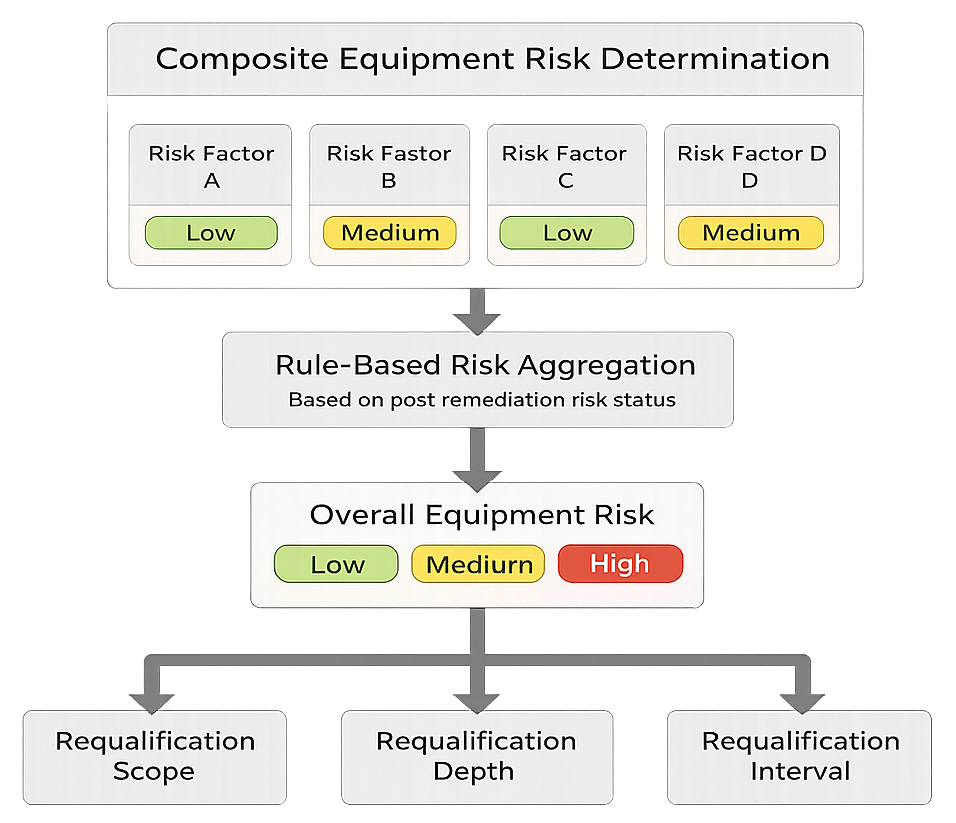
The overall equipment risk classification is determined based on the post-remediation risk status of all individual risk factors associated with the equipment. Risk factors may include, but are not limited to, equipment function, control strategy, utility dependency, automation, data integrity, maintenance history, and environmental exposure.
Composite risk determination is performed using a rule-based approach to ensure consistency, objectivity, and defensibility.
Rule-Based Risk Classification Logic
| Final Risk Composition | Overall Equipment Risk |
|---|---|
| Any single factor remains High after remediation | High |
| Two or more factors remain Medium after remediation | Medium |
| All factors are Low after remediation | Low |
The composite equipment risk classification represents the final risk position of the equipment following implementation of mitigation measures and confirmation of ongoing control through periodic assessment.
Use of Composite Risk in Requalification Decisions
The composite equipment risk classification is used to support risk-based decisions related to requalification, including:
- Requalification scope — which elements of the equipment or system require requalification
- Requalification depth — the extent of testing or verification required
- Requalification interval — how frequently requalification activities are performed
Higher composite risk classifications result in increased rigor, broader scope, and shorter requalification intervals. Lower composite risk classifications support reduced scope, limited depth, or extended intervals, when justified and approved.
Requalification decisions are documented and subject to Quality review and approval.
Lifecycle Perspective
Initial risk assessment establishes expected controls.
Periodic Equipment Assessment confirms ongoing performance.
Composite risk determination defines the current risk position.
Risk-Based Requalification determines when and how qualification is re-established.
Determination of Requalification Scope
Requalification scope defines what elements of a system require requalification. Scope may include all or a subset of the following, depending on risk:
- Installation aspects
- Operational controls and alarms
- Performance verification
- Interfaces with other systems
- Supporting utilities
Systems with stable performance and no significant changes may require limited or targeted requalification, while systems with adverse trends or significant changes may require expanded scope.
Determination of Requalification Depth
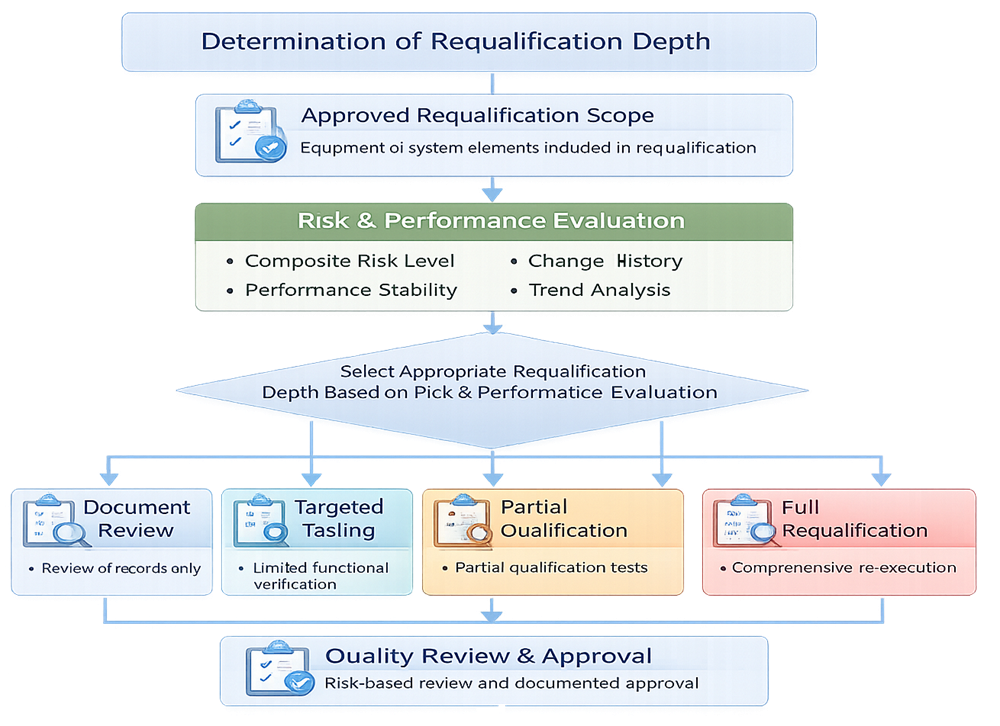
Requalification depth defines how extensively requalification activities are performed for the equipment or system elements included within the approved requalification scope. Requalification depth is not equivalent to scope; rather, it defines the level of verification or testing applied to the selected scope.
Requalification depth is determined based on:
- The overall equipment risk classification
- Confidence in continued control based on periodic assessment
- Performance history and trend stability
- Nature and impact of changes or deviations
Requalification depth may include one or more of the following approaches:
- Documentation review only
Review of change records, maintenance history, deviations, and prior qualification data to confirm continued control. - Targeted functional testing
Verification of specific functions, alarms, controls, or parameters identified as risk-relevant. - Partial qualification activities
Execution of selected qualification tests within the approved scope, without full re-execution of all qualification phases. - Full requalification
Comprehensive re-execution of qualification activities when loss of control, significant change, or high residual risk is identified.
Requalification depth is adjusted based on documented evidence and risk, not on precedent or fixed schedules.
Determination of Requalification Interval
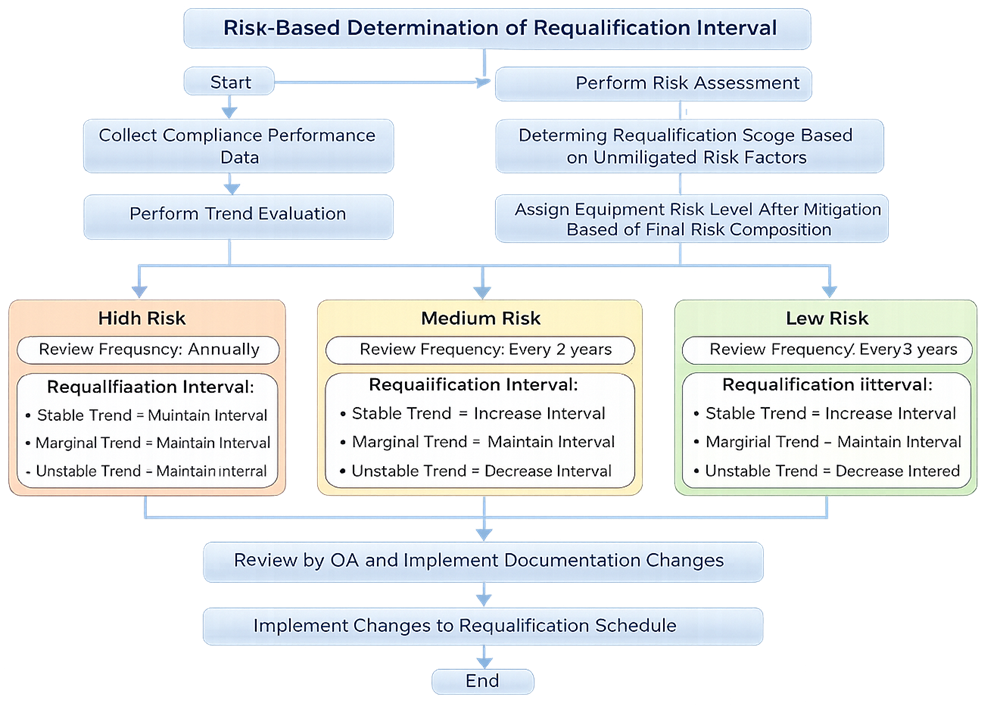
The requalification interval defines how often requalification activities are performed for equipment, systems, or utilities. Requalification intervals are not fixed by default and are established using a risk-based approach that considers both residual risk and demonstrated performance over time.
Requalification interval determination is based on a structured evaluation of the following factors:
- Overall equipment risk classification, as determined through composite risk evaluation
- Stability demonstrated through periodic equipment assessment, including trend analysis
- Frequency, severity, and recurrence of deviations or failures
- Effectiveness of preventive and corrective controls, including maintenance and monitoring
- Changes to operating conditions, configuration, or intended use
Based on this evaluation, the requalification interval may be:
- Maintained, when performance is stable and risk remains controlled
- Extended, when sustained control and low residual risk are demonstrated
- Shortened, when increased risk, adverse trends, or loss of control are identified
Extended requalification intervals shall be justified and documented, including supporting performance data and Quality approval. Reduced requalification intervals are applied when elevated risk or deteriorating performance is identified and shall be documented accordingly.
The following flowchart illustrates a risk-based approach to requalification interval determination, incorporating performance data review, trend evaluation, residual risk classification, and Quality oversight.
Triggers for Requalification Outside Planned Intervals
Requalification may be required outside of scheduled intervals when triggered by events such as:
- Significant deviations or failures
- Loss of control identified during periodic assessment
- Major changes under change control
- Repeated CAPAs or unresolved issues
- Regulatory observations or commitments
These triggers require evaluation and documented justification.
Documentation of Requalification Decisions
Risk-based requalification decisions shall be documented and include:
- Summary of inputs reviewed
- Rationale for scope, depth, and interval decisions
- Linkage to risk assessment and periodic assessment outcomes
- Quality review and approval
Documentation ensures traceability and defensibility.
Quality Oversight and Approval
Quality Assurance is responsible for:
- Reviewing requalification rationale
- Confirming alignment with risk and performance data
- Approving requalification scope, depth, and interval
Requalification decisions are not finalized without Quality approval.
Lifecycle Integration
Risk-Based Requalification is not a standalone activity. It is integrated into the validation lifecycle and relies on continuous feedback from risk assessment and periodic assessment activities.
Lifecycle Integration
Initial Risk Assessment defines expected controls. Periodic Equipment Assessment confirms ongoing performance. Risk-Based Requalification determines when and how qualification is re-established.