
Temperature Monitoring and Alarm Systems
1. Introduction
Temperature-controlled storage equipment must maintain environmental conditions within defined limits to ensure the quality and stability of stored materials. Continuous monitoring systems are therefore used to track temperature conditions during routine operation and to detect deviations from acceptable storage ranges.
Temperature monitoring systems typically consist of environmental sensors installed within the storage space, a monitoring controller or data acquisition unit, alarm notification functions, and software used for data recording and review. These systems operate continuously to provide documented evidence that storage conditions remain within acceptable limits.
Thermal mapping studies performed during qualification establish temperature distribution characteristics and identify worst-case monitoring locations. Monitoring probes used for routine control are normally installed at these locations to ensure that any deviation from acceptable storage conditions is detected as early as possible.
2. Temperature Monitoring System Architecture
2.1 System Components
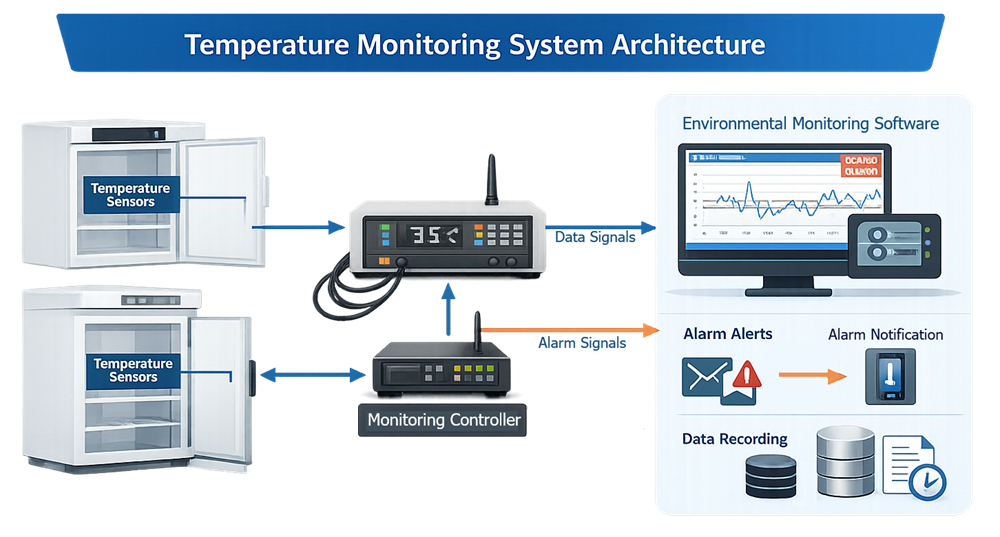
Temperature monitoring systems consist of environmental sensors installed within storage equipment, data acquisition hardware that collects measurement signals, and monitoring software that records temperature data and manages alarm notifications. These components operate together to provide continuous verification that storage conditions remain within acceptable limits. Typical system elements include:
- temperature sensors or monitoring probes
- local monitoring transmitters or controllers
- data acquisition hardware
- monitoring software or environmental monitoring system
- alarm notification functions
Sensors measure environmental temperature within the storage space and transmit measurement signals to a monitoring controller or environmental monitoring system where data is recorded and evaluated.
The diagram below illustrates the typical architecture of a temperature monitoring system, showing the relationship between storage sensors, monitoring controllers or transmitters, environmental monitoring software, alarm notification functions, and historical data recording.
2.2 Environmental Monitoring Systems
Many pharmaceutical facilities implement centralized environmental monitoring systems that collect temperature data from multiple pieces of equipment across the facility. These systems may be integrated with facility automation infrastructure or operated as independent monitoring platforms. Monitoring software typically provides:
- continuous temperature recording
- alarm monitoring and notification
- historical data storage
- trend visualization and reporting
Monitoring systems must be configured so that temperature measurements are recorded with appropriate timestamps and preserved as permanent records.
3. Monitoring Probe Placement
3.1 Relationship Between Thermal Mapping and Monitoring
Thermal mapping studies performed during qualification characterize temperature distribution within the storage equipment and identify locations where the highest or lowest temperatures consistently occur within the mapped volume. These locations represent potential worst-case conditions within the storage space.
Routine monitoring probes are typically installed at these worst-case locations so that any deviation from acceptable storage conditions is detected conservatively during routine operation.
During qualification, a temperature mapping sensor is normally placed at the location of the routine monitoring probe so that the representativeness of the monitoring location can be verified as part of the temperature distribution study. If the monitoring probe location has not yet been established, the thermal mapping results are used to determine the worst-case temperature location within the storage space. The permanent monitoring probe is then installed at that location to ensure that routine monitoring reflects the most challenging storage condition.
3.2 Typical Probe Placement Locations
Monitoring probes are commonly installed in locations where temperature conditions represent the most challenging storage environment. Typical probe placement locations include:
- upper regions of refrigerators where warmer air accumulates
- locations near doors where temperature disturbances may occur
- areas identified during thermal mapping as hot or cold spots
- regions representing the primary product storage zone
Correct probe placement ensures that monitoring sensors accurately represent storage conditions experienced by stored materials.
4. Alarm Configuration
4.1 Temperature Alarm Limits
Monitoring systems must generate alarms when temperature conditions approach or exceed defined storage limits. Alarm thresholds are normally configured based on:
- validated storage temperature ranges
- product stability requirements
- operational response capabilities
Alarm limits are commonly configured slightly inside the defined storage limits to provide early warning before an actual excursion occurs.
4.2 Alarm Delay and Filtering
Short-term temperature fluctuations may occur during routine equipment operation, particularly when doors are opened or defrost cycles occur. Monitoring systems therefore often include alarm delay functions to prevent nuisance alarms. Alarm delay parameters allow brief transient deviations to occur without triggering alarm notifications while still detecting sustained temperature excursions.
4.3 Alarm Notification and Escalation
When alarm conditions occur, monitoring systems must notify responsible personnel so that corrective action can be taken. Notification mechanisms may include:
- local audible alarms
- visual indicators on equipment panels
- electronic notifications such as email or text messages
- integration with facility alarm management systems
Alarm escalation procedures may also be configured so that unresolved alarms are automatically communicated to additional personnel.
5. Alarm Response and Investigation
Temperature monitoring systems are configured to generate alarms when measured conditions approach or exceed defined storage limits. When an alarm Temperature monitoring systems are configured to generate alarms when measured conditions approach or exceed defined storage limits.
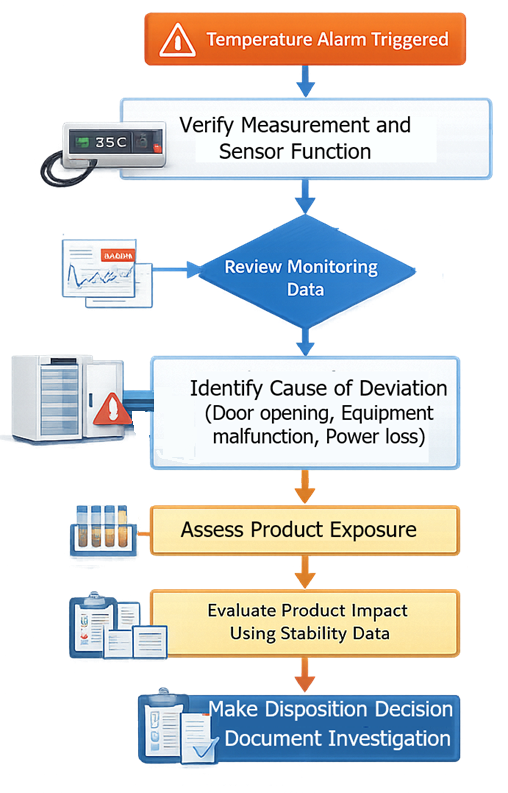
When a temperature alarm occurs, a structured response process is required to verify the alarm condition, evaluate the duration and magnitude of the temperature deviation, and determine whether stored materials may be affected. The diagram below illustrates a typical investigation workflow used when responding to temperature monitoring alarms in temperature-controlled storage systems.
The primary objective of an alarm investigation is to determine whether the temperature deviation could impact the quality, safety, or stability of the stored product.
Alarm response procedures typically begin with verification of the alarm condition. Personnel should confirm the measured temperature using the monitoring system interface or local display and verify that the monitoring probe and monitoring system are functioning correctly. Where necessary, an independent thermometer or calibrated reference probe may be used to confirm the measured temperature. Following confirmation of the alarm condition, the monitoring data should be reviewed to characterize the event and determine:
- duration of the temperature deviation
- maximum and minimum temperatures recorded
- time of alarm activation
- equipment operating conditions during the event
Operational factors that may contribute to temperature deviations should also be evaluated. These may include door openings, loading of warm materials, power interruptions, equipment malfunction, or environmental disturbances.
If a temperature excursion outside the defined storage range is confirmed, an investigation should be performed in accordance with facility deviation management procedures. The investigation should focus on evaluating the potential impact on stored materials by considering:
- duration and magnitude of the temperature excursion
- product storage requirements
- available product stability data
- product exposure conditions during the event
Based on this evaluation, appropriate disposition of affected materials must be determined in accordance with quality system procedures.
Alarm events and associated investigations should be documented and maintained as part of the environmental monitoring records for the equipment. These records demonstrate that temperature deviations are detected, evaluated, and managed in a controlled manner consistent with good manufacturing practices.
6. Data Integrity and Regulatory Considerations
Temperature monitoring systems generate records that support compliance with pharmaceutical storage requirements. These records must therefore be maintained in accordance with data integrity expectations. Monitoring systems should support the following functions:
- secure user access control
- audit trail recording of configuration changes
- time-stamped temperature records
- secure storage of monitoring data
Monitoring software used in regulated environments must also support compliance with electronic record requirements such as those described in 21 CFR Part 11.
7. Verification During Qualification
7.1 Alarm Verification During Operational Qualification
During Operational Qualification, alarm functions associated with the monitoring system are typically verified. Testing may include simulation of temperature excursions to confirm that alarms activate at the configured limits. Alarm verification testing may confirm:
- correct alarm activation thresholds
- operation of local alarm indicators
- operation of remote notification systems
7.2 Monitoring System Verification
Where monitoring systems are integrated with facility environmental monitoring platforms, additional verification may be performed to confirm correct communication between sensors, monitoring controllers, and data management software. Verification activities may include confirmation of:
- sensor signal transmission
- data recording within monitoring software
- correct timestamping of temperature measurements
- alarm notification functionality
8. Integration with Thermal Qualification
Temperature monitoring systems operate continuously after equipment qualification is completed. Thermal mapping studies performed during OQ establish temperature distribution characteristics and identify worst-case monitoring locations.
The monitoring system therefore functions as an ongoing control mechanism that confirms storage conditions remain within the validated operating range during routine operation.
9. Summary
Temperature monitoring and alarm systems provide continuous verification that temperature-controlled storage equipment maintains acceptable environmental conditions during routine operation. These systems integrate environmental sensors, data acquisition hardware, monitoring software, and alarm notification functions.
Monitoring probe placement is informed by thermal mapping results so that monitoring locations represent worst-case storage conditions. Alarm configuration and notification systems allow prompt response when temperature excursions occur.
Reliable monitoring systems, combined with appropriate alarm verification and data integrity controls, ensure that environmental conditions remain within validated limits throughout the operational lifecycle of temperature-controlled storage equipment.