
Thermal Mapping Instrumentation and Measurement Systems
1. Introduction
Thermal mapping instrumentation and measurement systems provide the data used to evaluate temperature distribution, stability, and environmental control within temperature-controlled storage equipment. Accurate measurement of temperature conditions is essential for demonstrating that storage environments meet defined operating specifications during qualification studies.
Thermal mapping systems typically consist of calibrated temperature sensors connected to data loggers or centralized acquisition systems that record temperature measurements at defined intervals. The resulting data sets are used to evaluate temperature uniformity, identify hot and cold locations, and verify that storage conditions remain within the specified operating limits.
Thermal mapping instrumentation and measurement approaches were previously introduced in the article Temperature Distribution and Qualification Strategy. This article expands on the technical characteristics of measurement systems, instrumentation selection, and data integrity considerations associated with qualification studies.
2. Temperature Measurement Principles
2.1 Temperature Sensor Technologies
Temperature mapping systems rely on electronic sensors capable of detecting environmental temperature conditions with high accuracy and stability. Several sensor technologies are commonly used depending on the required measurement range and application.
Typical temperature sensors include:
- Thermistors
- Resistance Temperature Detectors (RTDs)
- Thermocouples
Thermistors are commonly used in pharmaceutical storage mapping because they provide high sensitivity within typical storage ranges such as refrigerated or controlled room temperature environments.
RTDs provide very stable and accurate measurements and are frequently used in laboratory reference instruments or calibration systems. Thermocouples support very wide measurement ranges and are often used in high-temperature applications such as sterilization validation or specialized environmental testing.
2.2 Measurement Accuracy and Temperature Range
Selection of temperature sensors must consider both measurement accuracy and the operating temperature range of the storage system. Typical pharmaceutical storage environments include:
- Controlled Room Temperature
- Refrigerated Storage
- Frozen Storage
- Ultra-Low Temperature Storage
- Cryogenic Storage
Each environment requires instrumentation capable of measuring the expected temperature range while maintaining sufficient accuracy to evaluate compliance with storage specifications.
Typical performance expectations include:
- ±0.5 °C accuracy for controlled room temperature and refrigerators
- ±1.0 °C accuracy for freezers
- ±2.0 °C accuracy for ultra-low or cryogenic systems
Sensors must also operate reliably across the full temperature range encountered during the qualification study. Measurement uncertainty from the sensor, logger electronics, and calibration reference must remain small relative to the allowable storage limits.
2.3 Data Logging and Measurement Intervals
emperature sensors used during thermal mapping are connected to data loggers that record temperature measurements at predefined intervals.
The logging interval must be selected so that temperature fluctuations and control system cycling are captured while maintaining manageable data volumes during long studies.
For long-duration mapping studies such as 24–72 hour temperature distribution tests, typical recording intervals are: 5–15 minutes for refrigerators, freezers, stability chambers, and cold rooms. Shorter intervals may be used when studying transient events or equipment disturbances, such as:
- door opening studies
- power failure recovery testing
- defrost cycle evaluation
In these cases logging intervals of approximately 30 seconds to 1 minute may be used to capture rapid temperature changes. All recorded measurements must include accurate timestamps to ensure traceability and support evaluation of temperature stability throughout the mapping period.
3. Data Acquisition and Logging Systems
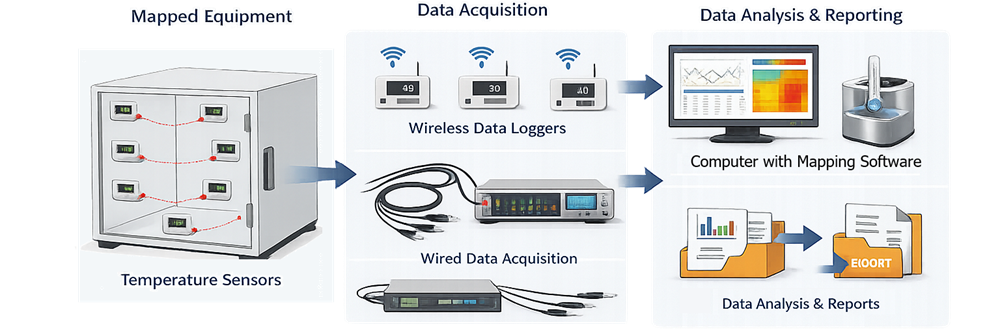
Thermal mapping studies rely on a combination of temperature sensors, data acquisition hardware, and analysis software to collect and evaluate environmental data during qualification. Temperature sensors positioned throughout the mapped space transmit measurements to data loggers or centralized acquisition systems, where data is recorded and later analyzed to evaluate temperature distribution and stability. The diagram below illustrates the typical architecture of a thermal mapping instrumentation system used during qualification studies.
3.1 Wireless Temperature Data Loggers
Wireless or standalone temperature loggers integrate a temperature sensor, memory, battery, and communication capability within a compact device.
These loggers are widely used for thermal mapping of refrigerators, freezers, incubators, and stability chambers. Advantages include:
- simple deployment
- minimal wiring requirements
- flexible placement throughout the storage volume
- rapid setup and removal after study completion
Wireless loggers are particularly useful when mapping smaller equipment where cabling would interfere with normal operation or door closure.
3.2 Wired Data Acquisition Systems
Wired temperature mapping systems use multiple sensors connected to a central data acquisition unit through cables.
Systems such as those manufactured by Kaye Instruments commonly use thermocouple sensors connected to multi-channel data acquisition modules. Advantages of wired systems include:
- high channel capacity for large studies
- real-time monitoring of sensor values
- very fast sampling rates
- high measurement stability during long mapping studies
These systems are commonly used for large cold rooms, environmental chambers, warehouses, or sterilization qualification where many measurement points are required.
3.3 Comparison of Wired and Wireless Systems
Different types of temperature mapping instrumentation are selected based on the size of the mapped space, required number of sensors, and operational constraints of the equipment. Wireless temperature data loggers provide flexible deployment and simplified installation for smaller equipment, while wired thermocouple acquisition systems are typically used when large volumes or high sensor counts must be monitored.
The illustration below presents typical decision criteria used when selecting between wireless temperature loggers and wired thermocouple data acquisition systems during thermal mapping studies.
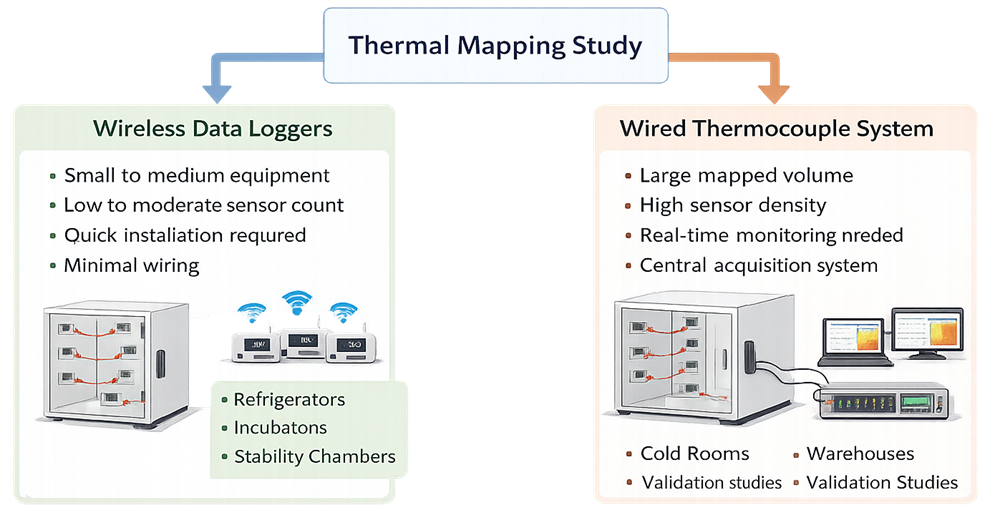
Wireless data loggers are typically preferred when:
- mapping small or medium equipment such as refrigerators, incubators, and stability chambers
- minimal installation complexity is desired
- rapid setup and removal are required
- sensor counts are relatively low
Wired data acquisition systems are typically preferred when:
- large volumes must be mapped
- high numbers of sensors are required
- continuous real-time monitoring is desired
- very short sampling intervals are needed
- mapping studies require centralized supervision
Both system types must demonstrate sufficient accuracy, calibration traceability, and data integrity controls to support qualification activities.
4. Calibration and Measurement Traceability
4.1 Calibration Requirements
All temperature measurement devices used during qualification must be calibrated prior to use.
Calibration ensures that recorded measurements accurately represent the environmental temperature conditions within the storage equipment. Calibration certificates should include:
- calibration date
- measurement uncertainty
- calibration points across the operating range
- traceability to recognized measurement standards
4.2 Reference Standards and Traceability
Calibration laboratories maintain reference temperature standards traceable to recognized national measurement authorities such as the National Institute of Standards and Technology.
Traceability ensures that measurement results obtained during thermal mapping can be linked to internationally recognized standards and provides confidence in the accuracy of qualification data.
4.3 Calibration Intervals
Calibration intervals must be defined to ensure continued accuracy of measurement systems.
Annual calibration is commonly applied for thermal mapping sensors used in pharmaceutical qualification programs. More frequent calibration may be required when sensors are exposed to extreme temperatures or mechanical stress.
5. Data Integrity and ALCOA Principles
Temperature data generated during thermal mapping studies represents qualification evidence supporting regulatory compliance. Therefore, measurement data must comply with established data integrity principles.
Data should be maintained in accordance with ALCOA and ALCOA+ expectations. Key attributes include:
- Attributable — measurement records clearly linked to the study and responsible personnel
- Legible — data readable and interpretable throughout the record retention period
- Contemporaneous — data recorded at the time of measurement
- Original — raw measurement records preserved without alteration
- Accurate — recorded data reflects true environmental conditions
Additional ALCOA+ attributes include:
- Complete — all data from the study retained
- Consistent — time sequences and measurement intervals maintained
- Enduring — data stored in durable format
- Available — records accessible for review and audit
Thermal mapping systems must preserve raw temperature records, audit trails, and configuration data to ensure that qualification evidence remains reliable and defensible.
6. Sensor Placement Strategy During Thermal Mapping
6.1 Distribution of Sensors
Thermal mapping requires distribution of sensors throughout the mapped space to evaluate temperature uniformity across the storage volume. Sensors are Thermal mapping requires placement of temperature sensors throughout the mapped space to evaluate temperature uniformity and identify potential spatial variation within the storage volume. Sensors are typically distributed across multiple vertical and horizontal locations so that temperature conditions can be evaluated throughout the entire chamber.
Mapping layouts are commonly organized as a three-dimensional grid covering upper, middle, and lower regions of the storage space. Additional sensors are often placed at potential worst-case areas such as doors, corners, and airflow supply or return locations where temperature variation may occur.
The diagram below illustrates a representative grid-based sensor layout used during thermal mapping qualification.
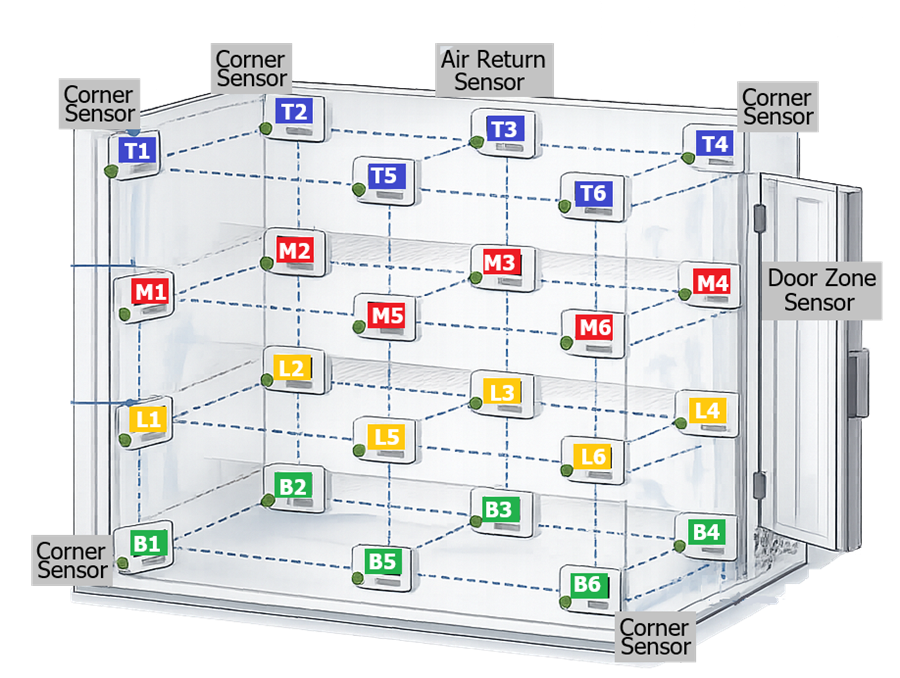
Sensors are typically positioned at locations representing:
- upper regions of the chamber
- middle regions of the chamber
- lower regions of the chamber
- center locations
- areas near doors or access panels
- regions near air supply or return vents
6.2 Identification of Worst-Case Locations
Mapping studies are designed to identify locations where temperature conditions may deviate from the desired storage range. Typical worst-case locations include:
- upper areas where warm air accumulates
- areas near evaporator airflow
- regions close to doors or access points
- corners with limited air circulation
Sensors placed in these areas help detect potential temperature excursions.
6.3 Sensor Quantity Considerations
The number of sensors used during thermal mapping depends on several factors including:
- volume of the mapped space
- internal geometry of the equipment
- air circulation patterns
- shelving configuration
- regulatory expectations
Typical mapping studies may include:
- 9–15 sensors for laboratory refrigerators or incubators
- 20–40 sensors for stability chambers
- 30–100 or more sensors for cold rooms or warehouses
Larger mapped volumes generally require greater sensor density to adequately characterize temperature distribution.
7. Data Analysis and Interpretation
7.1 Evaluation of Temperature Distribution
Following completion of the mapping study, recorded data is evaluated to determine whether temperature conditions remain within the defined operating limits. Analysis typically includes evaluation of:
- maximum and minimum temperatures
- average temperature values
- temperature variation across sensors
- temperature stability over time
7.2 Identification of Hot and Cold Spots
Thermal mapping results allow identification of hot and cold locations within the storage space. These areas represent potential worst-case conditions and are commonly used to determine placement of permanent monitoring probes.
7.3 Documentation of Mapping Results
Mapping results must be documented within the qualification report and typically include:
- sensor location diagrams
- temperature distribution graphs
- statistical summaries
- comparison against predefined acceptance criteria
These records demonstrate that the storage equipment maintains environmental conditions suitable for storage of temperature-sensitive pharmaceutical materials.
8. Integration with Continuous Monitoring Systems
8.1 Routine Temperature Monitoring
After qualification is completed, permanent monitoring sensors are typically installed to continuously track storage conditions. These monitoring sensors are frequently connected to facility monitoring systems or building management systems.
8.2 Alarm and Notification Systems
Continuous monitoring systems typically include alarm functions that notify personnel when temperature limits are exceeded. Alarm notifications may include:
- local audible alarms
- control panel alerts
- remote electronic notifications such as email or text messaging
8.3 Relationship Between Mapping and Monitoring
Thermal mapping results are used to determine the optimal placement of permanent monitoring probes. Monitoring sensors are normally positioned at identified worst-case temperature locations so that deviations from acceptable storage conditions are detected as early as possible.
9. Summary
Thermal mapping instrumentation forms the measurement foundation for qualification of temperature-controlled storage equipment. Accurate sensors, calibrated data loggers, and properly selected measurement systems ensure reliable characterization of temperature distribution within storage environments.
Appropriate sensor placement and sufficient measurement density allow identification of worst-case temperature locations and support evaluation of temperature stability across the mapped space.
Reliable measurement systems, combined with proper calibration and data integrity controls, ensure that qualification data accurately demonstrates compliance with pharmaceutical storage requirements.