
Utility System Change Control, Requalification, and Deficiencies
Utility systems are subject to change throughout their operational life. Equipment replacement, component upgrades, control modifications, maintenance activities, and changes in use all have the potential to affect system performance and product quality. As a result, utility systems require a structured change control and requalification approach to ensure continued fitness for intended use. Failures in this area are among the most common sources of regulatory observations related to utilities.
The diagram below illustrates how breakdowns in utility system change control, monitoring, and lifecycle management can propagate over time, ultimately resulting in loss of control and compliance deficiencies.
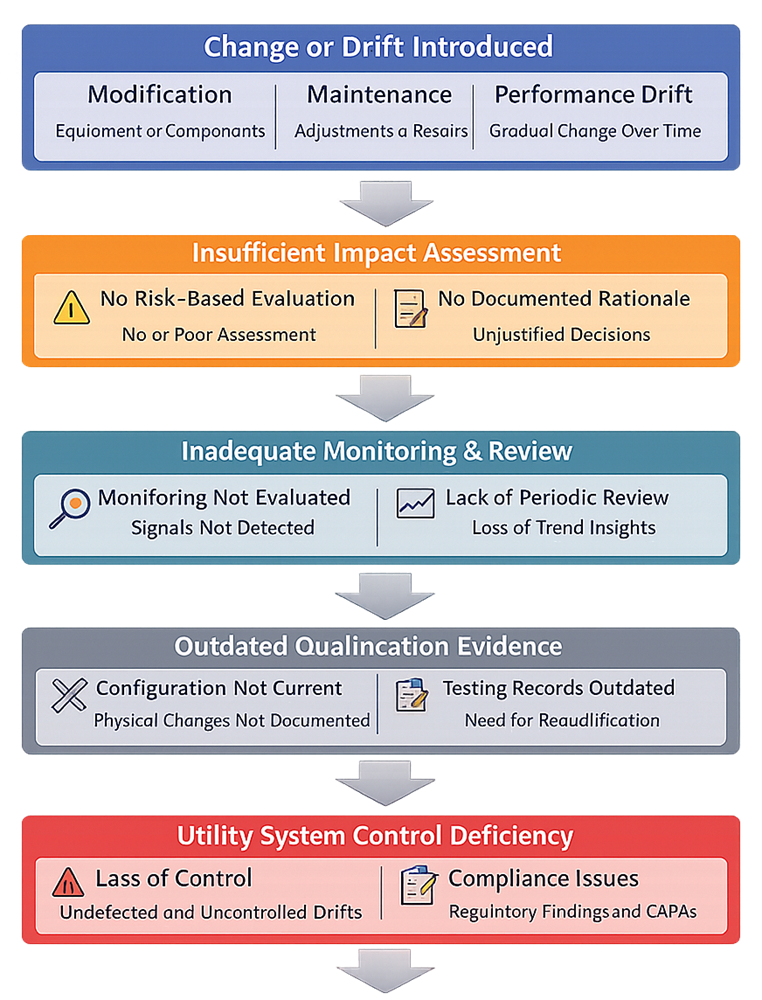
Change Control for Utility Systems
All changes affecting utility systems must be evaluated through formal change control. This includes planned modifications as well as unplanned changes resulting from maintenance, repairs, or corrective actions. Change control ensures that:
- The impact of the change on product quality is assessed
- Regulatory expectations remain satisfied
- Appropriate qualification or verification activities are identified before implementation
Utility system changes commonly subject to change control include:
- Replacement or modification of system components
- Changes to control logic, alarms, or setpoints
- Alterations to distribution piping or ductwork
- Changes in materials of construction
- Changes in operating ranges or system capacity
Each change is evaluated based on intended use, system impact, and risk. Documentation of the rationale and impact assessment is essential.
Change Impact Assessment
A change impact assessment determines whether requalification is required and defines the appropriate scope. Impact assessments consider:
- Direct or indirect impact on product quality
- Potential to introduce contamination or cross-contamination
- Effect on critical quality or performance parameters
- Interaction with other systems or processes
Not all changes require full requalification. However, all changes must be justified, documented, and supported by objective evidence.
Requalification of Utility Systems
Requalification confirms that a utility system continues to perform as intended following change or over time. Requalification activities are risk-based and proportional to the nature of the change or observed system performance. Requalification may be triggered by:
- Approved changes through change control
- Adverse trends in monitoring data
- Repeated deviations or excursions
- Extended operation without formal review
- Regulatory findings or internal audit observations
Requalification scope may range from targeted verification of affected functions to partial or full requalification, depending on risk and available performance history.
Periodic Review and Continued Control
In addition to change-driven requalification, utility systems should be subject to periodic review. Periodic reviews evaluate cumulative system performance and confirm continued suitability for intended use. Periodic review typically includes:
- Review of monitoring and trending data
- Assessment of deviations, investigations, and corrective actions
- Review of maintenance and calibration history
- Evaluation of changes implemented during the review period
Periodic review supports informed decisions regarding requalification frequency, monitoring adjustments, and preventive improvements.
Common Utility System Lifecycle Control Deficiencies
Deficiencies in utility systems most often arise from weaknesses in lifecycle control rather than isolated technical failures. During regulatory inspections, these weaknesses are frequently identified because they increase the risk of loss of control and impact to product quality. Common utility system deficiencies include:
- Changes implemented without documented impact assessment
- Inadequate justification for reduced qualification or verification scope
- Ineffective monitoring or failure to evaluate performance trends
- Qualification documentation that no longer reflects the current system configuration
- Failure to reassess system performance following repeated deviations or excursions
These deficiencies indicate gaps in change control, monitoring, and periodic review. When not addressed, they commonly result in regulatory observations and may require corrective action to restore and demonstrate continued control of the utility system.
Maintaining Compliance Through Discipline
Effective change control and requalification practices are essential to maintaining utility systems in a continued state of control. When supported by documented risk assessment, routine monitoring, and periodic review, these practices provide objective evidence that utility systems remain fit for their intended use throughout their operational life.
The expectations described above apply across GMP utility systems. Utility-specific documents address implementation details for individual system types.