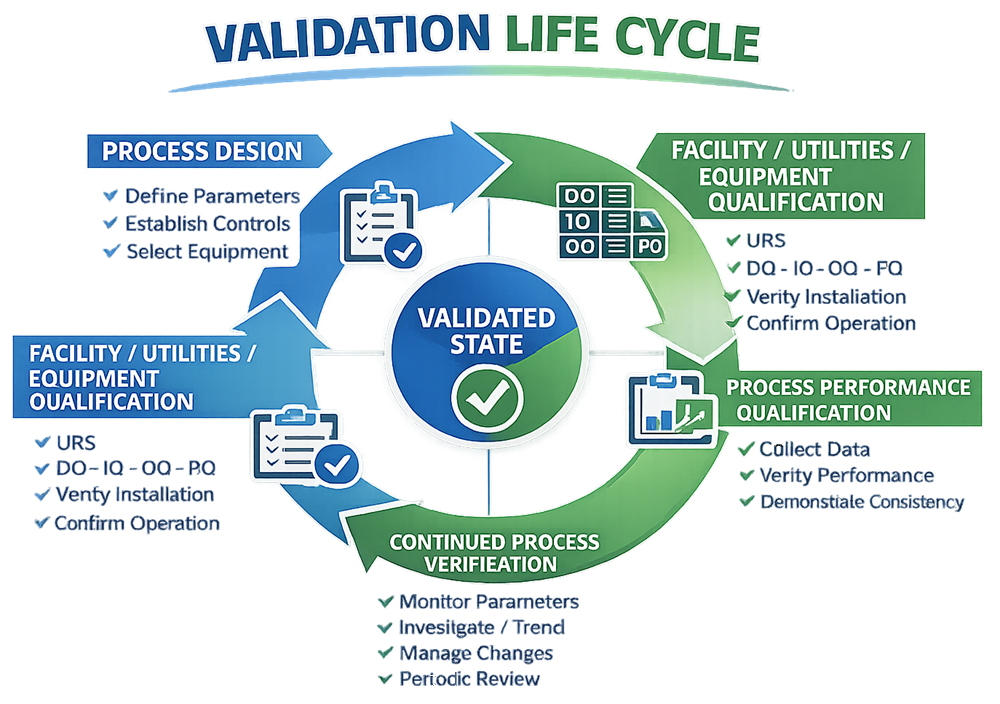
The Validation Life Cycle is a structured, end-to-end framework used in pharmaceutical and medical device industries to establish, demonstrate, and maintain a validated state for processes, systems, utilities, and equipment. It reflects a disciplined sequence of planning, qualification, verification, and ongoing control activities designed to ensure consistent product quality and regulatory compliance.
The life cycle concept reinforces a core principle of regulated manufacturing:
Validation is not a one-time event. It is a maintained state.
Purpose of the Validation Life Cycle
The Validation Life Cycle ensures that:
Processes and systems are designed intentionally
Equipment and utilities are qualified for their intended use
Processes perform consistently under routine conditions
Ongoing operation remains controlled and compliant over time
This approach provides traceable, documented evidence that quality is built into the process rather than tested in after the fact.
Phase 1: Process Design
Process Design establishes the scientific and engineering basis for the process or system before qualification begins.
Key activities include:
Defining process objectives and quality requirements
Identifying critical process parameters and control points
Establishing operating ranges and acceptance criteria
Selecting appropriate equipment, utilities, and automation
Defining raw materials, inputs, and outputs
The objective of this phase is to demonstrate that the process is capable by design of producing product that meets predefined quality standards.
Phase 2: Facility, Utilities, and Equipment Qualification
This phase confirms that supporting systems are suitable, properly installed, and operate as intended.
User Requirement Specification (URS)
The URS defines what the system must do from a user and regulatory perspective. It establishes functional, performance, and compliance expectations and serves as the foundation for design and qualification.
Design Qualification (DQ)
DQ verifies that the proposed design meets the requirements defined in the URS. This step ensures that deficiencies are addressed before installation, not discovered during execution.
Installation Qualification (IQ)
IQ confirms that equipment or systems are installed correctly according to approved drawings, specifications, and manufacturer recommendations.
Operational Qualification (OQ)
OQ demonstrates that the system operates within defined limits and performs its intended functions reliably under controlled conditions.
Performance Qualification (PQ)
PQ confirms that the system performs effectively and consistently under normal or simulated operating conditions, using representative materials, loads, or product.
Together, these activities establish that systems are fit for intended use.
Phase 3: Process Performance Qualification
Process Performance Qualification demonstrates that the overall process, as installed and operated, consistently produces acceptable outcomes.
This phase typically includes:
Execution under routine operating conditions
Collection and evaluation of performance data
Verification against predefined acceptance criteria
Confirmation of process capability and consistency
The outcome of this phase is documented evidence that the process performs as designed when operated by trained personnel using approved procedures.
Phase 4: Continued Process Verification
Continued Process Verification ensures that the validated state is maintained throughout routine operation.
Key elements include:
Ongoing monitoring of critical parameters
Trending and data review
Deviation investigation and impact assessment
Change control evaluation
Periodic review and requalification when required
This phase emphasizes proactive oversight and continuous control rather than reactive correction.
Key Principles of the Validation Life Cycle
Validation begins with planning and design, not testing
Qualification establishes system suitability
Process verification confirms consistent performance
Ongoing monitoring maintains the validated state
Documentation and traceability are essential throughout all phases
While terminology and implementation details may vary by organization or regulatory framework, the lifecycle structure of design, qualification, verification, and maintenance remains consistent across regulated industries.
Summary
The Validation Life Cycle provides a defensible, systematic approach to ensuring that processes and systems remain under control from initial concept through routine operation. When executed correctly, it supports inspection readiness, product quality, and long-term compliance.