
Cleaning Principles of Parts Washers
Automated parts washers are widely used in pharmaceutical manufacturing and laboratory environments to clean reusable equipment components, utensils, and laboratory glassware. Effective cleaning requires the removal of product residues, excipients, processing materials, and cleaning agents from component surfaces under controlled operating conditions.
The effectiveness of automated washing systems depends on the interaction of several fundamental factors including mechanical spray action, detergent chemistry, temperature, exposure time, and the configuration of components within the washer chamber. Understanding these principles helps ensure that washer systems are capable of consistently removing residues and supporting reliable equipment cleaning operations.
1. Types of Residues Encountered in Equipment Cleaning
Equipment components may contain a variety of residues depending on the manufacturing process and formulation materials handled by the equipment. The nature of these residues significantly influences the difficulty of cleaning and the selection of appropriate cleaning agents. Common residue types include:
- protein-based materials
- carbohydrates and sugars
- lipids and oily substances
- salts and inorganic compounds
- formulation excipients and binders
- dried or aged product residues
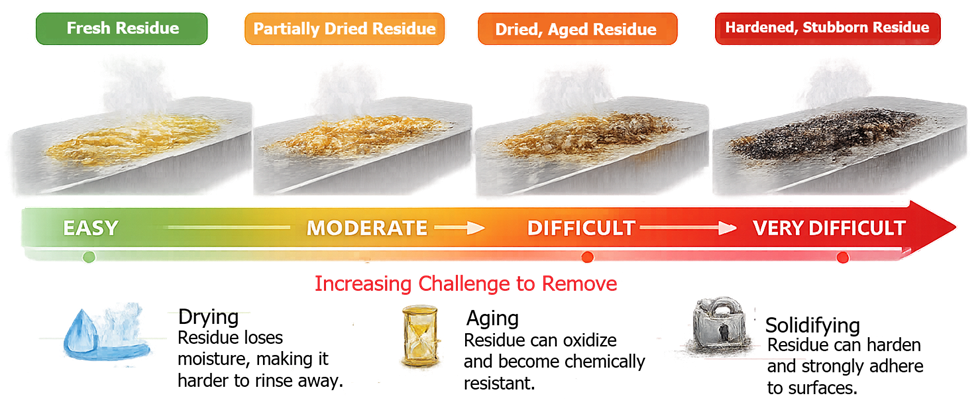
Some residues become more difficult to remove when they dry on equipment surfaces or when they interact with heat during processing. As a result, cleaning processes must be capable of removing both freshly deposited and dried residues. The illustration below compares fresh residues with dried or aged residues adhered to equipment surfaces. Residues that remain on equipment for extended periods may dry or chemically change, making them more difficult to remove during washing.
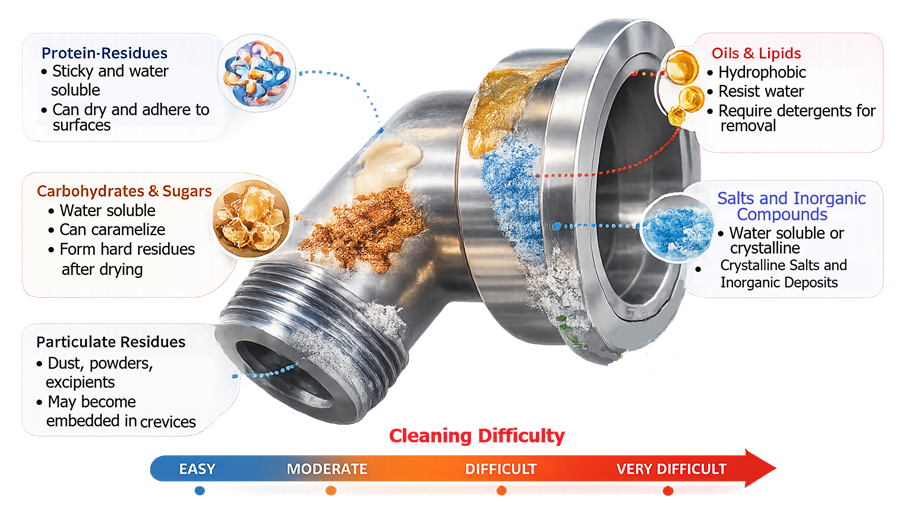
The illustration below shows how different types of residues adhere to equipment surfaces, including dried product films, oily contaminants, particulate matter, and crystalline salts. The nature of these interactions influences the difficulty of cleaning and determines the cleaning conditions required for effective residue removal.
2. Cleaning Chemistry
Detergents and cleaning agents are used in automated washer systems to assist in the removal of residues from equipment surfaces. These chemicals interact with residues in several ways to facilitate their removal during the wash cycle. Cleaning chemistry typically functions through mechanisms such as:
- solubilization of residues into the wash solution
- emulsification of oils and hydrophobic materials
- dispersion of particles into the cleaning solution
- hydrolysis or chemical breakdown of certain contaminants
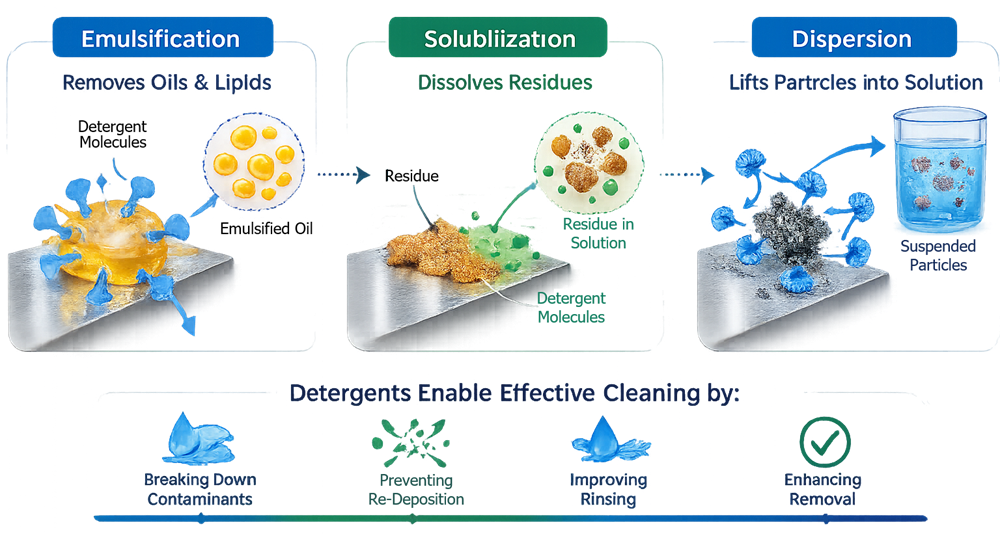
The effectiveness of a cleaning agent depends on its compatibility with the residues being removed and the operating conditions within the washer cycle. Detergent concentration must also be controlled to ensure effective cleaning while allowing complete removal during the rinse phase. The illustration below shows how detergents assist residue removal during automated washing through mechanisms such as emulsification of oils, solubilization of residues, and dispersion of particles into the cleaning solution.
3. Mechanical Cleaning Action
Mechanical cleaning action in automated washers is generated by pressurized cleaning solution delivered through rotating spray arms or injection nozzles. The force of the spray helps detach residues from equipment surfaces and promotes interaction between the cleaning solution and the contaminated surface. Important factors influencing mechanical cleaning action include:
- circulation pump capacity
- spray pressure
- nozzle orientation and spray pattern
- rotation of spray arms
- distribution of spray coverage within the chamber
Adequate spray coverage is essential to ensure that cleaning solution reaches all exposed surfaces of components placed inside the washer chamber.
4. Influence of Component Geometry
The geometry of equipment components has a major influence on cleaning effectiveness. Complex shapes or confined spaces may restrict access of cleaning solution and reduce the effectiveness of spray washing. Features that may complicate cleaning include:
- crevices and narrow gaps
- threaded components
- hollow assemblies
- overlapping surfaces
- recessed areas
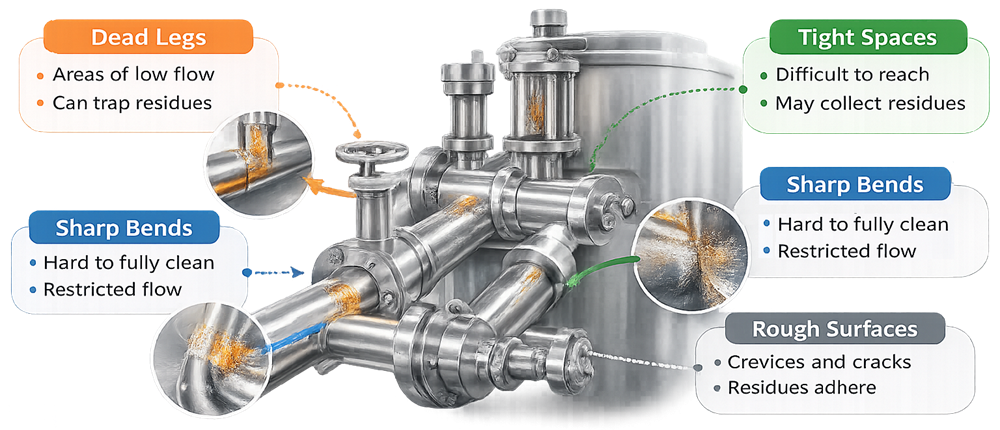
Such geometries can create areas where spray distribution is reduced or where residues may accumulate. Equipment design and cleaning procedures should therefore consider accessibility of surfaces during automated washing. The illustration below highlights equipment geometries that can complicate automated cleaning, including crevices, threaded components, recessed surfaces, and hollow assemblies that may restrict access of cleaning solution.
5. Influence of Load Configuration
The arrangement of components inside the washer chamber also plays an important role in cleaning performance. Improper loading can block spray paths and create shadowed regions where cleaning solution cannot reach. Important loading considerations include:
- adequate spacing between components
- orientation of parts relative to spray direction
- avoidance of stacked components
- positioning of large parts that may block spray distribution
Proper load configuration helps ensure that spray coverage reaches all surfaces requiring cleaning.
6. Cleaning Cycle Parameters
Cleaning cycles in automated parts washers are designed to combine mechanical action, cleaning chemistry, temperature, and time to achieve effective reCleaning cycles in automated parts washers are designed to combine mechanical action, cleaning chemistry, temperature, and time to achieve effective removal of residues from equipment components. The washer control system regulates these parameters during each phase of the cleaning cycle to ensure consistent cleaning performance.
A typical washer cycle consists of multiple sequential phases including pre-rinse, detergent wash, intermediate rinsing, and final rinse. Each phase contributes to the progressive removal of soils, detergents, and dissolved contaminants from component surfaces. Typical operating parameters controlled during washer operation include:
- Wash solution temperature: Elevated temperatures improve detergent activity and increase the solubility of many residues. Higher temperatures can also reduce the viscosity of oily contaminants and enhance chemical cleaning reactions.
- Detergent concentration: Detergent concentration must be sufficient to dissolve and disperse residues without creating excessive foam or leaving residual detergent after rinsing. Proper dosing is typically controlled through automated chemical dosing systems.
- Wash phase duration: Adequate wash time is required to allow detergents and mechanical spray action to interact with residues and detach them from equipment surfaces.
- Rinse cycle duration: Rinse time must be sufficient to remove both dissolved soils and residual detergent from components and washer surfaces.
- Number of rinse stages: Multiple rinse stages may be used to progressively dilute and remove detergent residues. Final rinsing is often performed using purified or deionized water to prevent spotting or residue deposition.
The selection of cleaning cycle parameters must consider the nature of residues being removed, the geometry of equipment components, and the loading configuration inside the washer chamber. Proper balance of these parameters ensures that the washer cycle achieves effective soil removal during the wash phase while preventing detergent carryover during the rinse phase.
7. Common Causes of Cleaning Failure
Cleaning failures in automated washers can occur when one or more of the key cleaning parameters are not properly controlled. Understanding common causes of ineffective cleaning helps improve washer operation and prevent recurrence of cleaning issues.
Common causes of cleaning failure include:
- spray shadowing due to improper loading
- insufficient detergent concentration
- incompatible cleaning chemistry for the residue
- inadequate wash temperature or exposure time
- complex component geometry that restricts spray access
- inadequate rinsing of cleaning agents
Identifying the underlying cause of cleaning failures is important for optimizing washer cycles and improving cleaning reliability.
8. Engineering Controls to Improve Cleaning Performance
Several engineering and operational controls can improve the cleaning performance of automated washer systems. Examples include:
- optimized rack design to improve spray access
- proper orientation of components within the washer
- selection of detergents appropriate for the residues present
- adjustment of wash temperature and cycle duration
- verification of spray coverage and mechanical performance
By understanding the principles governing automated washing and implementing appropriate engineering controls, facilities can ensure reliable and effective cleaning of reusable equipment components.